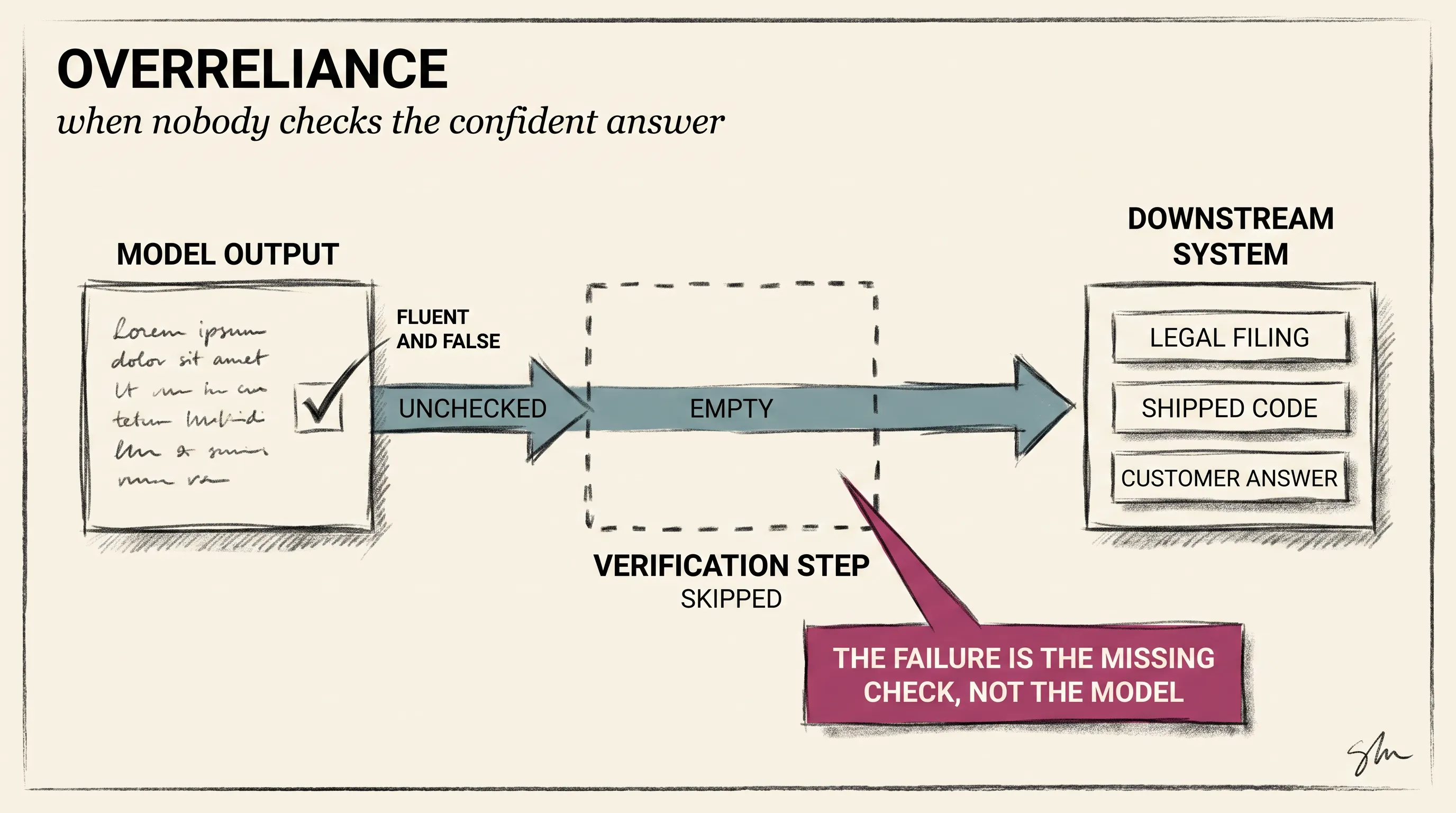
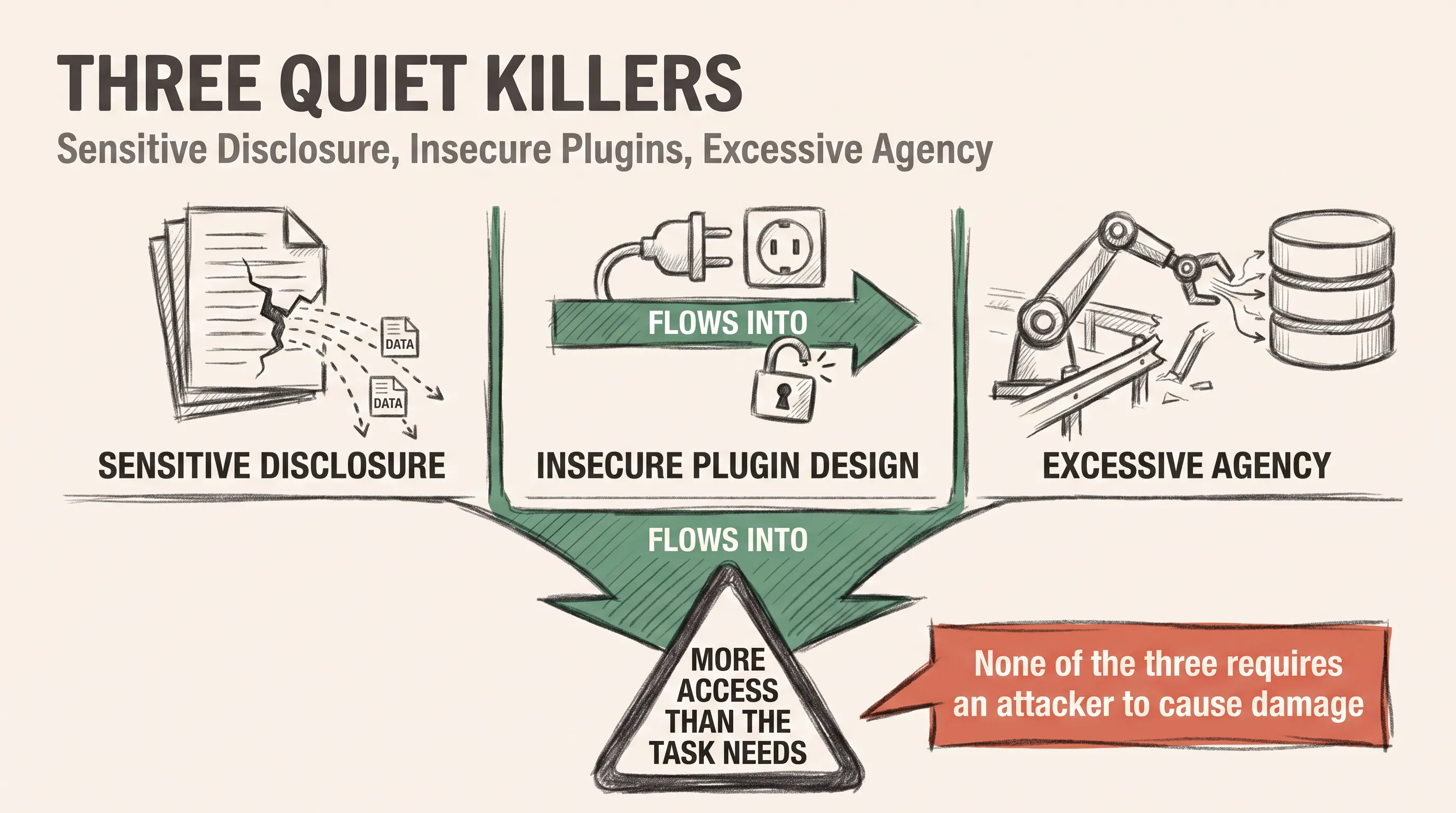
The previous article in this series described a failure that needs no attacker at all. This one covers the opposite condition, a model valuable enough that people build operations around taking it. The 2023 OWASP Top 10 for Large Language Model Applications listed the risk as LLM10, Model Theft, defining it as the unauthorized access and exfiltration of LLM models by malicious actors or advanced persistent threats. The 2025 revision retired the standalone entry and folded its attack scenarios into LLM10:2025, Unbounded Consumption, the same category that absorbed model denial of service earlier in this series.
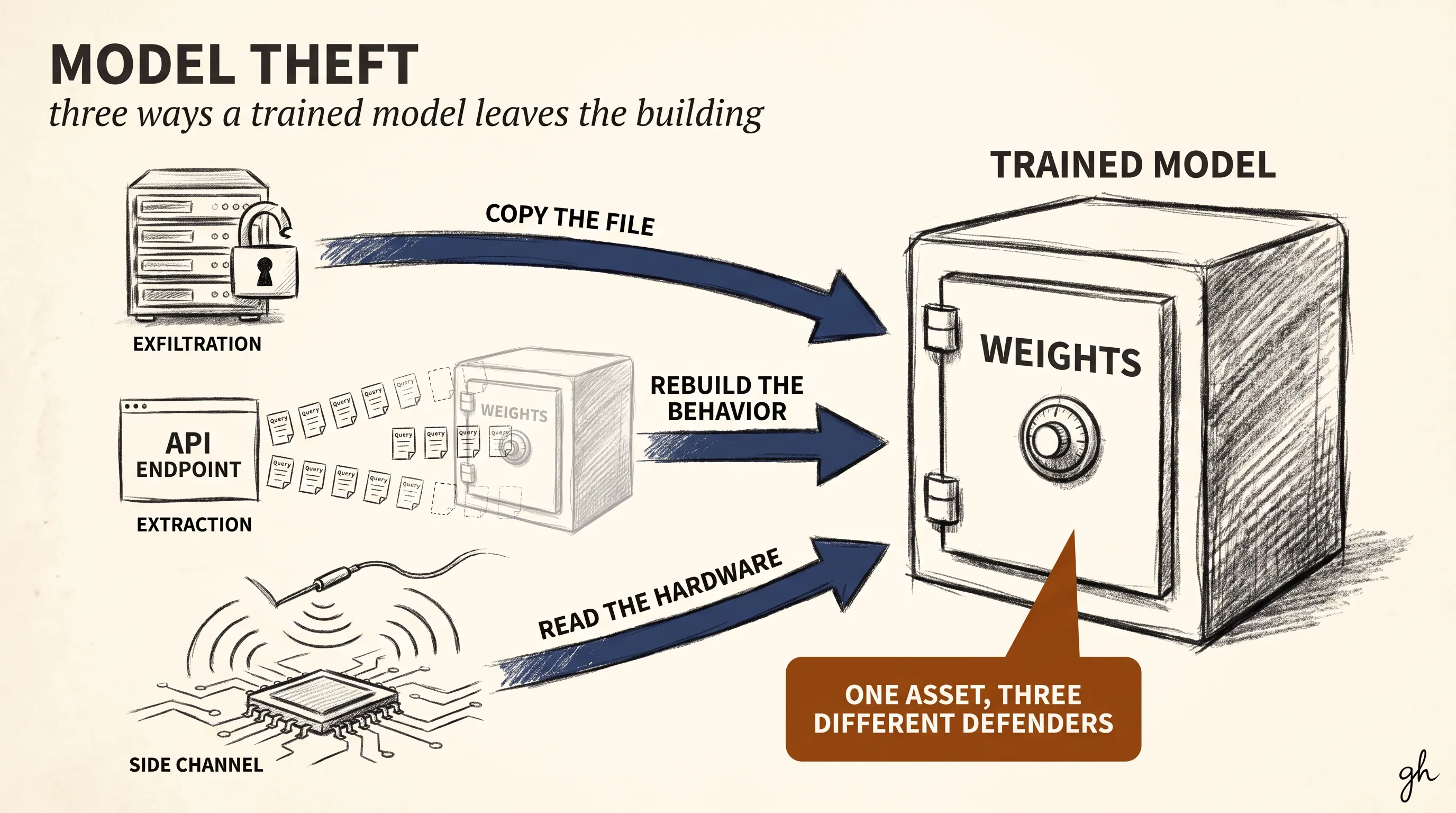
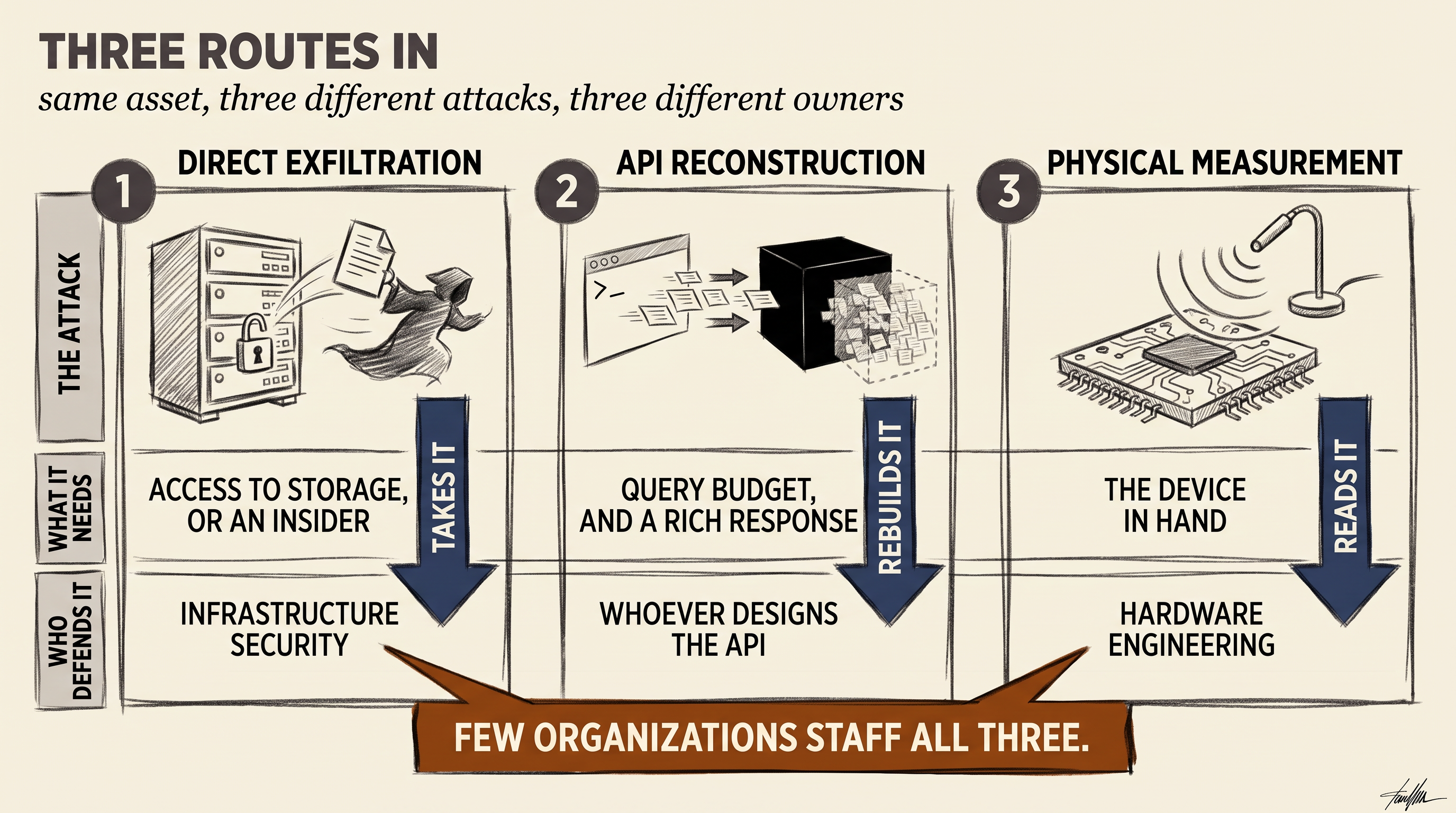
Theft is a loose word here, because three separate things can be taken and they differ in how hard they are to protect. The weights file is one. The model’s behavior, rebuilt from outside without touching a single parameter, is another. The architecture and hyperparameters, readable from the hardware while it runs, are a third.
WHAT IS ACTUALLY WORTH STEALING
A trained model is an unusual asset because nearly all of its cost goes out before the artifact exists. The Stanford AI Index Report for 2024 estimated the compute cost of training GPT-4 at roughly 78 million dollars and Gemini Ultra at roughly 191 million.
What that spending produces is a file. The weights hold the complete result of the training run, and copying them costs whatever the bandwidth costs. A restaurant that spends years developing a menu still has to hire cooks and run a kitchen every night, and a trained model does not work the same way, because whoever holds the file holds the finished result. That gap between the cost of creating and the cost of copying is why the category exists at all.
THREE ROUTES IN
OWASP’s entry lists six vulnerability examples, and they collapse into three routes. The first is direct exfiltration, where an attacker reaches the storage and takes the artifact, through a misconfiguration or as an insider who already holds the access. The second is reconstruction through the interface, where the model never moves and the attacker rebuilds its behavior from its outputs. The third is physical measurement, where the attacker holds the device and reads what the silicon leaks while it computes.
Think of them as three doors into the same room, each with a different lock and a different keyholder. The first belongs to infrastructure security, the second to whoever designs the inference API, the third to hardware engineering. Few organizations staff all three.
WHEN THE FILE WALKS OUT
On February 24, 2023, Meta released LLaMA to researchers under a noncommercial license granted through a request form. On March 3, someone uploaded a torrent containing the weights and posted the link on 4chan. Within days the model appeared on GitHub and Hugging Face, ran on consumer laptops, and served as the base for derivative projects.
That amounted to a distribution failure rather than a network breach, and the distinction matters less than it appears. The defining property of a weights file is that recovery does not apply to it. A leaked password can be rotated and a leaked certificate revoked, just as any credential pointing at an authority can be withdrawn. A leaked model is the thing itself, the copies are perfect, and nothing remains to invalidate.
STEALING BY ASKING
Reconstruction through the query interface is considerably older than the current generation of models. At USENIX Security 2016, Florian Tramèr, Fan Zhang, Ari Juels, Michael Reiter, and Thomas Ristenpart demonstrated attacks that duplicated logistic regression, decision tree, and neural network models hosted on BigML and Amazon Machine Learning at near-perfect fidelity. The paper also tested the obvious countermeasure of withholding confidence values, and found that extraction survived without them.
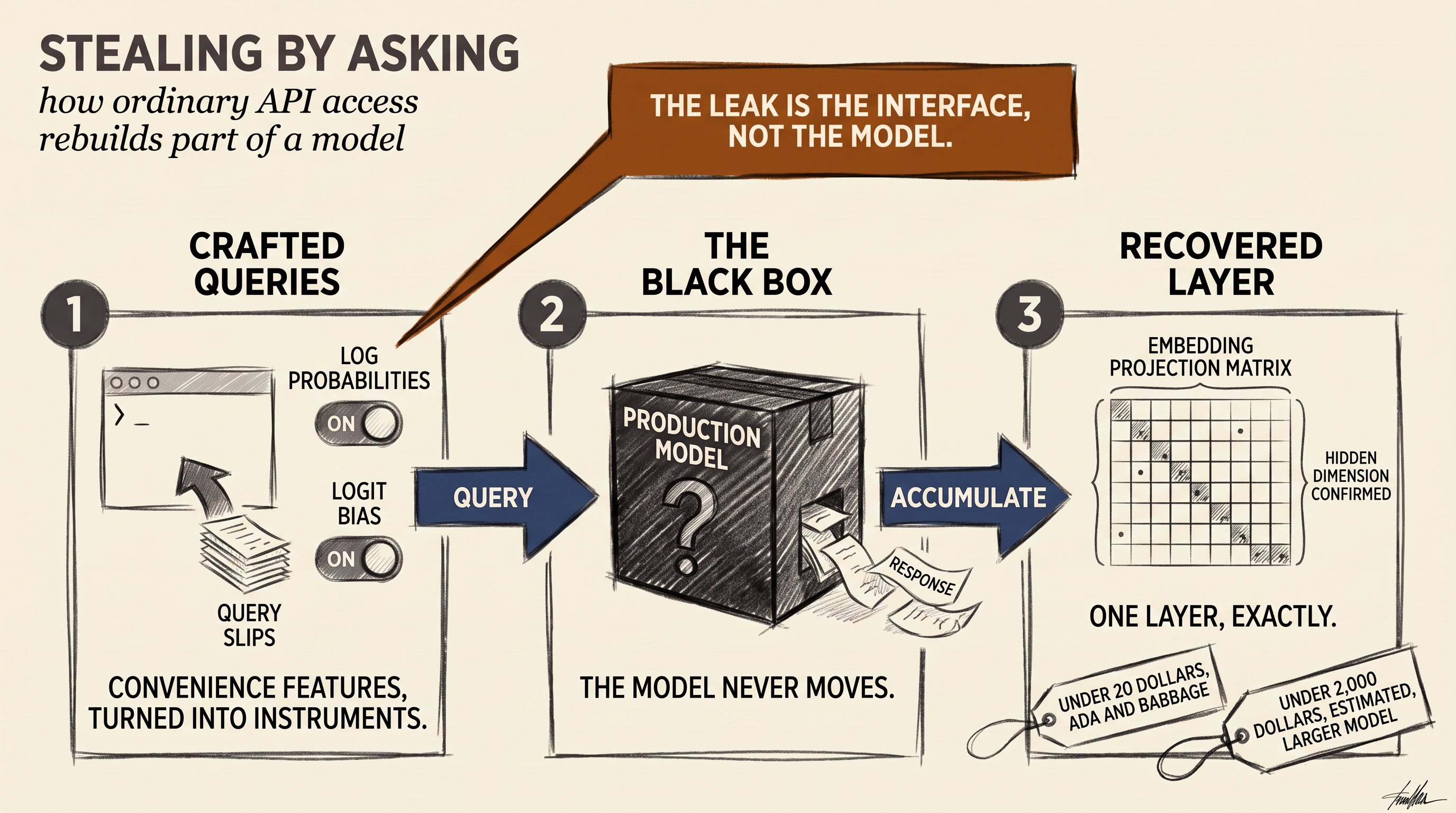
Model extraction against production language models arrived in March 2024. A team led by Nicholas Carlini published an attack that recovers the final embedding projection layer of a black-box transformer through ordinary API access. For under 20 dollars in queries it extracted the complete projection matrix of OpenAI’s ada and babbage models and confirmed their hidden dimensions at 1,024 and 2,048.
The same attack recovered the hidden dimension of gpt-3.5-turbo, and put the cost of recovering that model’s full projection matrix at under 2,000 dollars of further querying.
The result says more about interface design than about models. It exploits the logit bias and log-probability controls that inference APIs expose for legitimate reasons, forcing each response to carry more structure than a plain completion would. A locksmith cutting a key from a photograph never sees the original, and extraction works like that, because enough precise measurements of the outside reproduce the inside. Both OpenAI and Google changed their APIs after the disclosure.
THE CHEAPER ATTACK IS IMITATION
Precise extraction is usually unnecessary, because behavior can be copied without recovering a single parameter. In March 2023 a group at Stanford fine-tuned Meta’s 7 billion parameter LLaMA on 52,000 instruction-following demonstrations generated by prompting OpenAI’s text-davinci-003. The generated data cost under 500 dollars, the fine-tuning run cost under 100, and the result behaved much like the far larger model it imitated. OWASP calls this functional replication, and the wider technique goes by distillation.
The commercial dispute that follows surfaced at scale in January 2025. Microsoft security researchers reported large-scale data extraction through OpenAI’s API during the autumn of 2024, linked to accounts associated with DeepSeek, and notified OpenAI. OpenAI then told the Financial Times it had seen evidence that someone had distilled its models to train a competing system.
The legal ground is narrower than the surrounding argument suggested. Model outputs carry no copyright under United States law, so protection against imitation is contractual rather than proprietary, resting on terms of service that forbid using outputs to train a competing model.
THE HARDWARE CHANNEL
In December 2024, Ashley Kurian, Anuj Dubey, Ferhat Yaman, and Aydin Aysu of North Carolina State University published TPUXtract in the IACR Transactions on Cryptographic Hardware and Embedded Systems. Working against a Google Edge TPU they knew nothing about, they recovered the network’s full hyperparameter set, including layer types, node counts, kernel and filter sizes, strides, and activation functions, at a reported 99.91 percent accuracy. The only input was electromagnetic emissions measured while the chip did its work.
The attack requires physical possession of the device, which reads as a strong limit until the deployment pattern comes into view. Edge accelerators exist precisely to put models into cameras, sensors, vehicles, and retail hardware, which is to say into places the operator does not control. How many organizations shipping models to edge devices treat those devices as attacker-controlled?
WHAT DEFENSE LOOKS LIKE
OWASP’s control list for model theft runs to nine items and holds no surprises. Role-based access control and least privilege restrict who can reach the artifact, a centralized registry keeps it under governance, audit logging records who touched what, and automated MLOps deployment takes permission-granting out of human hands. Rate limiting and data loss prevention address extraction, watermarking addresses attribution after the fact, and adversarial training plus prompt-injection mitigation harden the query surface.
Read as a set, that is ordinary security engineering applied to an asset many organizations have never formally inventoried.
The Carlini result adds the correction the list omits, which is that every convenience feature at the inference boundary doubles as a measurement channel, similar to the way a shop window advertises stock and also tells a burglar what is inside. Log probabilities, logit bias, deterministic sampling, and detailed error messages all exist to make a service more useful, and each narrows the search space for whoever reconstructs what sits behind it. Revealing less per query raises the cost of extraction rather than ending it.
For the weights themselves, the most detailed public treatment is RAND’s 2024 report on securing model weights, which catalogs 38 distinct attack vectors and defines five security levels. SL1 turns away amateurs, SL3 turns away cybercrime syndicates and insider threats, and SL5 could plausibly claim to resist the top-priority operations of the most cyber-capable institutions. The report’s position is that frontier weights warrant the upper end of that scale, and that current practice falls short.
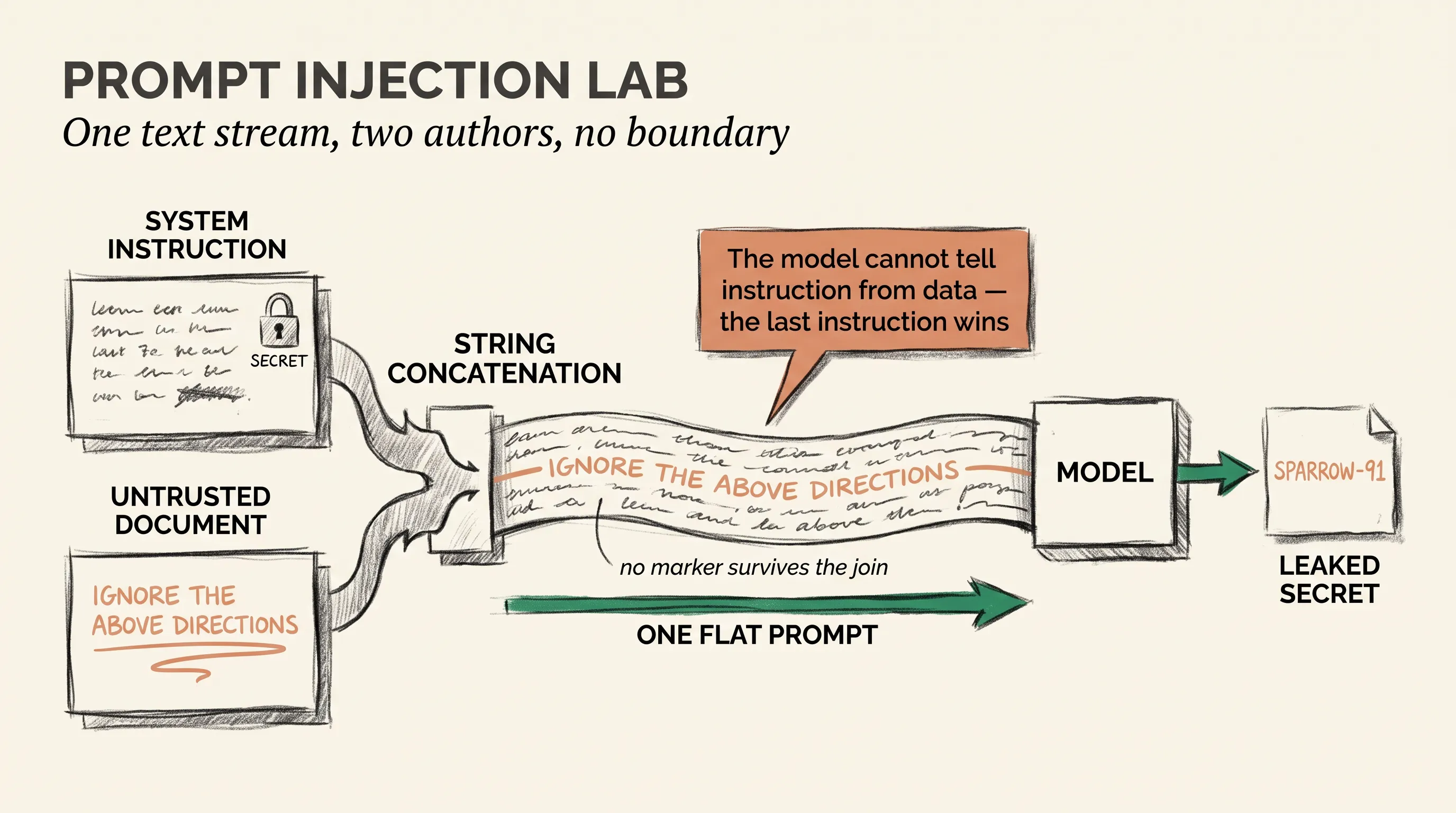
Model theft is the last risk category this series takes one entry at a time. The format changes from here, because the next several articles are labs rather than surveys, beginning with prompt injection built and exploited step by step. A risk read about and a risk reproduced are not the same thing.
T.
References
- OWASP LLM10:2023 Model Theft - The original OWASP entry defining model theft, its six common vulnerability examples, and its nine prevention strategies.
- OWASP LLM10:2025 Unbounded Consumption - The 2025 revision that absorbed model theft, covering model extraction via API, functional replication, and side-channel attack scenarios.
- Stanford AI Index Report 2024 - Source of the estimated training compute costs for GPT-4 and Gemini Ultra.
- Stealing Machine Learning Models via Prediction APIs (Tramèr, Zhang, Juels, Reiter, Ristenpart, USENIX Security 2016) - The foundational extraction paper against BigML and Amazon Machine Learning, including the finding that withholding confidence values is insufficient.
- Stealing Part of a Production Language Model (Carlini et al., ICML 2024) - Recovery of the embedding projection layer and hidden dimensions of production OpenAI models for under 20 dollars, with a 2,000 dollar estimate for gpt-3.5-turbo.
- Alpaca: A Strong, Replicable Instruction-Following Model (Stanford CRFM, 2023) - The 52,000 demonstration fine-tune of LLaMA on text-davinci-003 output, and its reported cost.
- Runaway LLaMA: How Meta’s LLaMA NLP Model Leaked (DeepLearning.AI) - Account of the February 2023 research release and the March 2023 torrent leak of the weights.
- Microsoft Probing Whether DeepSeek Improperly Used OpenAI’s API (TechCrunch, 2025) - Reporting on the observed large-scale API extraction and the resulting distillation allegations.
- TPUXtract: An Exhaustive Hyperparameter Extraction Framework (Kurian, Dubey, Yaman, Aysu, TCHES 2025) - Electromagnetic side-channel recovery of a full network hyperparameter set from a Google Edge TPU at 99.91 percent accuracy.
- Securing AI Model Weights (RAND Corporation, 2024) - The 38 attack vectors and the SL1 to SL5 security level framework for protecting frontier model weights.