THE RESOURCE EVERY TECHNIQUE SPENDS
Five posts into this series the toolkit is largely assembled. Retrieval practice outperforms review, spacing outperforms cramming, edge-of-ability drills outperform raw repetition, and calibration decides where the effort lands. Every one of those techniques carries the same silent dependency: it assumes the learner can hold one thing in mind long enough for the technique to do its work.
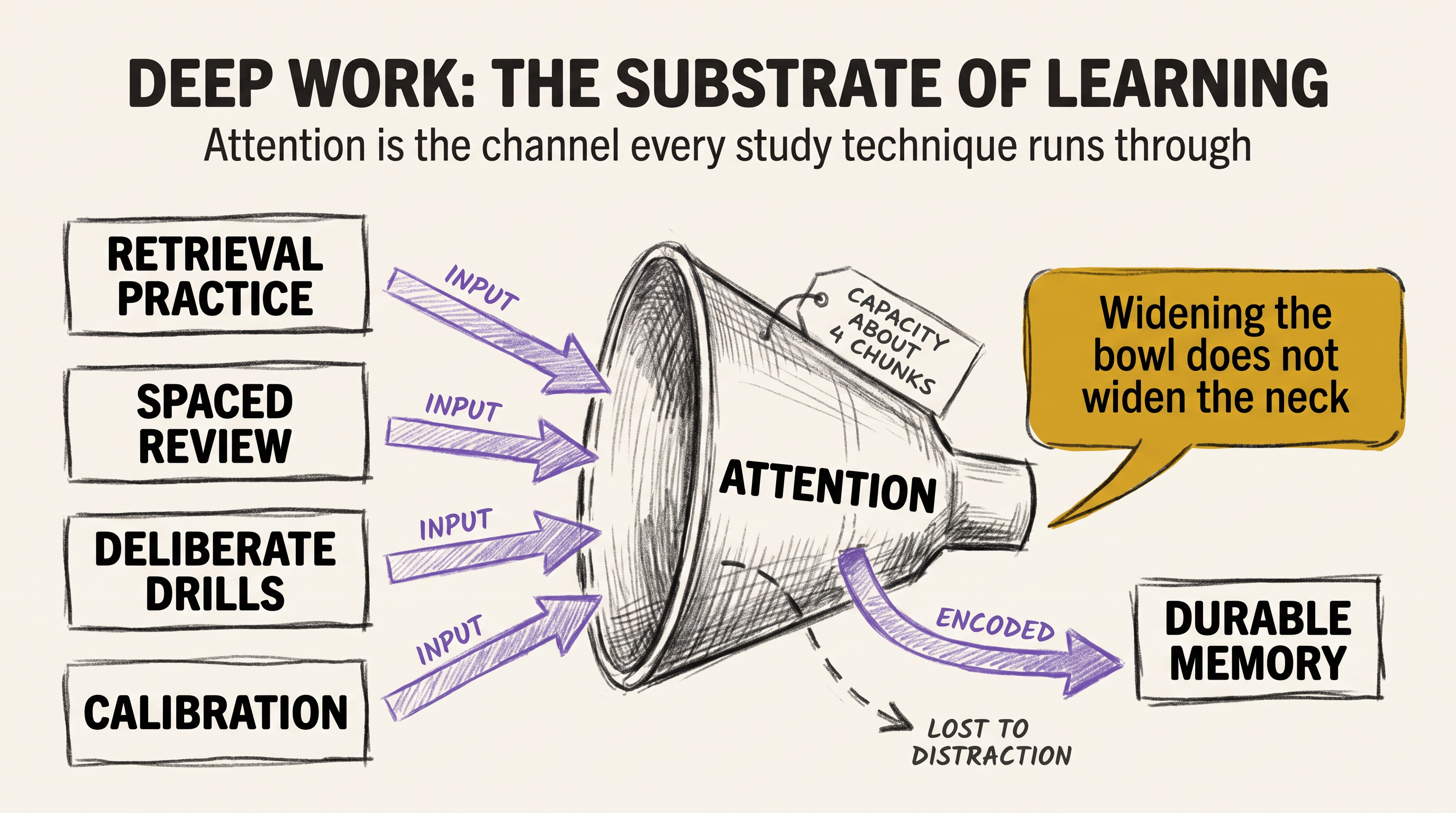
That assumption deserves more scrutiny than it usually gets, because the resource it draws on is narrow and fixed. Nelson Cowan’s 2001 review in Behavioral and Brain Sciences placed the capacity of the focus of attention at roughly four chunks of information for adults, once researchers control for rehearsal and chunking strategies. No study technique raises that ceiling.
Attention works like the neck of a funnel, and widening the bowl above it changes nothing about the rate at which anything gets through. What a technique can do is change how those few slots get spent, which makes attention the channel every other method in this series depends on.
WHAT ATTENTION BUYS AT THE MOMENT OF ENCODING
Fergus Craik and Robert Lockhart argued in 1972 that memory is a by-product of processing depth rather than the output of a separate storage step. Surface processing, attending to how a word looks or sounds, leaves a fragile trace. Semantic processing, attending to what it means and what it connects to, leaves a durable one. Craik and Endel Tulving tested the claim directly in 1975 and found that participants later recognised words judged for meaning far more often than words judged for appearance or rhyme, even where the shallow judgment had taken longer to make.
Time spent is not the variable that matters. Depth of processing is.
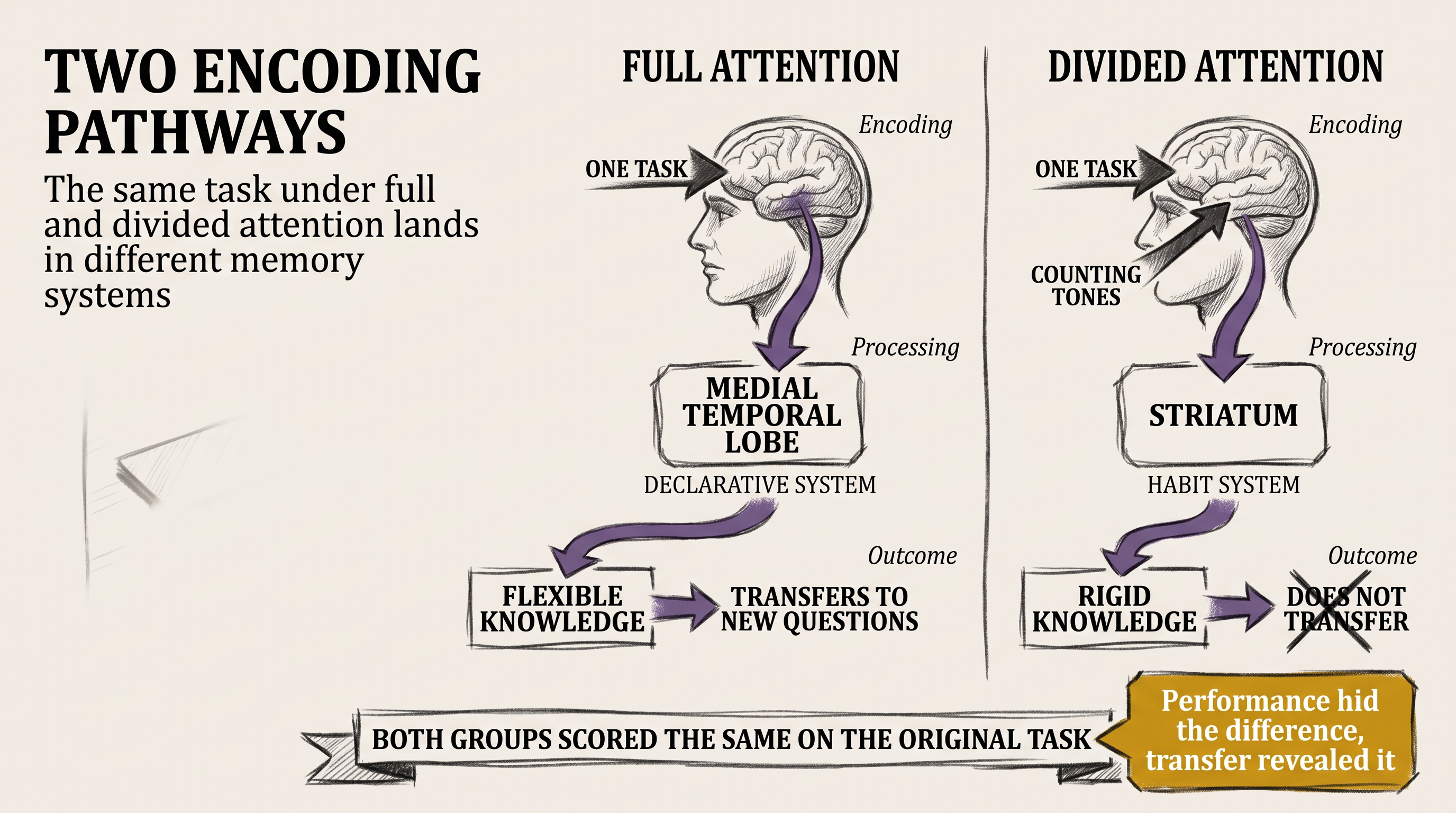
The clearest evidence that attention gates that depth came from Karin Foerde, Barbara Knowlton and Russell Poldrack in 2006. Participants learned a probabilistic classification task either with full attention or while simultaneously counting tones in a second stream. Both groups learned the task to a similar level, which on a behavioural measure alone would suggest that the distraction cost nothing.
Brain imaging showed otherwise. Full attention recruited the medial temporal lobe, the declarative memory system, while divided attention shifted the work to the striatum, the habit system, and when the researchers probed the knowledge in an unfamiliar way the divided-attention group could not transfer it. Knowledge acquired that way is the equivalent of a route learned by turns rather than by map: it holds while the road stays the same and fails at the first detour.
Distraction in that experiment did not slow learning down. It routed learning into a system that produces knowledge which only works in the shape it took on the way in.
DEEP AND SHALLOW AS A DISTINCTION
Cal Newport supplied the working vocabulary in his 2016 book Deep Work, splitting effort into two regimes. Deep work is cognitively demanding activity performed in a state of distraction-free concentration, pushing capability toward its limit. Shallow work is logistical activity performed while distracted, easily replicated and rarely producing anything new.
The line is not drawn by how important the task is. It is drawn by the state the person is in while doing it. A student reading a difficult chapter with a phone face-up on the desk is doing shallow work on deep material, and the Foerde result suggests the bill for that arrangement arrives at encoding rather than at comprehension in the moment.
THE MEASURABLE COST OF SWITCHING
The natural objection is that nobody genuinely splits attention between two things at once; people alternate rapidly instead. The research on alternation is not more encouraging.
Joshua Rubinstein, David Meyer and Jeffrey Evans reported in 2001 in the Journal of Experimental Psychology: Human Perception and Performance that participants alternating between tasks lost measurable time on every switch, and that the loss grew as the tasks became more complex and less familiar. Stephen Monsell’s 2003 review in Trends in Cognitive Sciences added the detail that matters most for study planning: a residual switching cost survives even when people receive ample warning and preparation time before the switch arrives. The cost is not simply the cost of surprise.
Sophie Leroy named the mechanism in 2009. Her studies found that when people move from one task to another without finishing the first, part of their attention stays behind in a condition she called attention residue, and performance on the new task degrades in proportion to how much stays there. The residue weighs heaviest when the learner abandons the first task unresolved and under time pressure, which describes most interruptions in a study session.
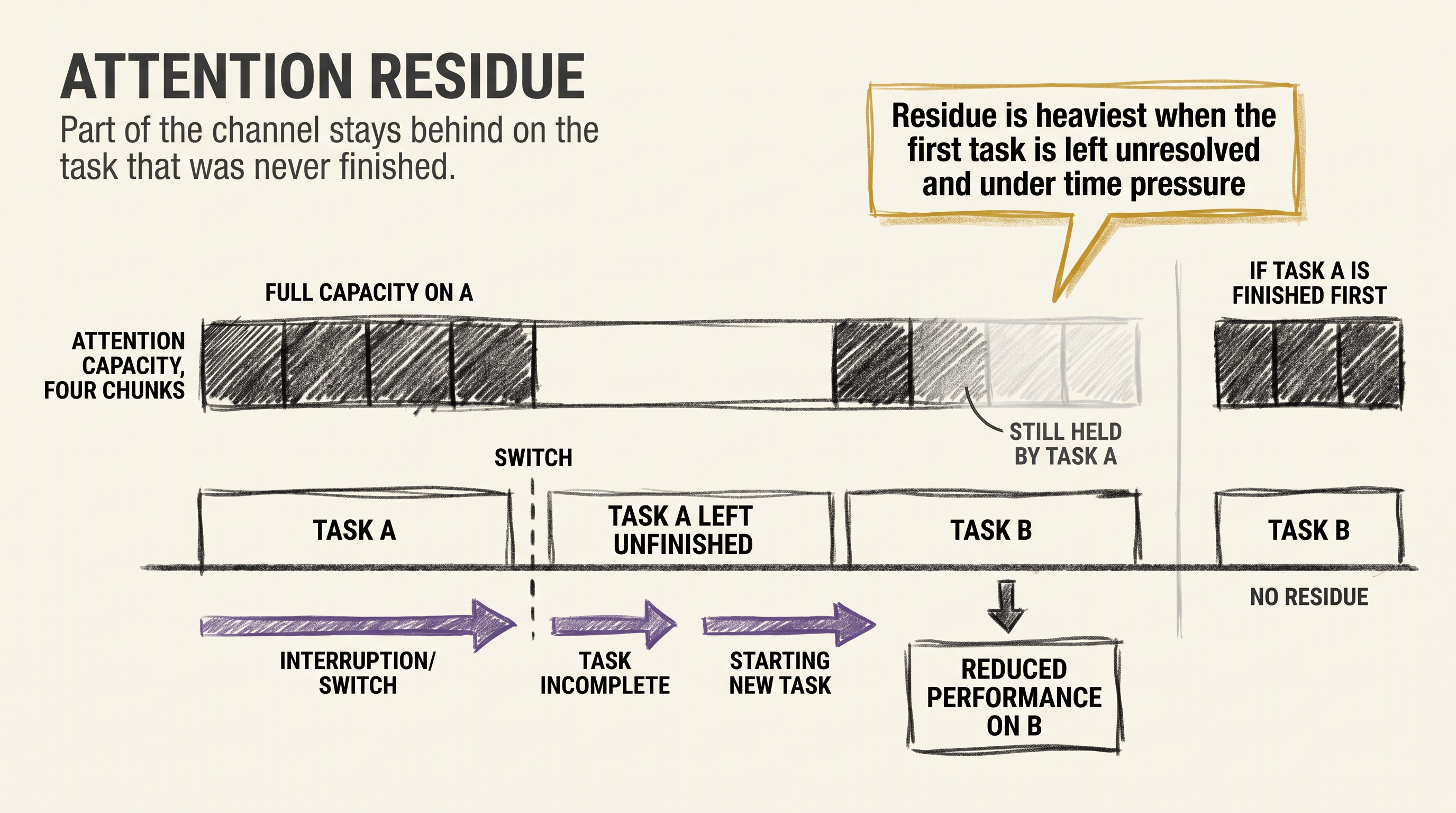
Remember the four-chunk ceiling from the opening section: residue spends part of that capacity before the new task even begins.
Field data matches the laboratory. Gloria Mark, Victor Gonzalez and Justin Harris shadowed information workers in 2005 and found them spending only around three minutes on an individual task, and roughly eleven minutes within a broader working sphere, before switching away. Mark returned to the question with Daniela Gudith and Ulrich Klocke in 2008 and reported something counterintuitive: participants finished interrupted work faster than uninterrupted work, but at the cost of higher stress, frustration, time pressure and mental effort. Speed was not the thing that fragmentation destroyed.
STRUCTURING THE BLOCK
If attention is a narrow and depletable channel, the practical question becomes how long a block should run and what belongs inside it. Anders Ericsson, Ralf Krampe and Clemens Tesch-Römer’s 1993 study of elite violinists found the strongest performers practising around four hours a day, broken into sessions of roughly an hour, distributed across morning and afternoon, with sleep and daytime naps protecting the total. Four hours was not a target those musicians were working toward. It was a ceiling they had settled at.
Inside the block, structure helps in a way that connects directly to the second post in this series. Karl Szpunar, Novall Khan and Daniel Schacter reported in 2013 that inserting short memory tests between segments of an online lecture cut self-reported mind wandering roughly in half, improved note-taking, lowered anxiety about the final test, and improved retention of the material. Retrieval practice, on that evidence, works as an attention-management device and not only as a memory technique.
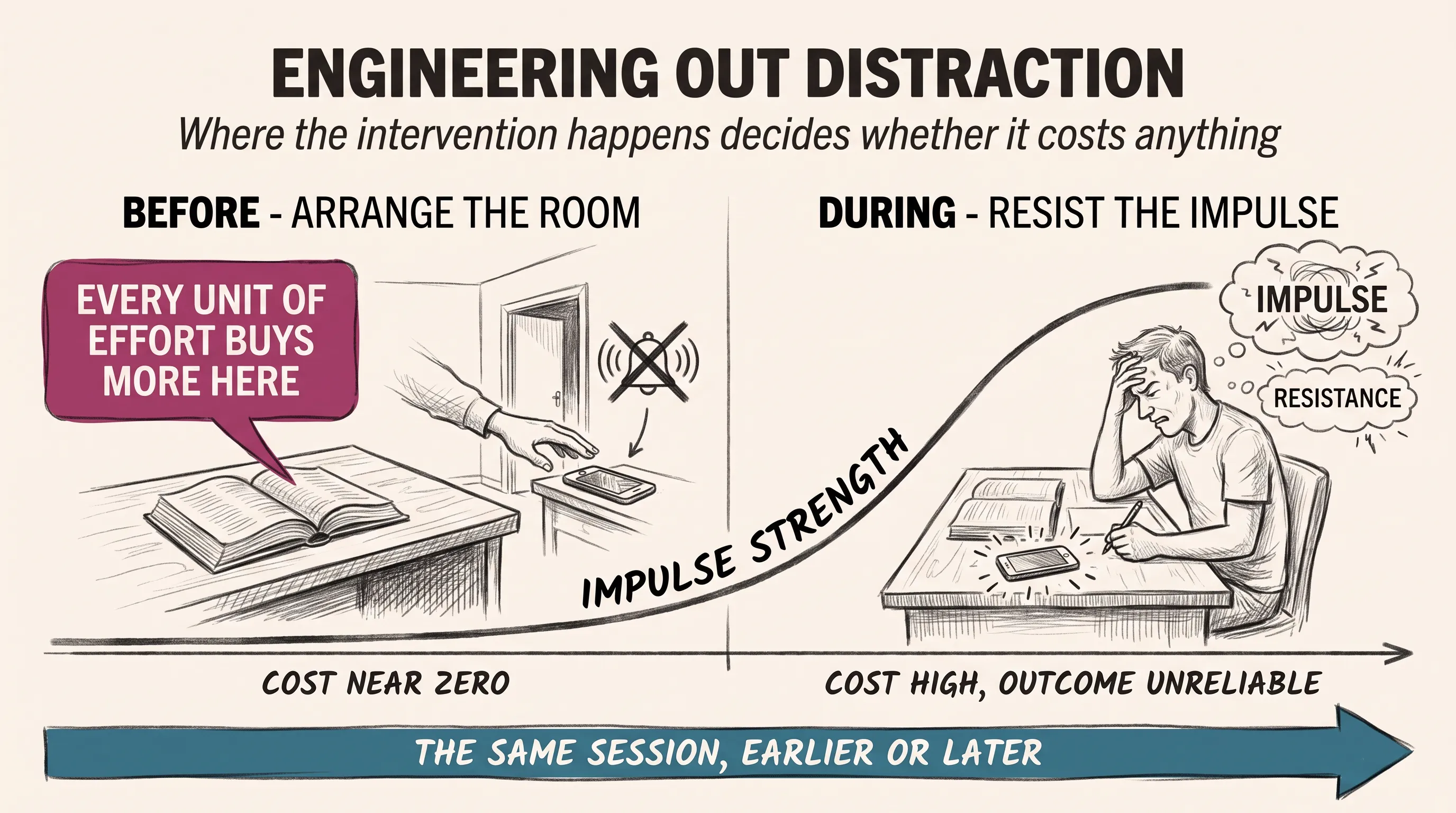
Removing competing inputs matters as much as arranging the hours. Faria Sana, Tina Weston and Nicholas Cepeda found in 2013 that students multitasking on laptops during a lecture scored lower on a comprehension test afterwards, and that students seated where they could see a multitasking peer’s screen also scored lower, without having touched a device themselves.
Ever tried to hold a difficult paragraph in mind while somebody nearby scrolls a video feed at the edge of your vision?
WHAT ATTENTION DOES NOT FIX
Protected attention is a precondition, not a method. An undistracted hour spent re-reading a chapter is still an hour spent re-reading, and the opening post in this series covers why that particular hour buys so little. Focus determines whether a technique gets a fair chance to work; it does not choose the technique.
The evidence also has edges worth marking honestly. Eyal Ophir, Clifford Nass and Anthony Wagner reported in 2009 that people who habitually consume several media streams at once performed worse at filtering irrelevant information and at switching between tasks, but the design was correlational, comparing self-identified heavy and light multitaskers rather than assigning anyone to a condition. It establishes an association and not a direction, and it says nothing about whether the habit caused the deficit or the deficit encouraged the habit.
What the literature does support is narrower and more useful than the popular framing around focus. Attention sets how deeply material encodes, switching charges a fee on every switch rather than only on the dramatic interruptions, and the residue of an unfinished task follows the learner into whatever comes next. Whether anyone can train the underlying capacity, rather than merely protect it by arranging better conditions around it, is a question this body of work has not settled.
T.
References
-
The Magical Number 4 in Short-Term Memory - Cowan (2001), Behavioral and Brain Sciences. Reconsiders the capacity of the focus of attention and places it at roughly four chunks once rehearsal and grouping strategies drop out of the count.
-
Levels of Processing: A Framework for Memory Research - Craik & Lockhart (1972), Journal of Verbal Learning and Verbal Behavior. Proposes that retention is a by-product of processing depth rather than a separate storage operation.
-
Depth of Processing and the Retention of Words in Episodic Memory - Craik & Tulving (1975), Journal of Experimental Psychology: General. Demonstrates that semantic judgments produce far better later recognition than surface judgments.
-
Modulation of Competing Memory Systems by Distraction - Foerde, Knowlton & Poldrack (2006), Proceedings of the National Academy of Sciences. Shows divided attention shifting learning from the declarative system to the habit system, with reduced transfer.
-
Deep Work: Rules for Focused Success in a Distracted World - Newport (2016), Grand Central Publishing. Source of the deep and shallow work vocabulary used throughout this post.
-
Executive Control of Cognitive Processes in Task Switching - Rubinstein, Meyer & Evans (2001), Journal of Experimental Psychology: Human Perception and Performance. Measures the time lost on each switch and how it grows with task complexity.
-
Task Switching - Monsell (2003), Trends in Cognitive Sciences. Review establishing that a residual switch cost persists despite advance warning and preparation time.
-
Why Is It So Hard to Do My Work? The Challenge of Attention Residue When Switching Between Work Tasks - Leroy (2009), Organizational Behavior and Human Decision Processes. Introduces attention residue and links it to degraded performance on the following task.
-
No Task Left Behind? Examining the Nature of Fragmented Work - Mark, Gonzalez & Harris (2005), Proceedings of the SIGCHI Conference on Human Factors in Computing Systems. Field observation of how briefly information workers stay on a single task.
-
The Cost of Interrupted Work: More Speed and Stress - Mark, Gudith & Klocke (2008), Proceedings of the SIGCHI Conference on Human Factors in Computing Systems. Finds interrupted work finished faster but with higher stress, frustration and effort.
-
The Role of Deliberate Practice in the Acquisition of Expert Performance - Ericsson, Krampe & Tesch-Römer (1993), Psychological Review. Documents the daily practice ceiling, the session length, and the role of rest among elite performers.
-
Interpolated Memory Tests Reduce Mind Wandering and Improve Learning of Online Lectures - Szpunar, Khan & Schacter (2013), Proceedings of the National Academy of Sciences. Shows short tests between lecture segments halving mind wandering and improving retention.
-
Laptop Multitasking Hinders Classroom Learning for Both Users and Nearby Peers - Sana, Weston & Cepeda (2013), Computers & Education. Reports comprehension losses for multitasking students and for peers in view of the screen.
-
Cognitive Control in Media Multitaskers - Ophir, Nass & Wagner (2009), Proceedings of the National Academy of Sciences. Correlational comparison of heavy and light media multitaskers on filtering and task-switching measures.