In the last article, we saw what chronic stress and burnout do to the brain. Cortisol shrinks the hippocampus. The amygdala grows more reactive. The prefrontal cortex loses synaptic connections.
Nine articles on how the modern world exploits and damages your brain. This one is about the other half of the equation.
Your brain has a recovery mode. You don’t install it. You just have to stop blocking it.

THE DEFAULT MODE NETWORK
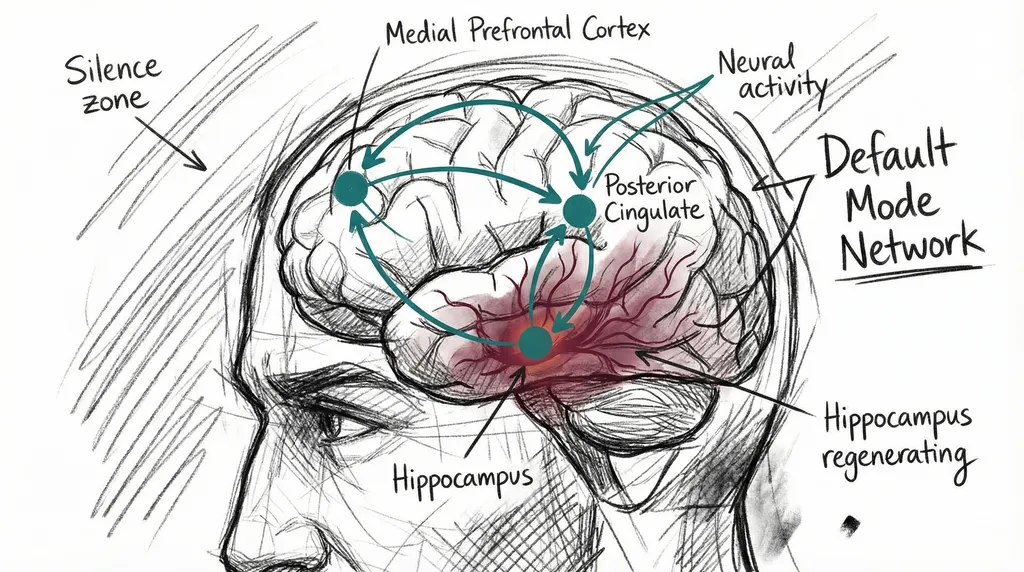
When you stop focusing on a task, your brain does not go quiet. It switches networks. The default mode network, or DMN, activates during rest, mind-wandering, and daydreaming. It handles things that focused attention cannot: consolidating memories, processing emotional experiences, connecting distant ideas.
Think of it like a building’s night shift. The day workers leave and a different crew arrives. Cleaners work through every room. Maintenance checks the pipes.
Supplies get restocked. The building looks empty from outside. Your brain in rest mode works the same way. The night shift matters just as much as the day shift.
Mary Helen Immordino-Yang at the University of Southern California found that suppressing the DMN, filling every moment with stimulation and directed activity, correlates with reduced empathy and impaired moral reasoning. The research is clear on this: idle time is not wasted time. It is when certain important mental work gets done. This is why constant stimulation is not just tiring; it actively prevents a category of processing from occurring.
WHAT NATURE DOES
Rachel and Stephen Kaplan developed attention restoration theory in the 1980s after studying what helped people recover from mental fatigue. Their key finding: natural environments engage what they called involuntary attention, a gentle fascination that holds you without requiring effort. Watching a river flow or sitting under trees draws your attention the same way a good story does, without demanding that you manage it. Directing attention to city traffic, by contrast, requires constant active maintenance.
One refills capacity. The other spends it.
A 2019 study in Frontiers in Psychology found that 20 to 30 minutes sitting or walking in a natural setting significantly reduced salivary cortisol. Not a weekend away. Twenty minutes in a park.
A 2015 Stanford brain imaging study showed that nature walks reduced activity in the subgenual prefrontal cortex, the region linked to rumination, that repetitive negative-thought loop we connected to depression and chronic stress. Urban walks produced no such effect.
I think people overestimate how much nature they need. The research is on exposure to natural settings, not on distance from the nearest coffee shop.
THE SCIENCE OF SILENCE
In 2013, Imke Kirste and colleagues at Duke University were studying the effect of different audio environments on mouse brains. They used music, ambient noise, and other stimuli. They included silence as the control condition, expecting nothing interesting to happen there.
The silence group outperformed every other condition.
Two hours of silence per day led to measurable new cell growth in the hippocampus. The researchers described it as an accidental finding.
Think of your auditory cortex like a security guard who is always on duty. Even when you stop consciously noticing sounds, that guard is scanning, sorting, and flagging incoming signals. It never clocks out.
When you sit in silence, the guard finally has nothing to monitor. The resources normally spent on that constant surveillance become available elsewhere. The hippocampus, which shrinks under chronic stress, may use that freed-up capacity to do what it could not while the noise was running.
The implication is not comfortable if you commute with headphones or work in an open office: noise is a cognitive tax your brain is paying continuously, whether you notice it or not.
SLEEP: THE ACTUAL RESET
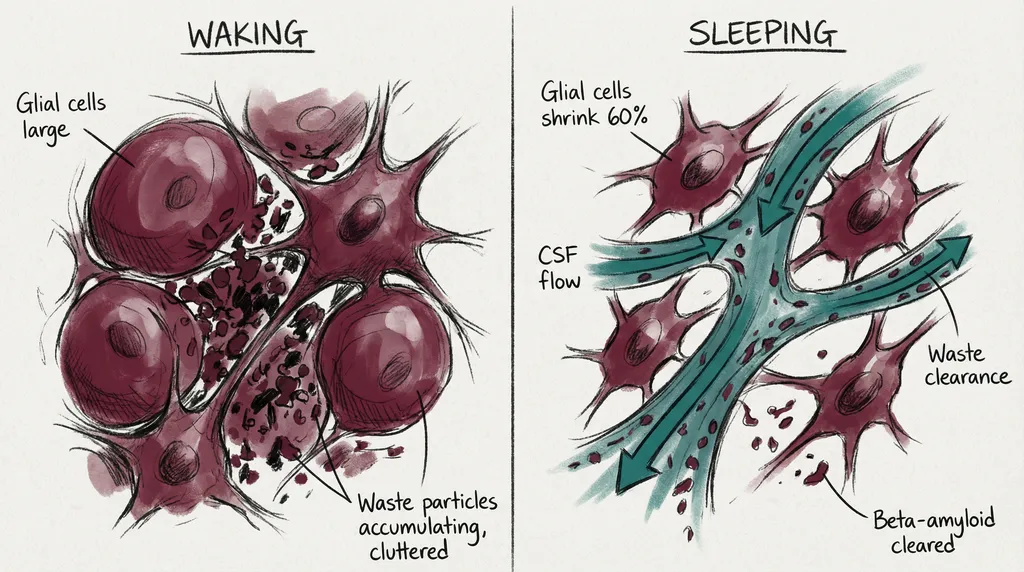
Sleep is when the brain does the maintenance it cannot do while you are awake. During sleep, glial cells shrink by approximately 60 percent. The gaps that open between neurons allow cerebrospinal fluid to flush through, clearing metabolic waste including beta-amyloid proteins linked to Alzheimer’s disease.
Maiken Nedergaard’s team at the University of Rochester discovered this glymphatic system in 2013. It runs almost exclusively during sleep.
Staying awake is, in a quite literal sense, letting the waste accumulate.
Neuroplasticity adds another dimension. We covered earlier how the brain rewires through repeated activation, how practiced skills form stronger pathways. Sleep is when that consolidation happens.
The hippocampus replays the day’s experiences and transfers selected material to the cortex for long-term storage. A skill you practiced feels more accessible the next morning not because you rested but because your brain worked on it overnight.
Matthew Walker’s research at Berkeley shows that sleeping fewer than seven hours raises cortisol, impairs prefrontal function, and reduces emotional regulation. Chronic stress, as we covered in the last article, gets worse without adequate sleep. The two conditions reinforce each other in a loop that only consistent sleep breaks.
WHERE THIS SERIES LEAVES YOU
This series started with one argument: social media algorithms exploit your brain’s operating system, and most people do not know the rules of the game. Ten articles to change that.
We traced the hardware: 86 billion neurons communicating across synapses 20 nanometers wide. We saw that dopamine is a prediction signal, not a pleasure chemical, and how variable rewards exploit this to make checking your phone compulsive. We followed the fight-or-flight cascade from amygdala activation to cortisol flood, and saw how modern platforms deliberately trigger that response because a stressed brain keeps paying attention.
We saw how chronic stress physically shrinks the hippocampus. We covered neuroplasticity, and the simple fact that your brain rewires for whatever you do most. We looked at how screens weaken prefrontal cortex function. And in the last article, we saw that burnout is not tiredness; it is a measurable brain injury.
Recovery is not a soft counterpoint to any of that. It connects mechanically to every topic we covered.
Nature lowers the cortisol that damages your hippocampus. Silence gives that region the conditions to regenerate. Sleep flushes the waste that builds up during the day and consolidates the neural changes that attention training creates.
FOCUS TRAINING. One idea kept returning throughout this series: your brain is a plasticity machine. It becomes what you practice. The platforms practicing you toward distraction are not neutral forces.
They are, in the most literal sense, reshaping the organ that makes every decision in your life. Practicing focus, even for short periods each day, rebuilds the prefrontal connections that stress and screens erode. Recovery makes that training permanent.
The brain you have in a year is mostly shaped by what you repeatedly do with it today. That is the thing I wanted this series to make clear.
Spend as much time as possible in places like this.

T.
References
-
Kaplan, S. (1995). The Restorative Benefits of Nature - Foundational attention restoration theory paper showing how natural environments restore directed attention capacity.
-
Hunter, M.R. et al. (2019). Urban Nature Experiences Reduce Stress - Frontiers in Psychology study showing 20–30 min in nature significantly reduces salivary cortisol.
-
Bratman, G.N. et al. (2015). Nature and rumination - Stanford fMRI study showing nature walks reduce activity in the subgenual prefrontal cortex, the brain region linked to rumination and depression.
-
Kirste, I. et al. (2013). Is silence golden? - Brain Structure and Function study finding 2 hours of silence per day promotes new cell growth in the hippocampus, an accidental discovery from a control condition.
-
Xie, L. et al. (2013). Sleep Drives Metabolite Clearance from the Adult Brain - Science paper describing the glymphatic system and how sleep flushes metabolic waste including beta-amyloid.
-
Immordino-Yang, M.H. et al. (2012). Rest Is Not Idleness - Perspectives on Psychological Science, linking default mode network function to empathy, moral reasoning, and self-regulation.