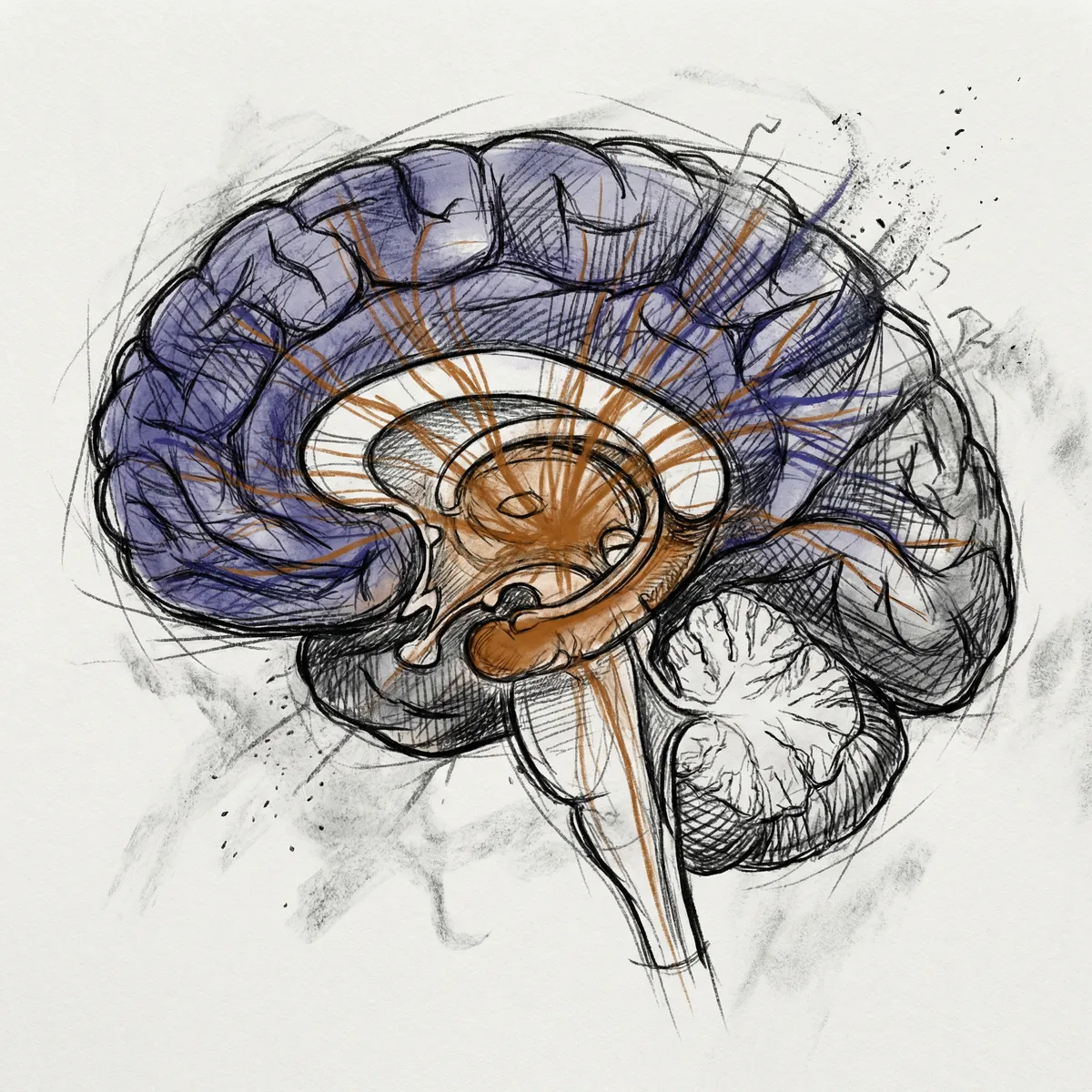
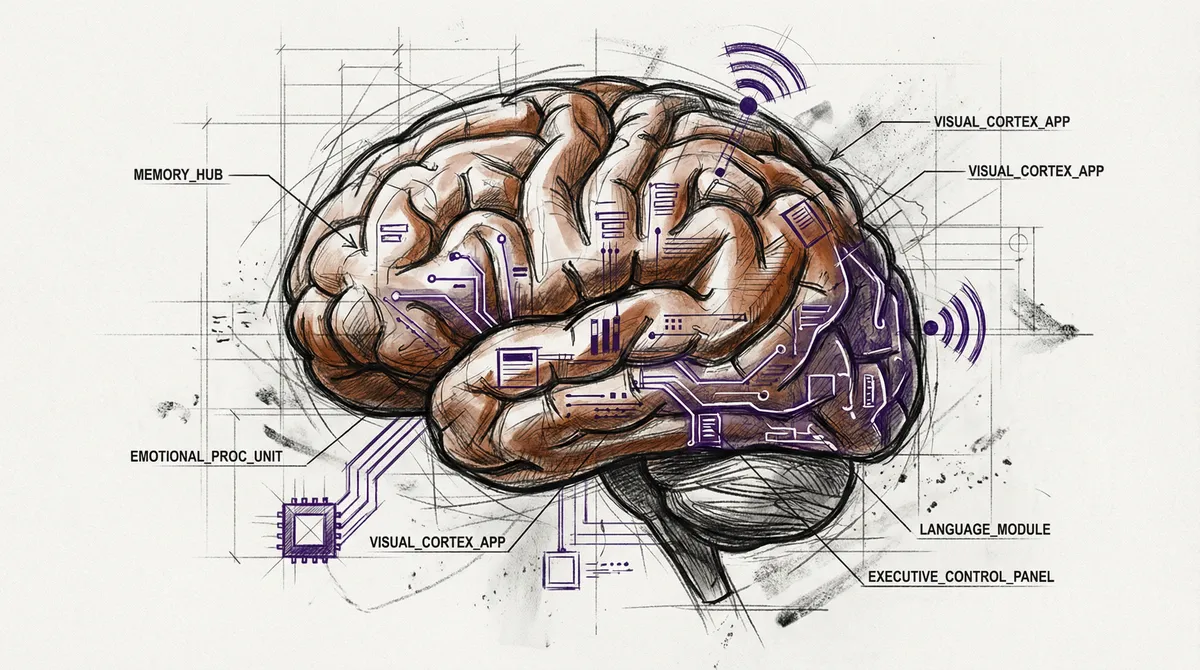
You have probably heard that dopamine is the pleasure chemical. That eating chocolate or getting a like on social media gives you a dopamine hit, and that is why it feels good.
This is wrong. Not slightly wrong. Fundamentally wrong.
Dopamine is not about pleasure. It is about wanting. It is the molecule that makes you reach for your phone before you even decide to, the molecule that keeps you watching one more episode.
Why does it get you out of bed on some mornings and not others? That question sent me down a rabbit hole.
In the last article, we looked at how memory works and why you forget most of what you learn. Dopamine is the reason your brain decides what is worth remembering in the first place.
NOT PLEASURE. PREDICTION.
THE MISCONCEPTION FIRST. For decades, scientists believed dopamine equaled pleasure. They saw it spike during enjoyable activities and drew the obvious conclusion.
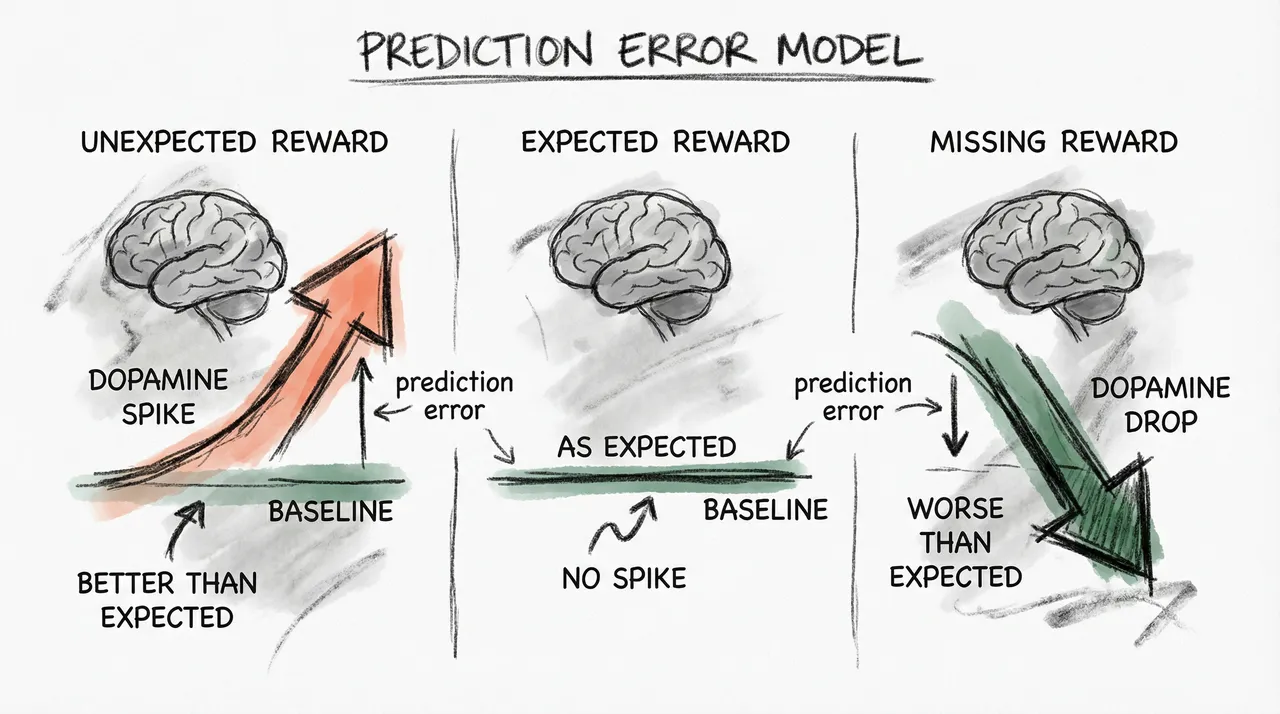
Then in the 1990s, Wolfram Schultz at the University of Cambridge ran experiments with monkeys that changed everything. He trained monkeys to expect juice after a signal. At first, dopamine spiked when the juice arrived.
But after the monkeys learned the pattern, dopamine shifted. It spiked at the signal, not the juice. The expected reward produced nothing.
Even more interesting: when the juice did not arrive after the signal, dopamine dropped below baseline. The absence of an expected reward felt worse than never expecting it at all.
This is the prediction error model. Dopamine does not say this feels good. It says this is better than expected or this is worse than expected. A teaching signal, not a pleasure signal.
I think once you understand this, you can never look at your phone the same way again.
THE WANTING MACHINE
Kent Berridge at the University of Michigan took this further. He found that wanting and liking are separate brain systems. Dopamine drives wanting, the motivation to pursue something.
Liking, the actual enjoyment, uses different chemicals: endorphins and endocannabinoids.
This separation explains a lot.
Ever scrolled social media for an hour and felt worse afterward? You kept wanting the whole time. Dopamine kept saying check the next post, something good might be there. But the liking never arrived.
Think of dopamine like a compass needle. It does not care about where you are, only about which direction to move. It points toward things your brain predicts will be rewarding.
The bigger the predicted reward, the stronger the pull. The less certain the outcome, the more dopamine flows.
This is why gambling is so addictive. Not because winning feels amazing, but because the uncertainty itself generates massive dopamine spikes. Variable rewards, where you sometimes win and sometimes lose, produce four times more dopamine than predictable rewards.
HOW YOUR BASELINE WORKS
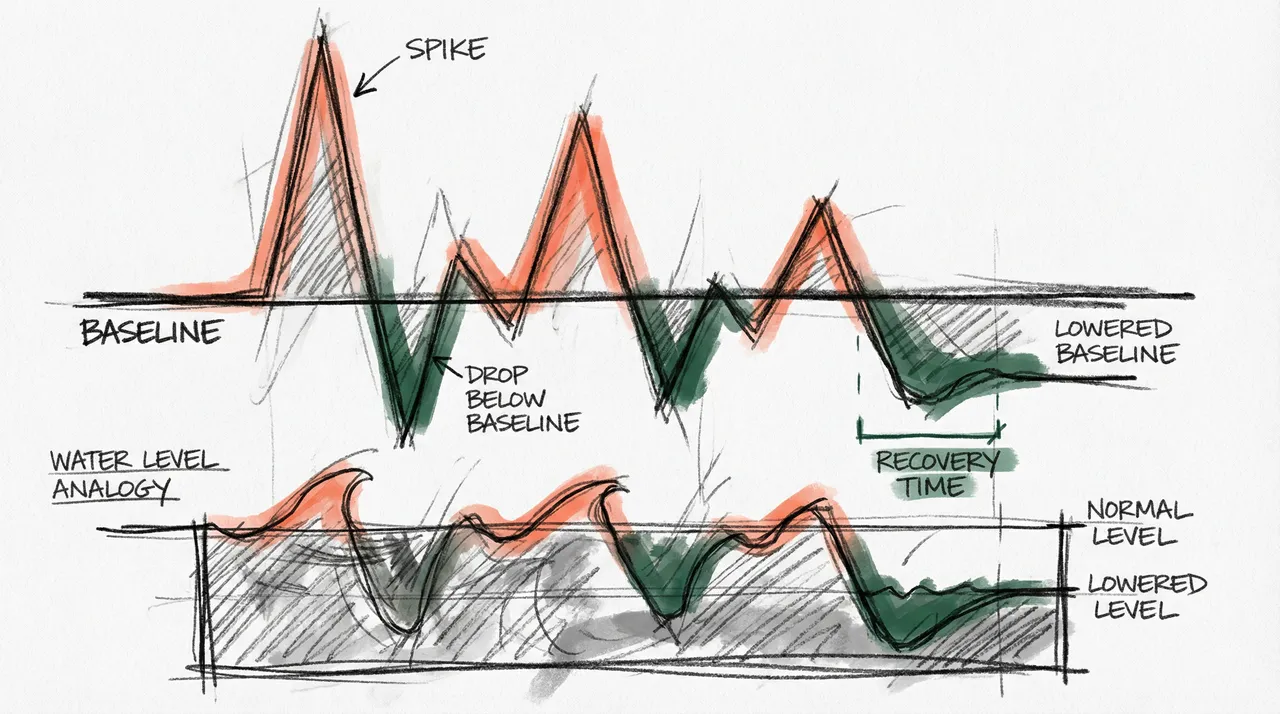
Your brain maintains a baseline level of dopamine, a resting state that determines your general motivation and mood. When something exciting happens, dopamine spikes above baseline. Here is the part most people miss: after every spike, dopamine drops below baseline before returning to normal.
The higher the spike, the deeper the drop.
Imagine a swimming pool. Baseline is the normal water level. A dopamine spike is like dumping a bucket of water in. The level rises, then some water splashes out over the edge.
When things settle, you have less water than you started with. Your brain needs time to refill.
This is why you feel flat after an exciting event. The post-vacation blues, the emptiness after finishing a great show, the low mood the day after a party. That is not weakness. That is your dopamine system rebalancing.
The problem starts when you spike dopamine constantly without giving it time to recover. Each spike causes a small drop below baseline. If you chain them together, check phone, eat sugar, check phone, watch video, check phone, the drops accumulate. Your baseline gradually sinks lower.
A lower baseline means less motivation, less interest, less drive to do anything without an immediate reward. Things that used to feel satisfying now feel boring. Not because they changed, but because your dopamine system needs time it never gets.
WHEN SCROLLING DRAINS YOUR BATTERY
Here is something that took me a while to understand. Scrolling through social media feels like resting. You are sitting down, not thinking hard, just passively consuming. But your brain tells a different story.
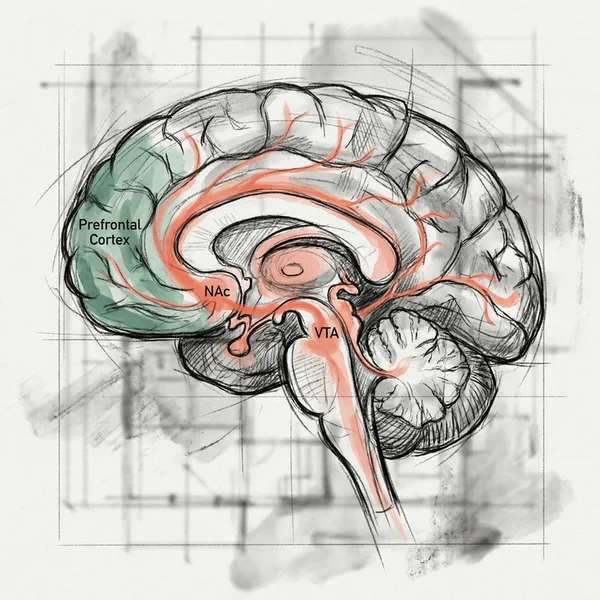
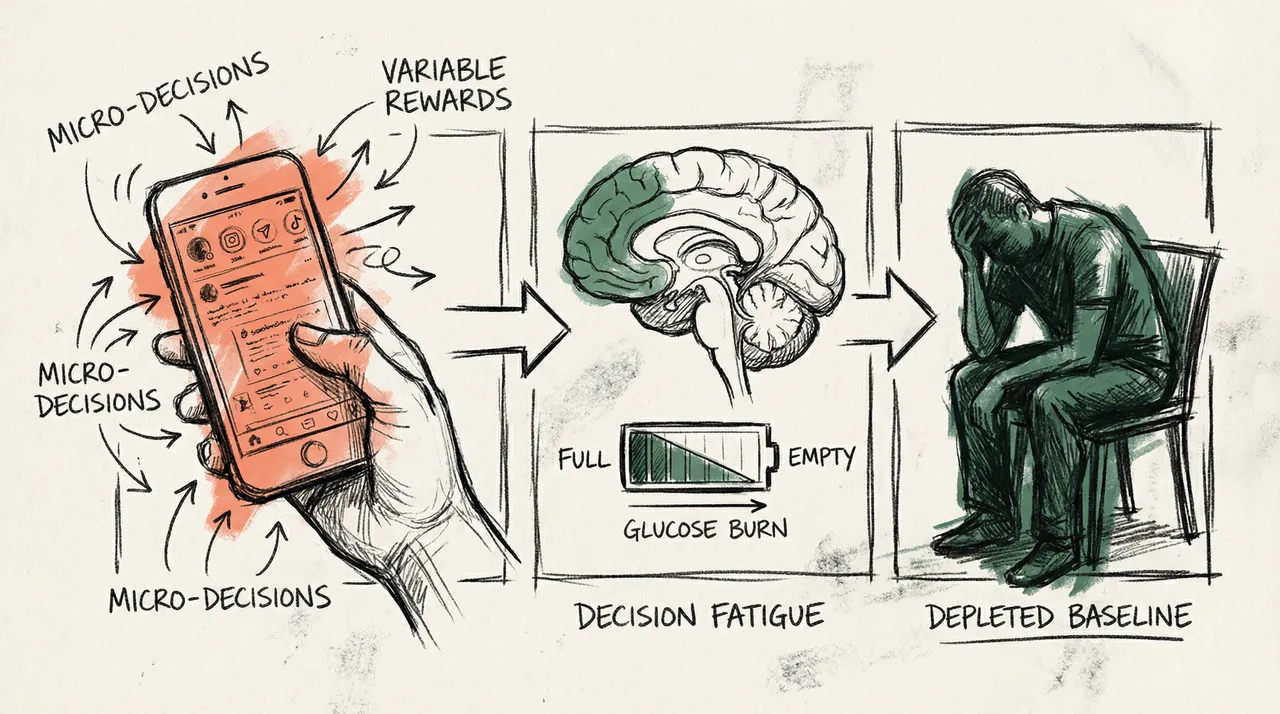
Every piece of content you scroll past forces a micro-decision: is this interesting, should I stop, read more, like it, skip? Your prefrontal cortex burns glucose with each evaluation.
After hundreds of these micro-decisions in a few minutes, you have done the cognitive equivalent of a long meeting. I tested this on myself once, tracked my screen time, and the days with more scrolling were always the days I felt most drained by evening.
This is decision fatigue. Your brain has a limited budget for decisions each day. Scrolling spends that budget on content that gives you almost nothing back.
Social media makes this worse with variable reward schedules. Every few posts, something catches your attention: a funny video, an outrageous headline, a friend’s photo. These unpredictable hits keep dopamine flowing, which keeps you scrolling, which keeps spending your decision budget.
You put the phone down feeling tired, unfocused, and strangely unmotivated. That is not laziness. Your brain literally spent its energy on nothing.
YOUR BASELINE UNDER SIEGE
The scrolling problem goes deeper than one tired afternoon.
When you train your dopamine system on constant, low-effort, high-frequency rewards, you are teaching it a new normal. Your brain adapts to the stimulation level. What used to be exciting becomes the new baseline.
Anna Lembke, a psychiatrist at Stanford, describes this as a pleasure-pain balance in her book Dopamine Nation. Your brain has a set point it tries to maintain. Push the pleasure side down too often, and the pain side tips up to compensate. You need more stimulation just to feel normal.
This is the same mechanism behind drug tolerance, just at a smaller scale. Nobody becomes a social media addict from one scroll session. But after months or years of daily high-frequency dopamine hits, the baseline shifts. You need the phone just to feel okay.
Recovery takes time. Lembke recommends a 30-day dopamine fast: remove the source of constant stimulation and let your brain recalibrate. Studies show that after about 2 to 4 weeks without the stimulus, baseline dopamine levels start to recover.
The good news: neuroplasticity, the same mechanism that shifted your baseline down, can shift it back up. But only if you give it the space.
WHAT THIS MEANS FOR YOU
Understanding dopamine changes how you see your own behavior. That urge to check your phone is not a character flaw. It is a prediction error signal firing because your brain learned that uncertain rewards live behind that screen.
The afternoon slump after a scrolling session is not tiredness from work. It is a depleted dopamine baseline and an exhausted prefrontal cortex.
The inability to sit with a book for more than ten minutes is not a short attention span. It is a recalibrated reward system that finds slow, predictable rewards boring compared to the fast, variable ones it trained on.
None of this means you are broken. It means you are running a brain that evolved for one environment and got dropped into another. The algorithms that design your feed understand your dopamine system. Now you do too.
T.
References
-
A Neural Substrate of Prediction and Reward - Wolfram Schultz’s foundational 1997 paper establishing the dopamine prediction error model in primate brains.
-
Pleasure Systems in the Brain - Kent Berridge and Morten Kringelbach’s 2015 review showing that wanting (dopamine) and liking (opioid/endocannabinoid) are distinct neural systems.
-
Dopamine Nation: Finding Balance in the Age of Indulgence - Anna Lembke’s 2021 book on how overconsumption of dopamine-triggering stimuli shifts the pleasure-pain balance.
-
Variable Ratio Reinforcement and Dopamine - Research on how unpredictable reward schedules produce stronger dopamine responses than fixed schedules.
-
The Cost of Interrupted Work - Gloria Mark’s research on how task switching depletes cognitive resources and increases stress.