You checked your phone 205 times yesterday. That number sounds wrong, but it is the 2024 average for Americans, up 42% from the year before. Nobody plans to check their phone that often. You just do it, again and again.
Earlier in this series, we covered how dopamine works and how your brain responds to threat. This article is about what happens when those systems meet technology designed to keep you scrolling. Not a general overview; the specific mechanisms, the specific damage, and what the research actually says.
THE DESIGN PLAYBOOK
Social media platforms don’t exist to inform you. They exist to hold your attention as long as possible, because attention is what advertisers buy.
THE INFINITE SCROLL. In 2006, Aza Raskin invented infinite scroll while working at Humanized. It does one thing: it removes the moment where you would normally stop. Think of it like removing the chapter breaks from a book; you keep reading because there is no natural place to pause.
Raskin later estimated his invention wastes around 200,000 human lifetimes per day. The European Commission has started working on banning it.
VARIABLE REWARDS. This is the slot machine principle, straight from B.F. Skinner’s research in the 1950s.
When rewards come at unpredictable intervals, animals and humans become obsessed with checking.
Your social media feed mixes boring posts with interesting ones on purpose. The unpredictability itself triggers dopamine release in your nucleus accumbens.
We covered how dopamine responds to prediction errors in an earlier article. This is that mechanism, weaponized at scale.
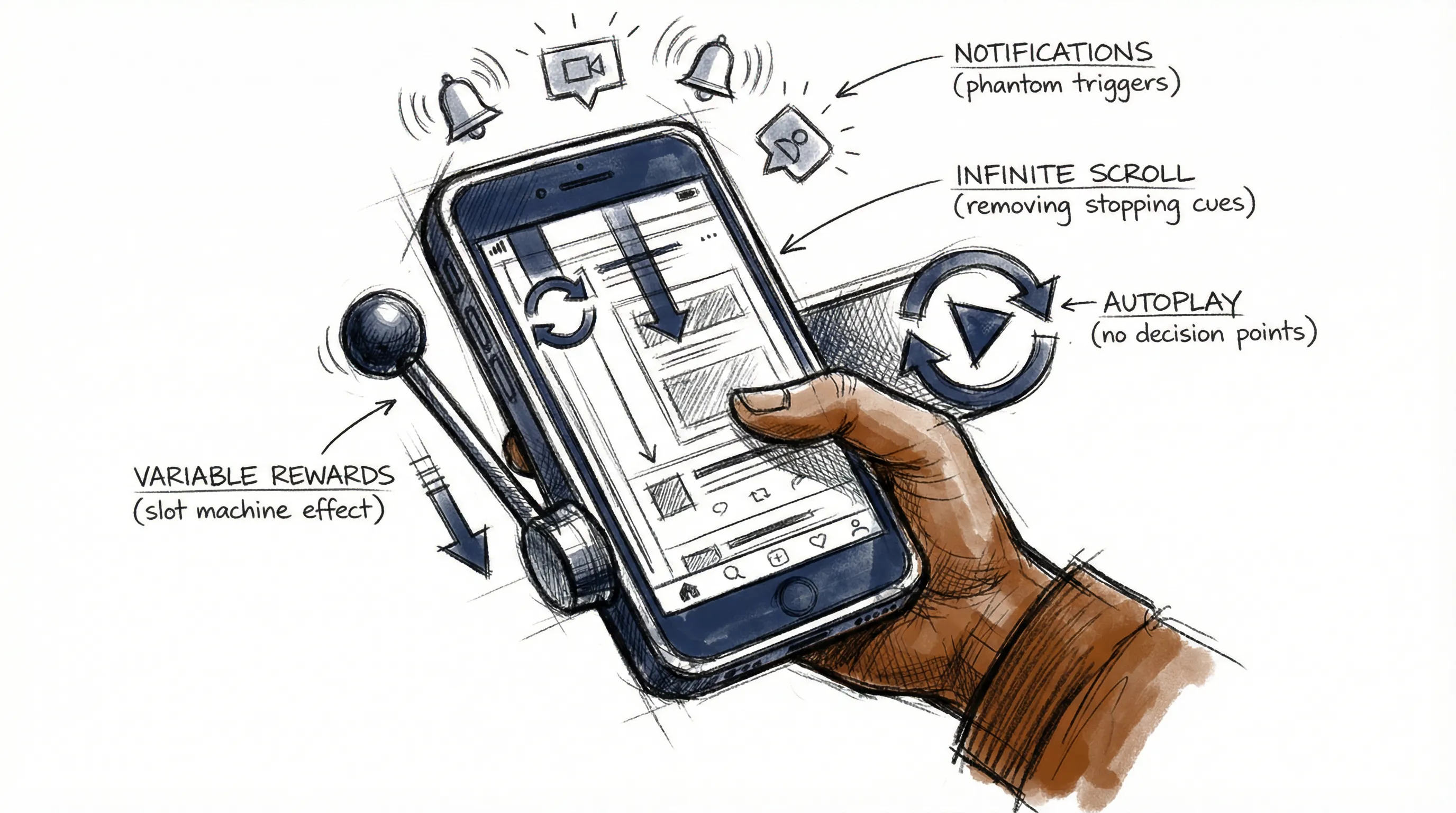
AUTOPLAY AND STOPPING CUES. Adam Alter, the NYU psychologist who wrote Irresistible, points out that platforms systematically remove what he calls “stopping cues.” Netflix auto-plays the next episode. YouTube queues the next video.
TikTok loads the next clip before you can decide whether you want it. It is like a waiter refilling your glass the moment you take a sip; you never experience an empty glass, so you never decide to stop drinking.
The decision to stop watching is harder than the decision to keep going, because keeping going requires zero effort.
THE HOOK MODEL. Product designer Nir Eyal mapped the full cycle in his book Hooked. It goes: trigger (you feel bored or anxious), action (you open the app), variable reward (unpredictable content), investment (you post, comment, follow).
The investment step is clever. The more you put into a platform, the harder it becomes to leave. Your data, your connections, your history; they all create switching costs.
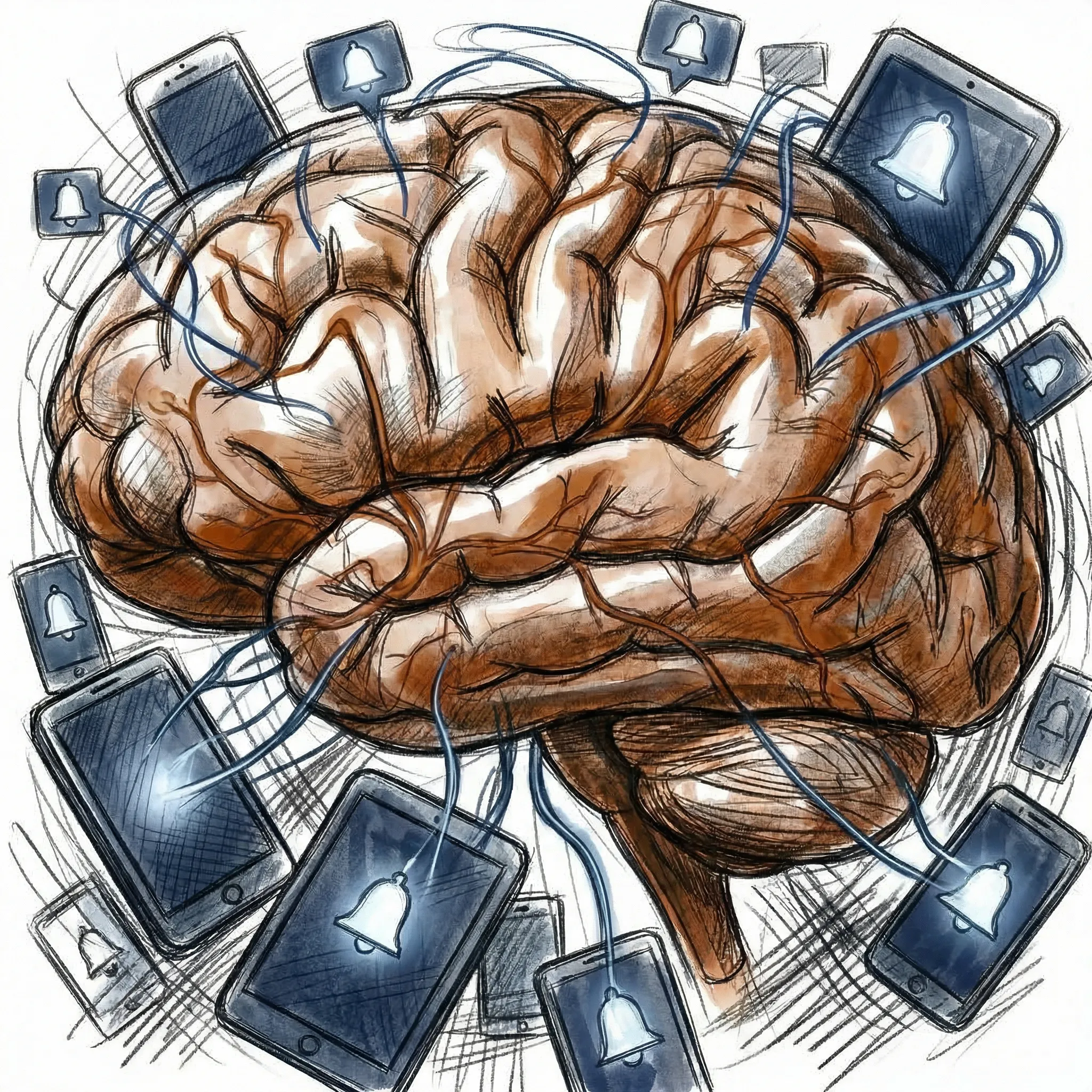
One more mechanism that doesn’t get enough attention: phantom vibrations. About 49% of college students report feeling their phone vibrate when it didn’t. Your brain has become so tuned to expect notifications that it hallucinates them. I find this genuinely disturbing.
THE ALGORITHMS
The design tricks above are bad enough. But the real power comes from AI recommendation engines that learn your specific weaknesses.
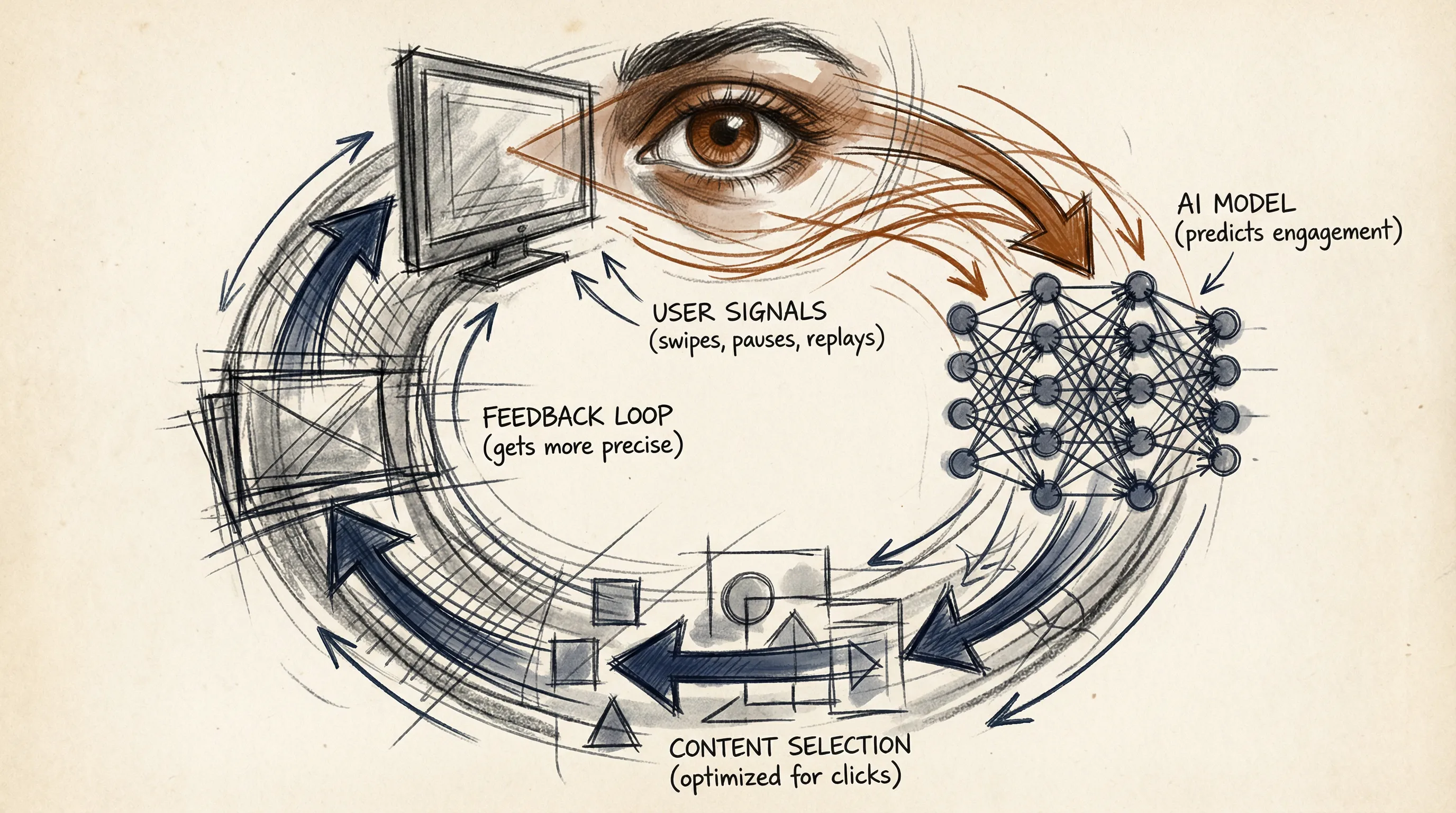
TikTok’s For You page uses reinforcement learning. Every swipe, every pause, every replay trains the model. The algorithm doesn’t just learn what topics you like; it learns your emotional triggers, the time of day you’re most vulnerable, and how long it takes before you stop.
It deliberately uses curiosity gaps, cutting videos at cliffhangers, because your brain compulsively needs to fill information voids.
YouTube processes 80 billion signals daily across 800 million videos. The platform runs tens of thousands of A/B experiments every year, all optimizing for one metric: watch time. Not satisfaction. Not learning.
Imagine a librarian who only cares how long you stay in the building, not whether you read anything good. That is YouTube’s recommendation engine.
A January 2025 study found that YouTube recommendations actively reinforce negative emotions. The algorithm pushes viewers toward content that makes them feel worse but keeps them watching longer.
Ever wonder why angry political content spreads so fast?
A pre-registered 2025 study found that Twitter/X’s engagement-based ranking amplifies anger by 0.47 standard deviations. For political tweets, it jumps to 0.75.
Here is the part that matters: users don’t even prefer the angry content the algorithm selects. It performs worse on satisfaction. The algorithm optimizes for clicks, not for what people actually want to see.
All these platforms share the same core architecture: massive signal ingestion, deep learning models that predict engagement, and reinforcement learning loops that treat your clicks as reward signals. The system gets better at capturing your attention with every interaction.
It is an arms race between your prefrontal cortex and a machine learning model running on thousands of GPUs, updating in real time.
YOUR BRAIN UNDER SIEGE
What does this do to your brain over time? Three things, all bad.
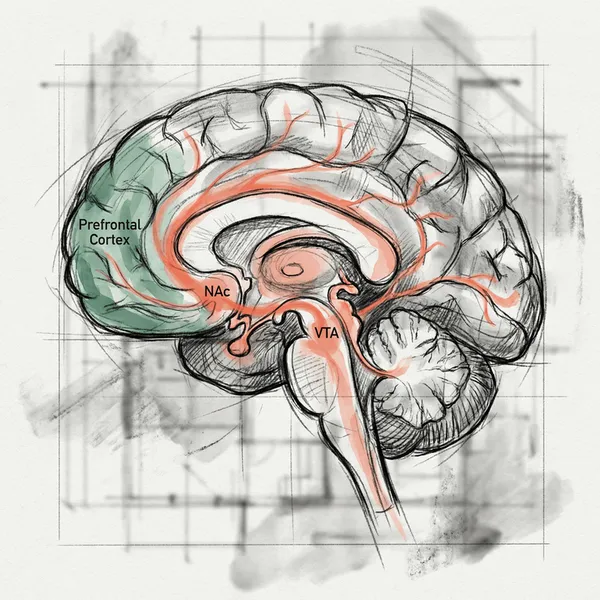
DOPAMINE TOLERANCE. Variable rewards from social media stimulate the ventral striatum, the same region activated by gambling. With constant stimulation, your brain develops tolerance; you need more stimulation for the same effect.
This is why people report needing to scroll longer and faster to feel satisfied. Your dopamine system evolved for occasional surprises, like finding a berry bush on a walk. It was not built for a machine optimized to surprise you every 15 seconds.
PREFRONTAL DAMAGE. Your prefrontal cortex handles impulse control and rational decision-making. A 500-person study found that people who scrolled more than two hours daily showed a 35% drop in prefrontal impulse control over six months.
The nucleus accumbens reward signals literally overpower the prefrontal cortex’s ability to say “stop.” Teens face even more risk because their prefrontal cortex is still developing while their reward circuits already run at full power. The platforms don’t know or care about the age of the brain they reshape.
Gloria Mark, a professor at UC Irvine, has tracked attention spans for nearly two decades. Average attention on any screen has declined from 2.5 minutes to 47 seconds, and a 2026 large-scale study measured it at 43 seconds.
Workers now switch tasks 566 times per eight-hour workday, roughly once every 51 seconds. Sophie Leroy’s research on attention residue shows that each switch leaves cognitive debris that degrades the next task. You don’t just lose the time of the interruption; you lose quality on everything that follows.
DEFAULT MODE DISRUPTION. Your brain has a network called the Default Mode Network that activates during rest, self-reflection, and future planning. It handles your sense of identity, emotional regulation, and creative thinking.
Constant screen stimulation prevents the DMN from doing its job. If you never give your brain unstructured quiet time, you are running it without maintenance.
Ever skip system updates on a computer for months? Eventually, performance degrades. Same principle.
TAKING YOUR BRAIN BACK
Here is the good news, and we covered this in the neuroplasticity article: your brain rewires itself. The same mechanism that makes you vulnerable to these systems also means you can recover.
The practical steps are simple, even if they’re not easy. Turn off non-essential notifications. Set screen time limits on specific apps. Use grayscale mode; color is a variable reward trigger.
Replace infinite scroll breaks with defined-length alternatives like reading a single article or listening to a podcast episode. Schedule blocks of unstructured time with no screens. Even 20 minutes helps the Default Mode Network recover.
My honest take: I don’t think most people will do these things consistently. The systems are too good at what they do, and willpower alone is not enough. But understanding the mechanisms is the first step.
When you feel the pull to check your phone for no reason, you can now name what is happening. That awareness creates a gap between stimulus and response, and in that gap, you get to choose.
82% of Gen Z believe they are addicted to social media. They know it, and they still can’t stop. That tells you everything about how powerful these systems have become.
This is not a personal failing. This is industrial-scale behavior engineering meeting a brain that evolved for a completely different environment.
T.
References
-
Engagement, User Satisfaction, and the Amplification of Divisive Content on Social Media - Pre-registered 2025 study showing Twitter/X algorithm amplifies anger by +0.47 SD, with political anger at +0.75 SD.
-
Modern Day High: Neurocognitive Impact of Social Media on the Brain - Comprehensive review of social media’s effects on dopamine pathways, prefrontal cortex function, and impulse control.
-
Dopamine-scrolling: A Modern Public Health Challenge (Sharpe & Spooner, 2025) - Peer-reviewed analysis of infinite scroll and variable reward mechanisms as public health concerns.
-
Gloria Mark: Attention Span - Two decades of empirical research documenting the decline from 2.5-minute to 47-second average attention spans.
-
Sophie Leroy: Why Is It So Hard to Do My Work? - Foundational 2009 paper on attention residue and the cognitive cost of task switching.
-
YouTube Recommendations Reinforce Negative Emotions (2025) - Research showing YouTube’s recommendation engine pushes users toward negative emotional content.
-
Neurobiology of Internet Addiction: Scoping Review (Frontiers, 2026) - Review of structural brain changes associated with internet and social media overuse.