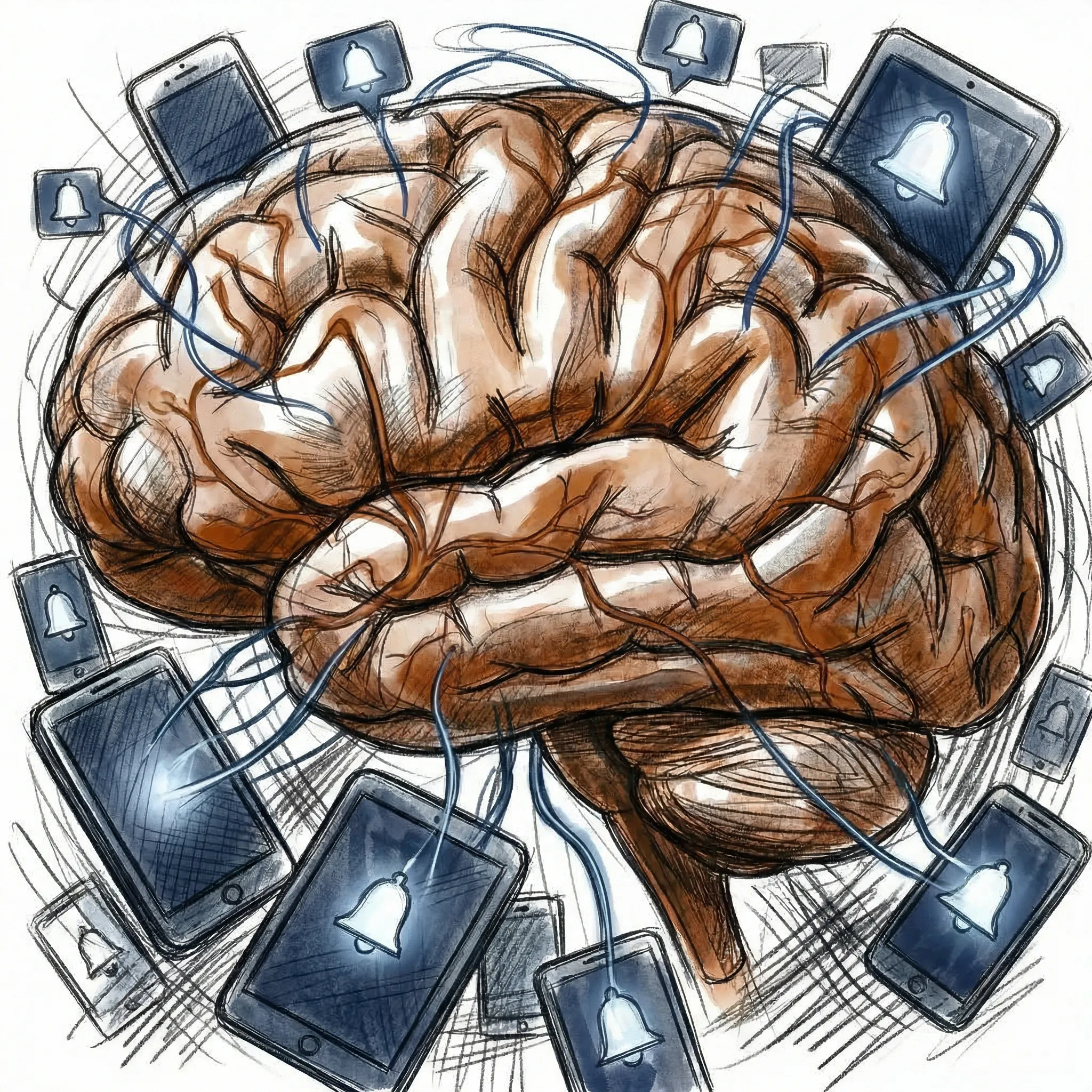
You check your phone. Again. You weren’t planning to. You just did.
If this happens dozens of times a day, you’re not weak-willed. Social media algorithms exploit how your brain works, and they’re winning because most people don’t understand the rules of the game.
I used to think understanding neuroscience was for researchers and doctors. It’s not. It’s practical self-defense.
YOUR BRAIN AS AN OPERATING SYSTEM
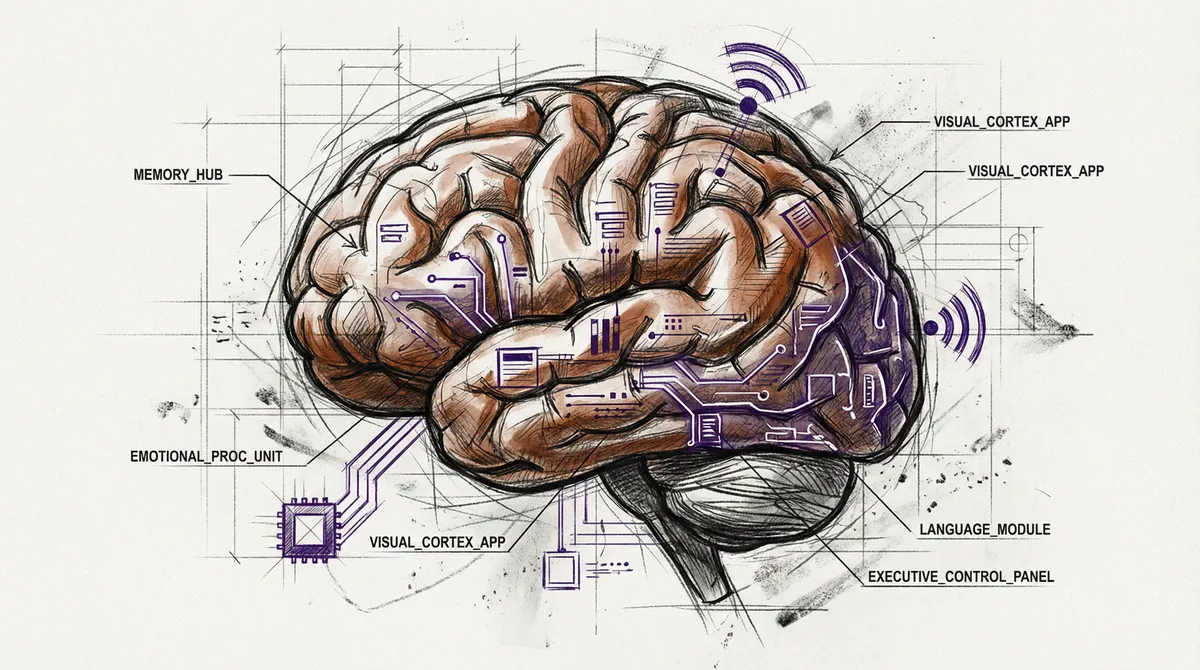
Think of your brain like a computer’s operating system. You have hardware (86 billion neurons, specialized brain regions) running adaptive software (neural pathways, learned patterns) that continuously updates itself based on what you do.
Here’s where it gets interesting. Your brain ships with preset conditions, like an OS that boots up before any applications load. New research shows electrical activity begins before external experience shapes it. You’re running Brain OS from day one.
The software layer is where things change. Every action you repeat, every thought pattern you practice, physically rewires the connections. Neuroscientists call this neuroplasticity. I call it your brain optimizing for whatever you expose it to most.
If you spend three hours a day scrolling social media, your brain wires itself for distraction and dopamine-seeking. If you practice deep focus, it wires itself for concentration. The hardware adapts to the software you run.
WHY ALGORITHMS TARGET YOUR OS
I always thought dopamine was about pleasure. Turns out it’s about prediction.
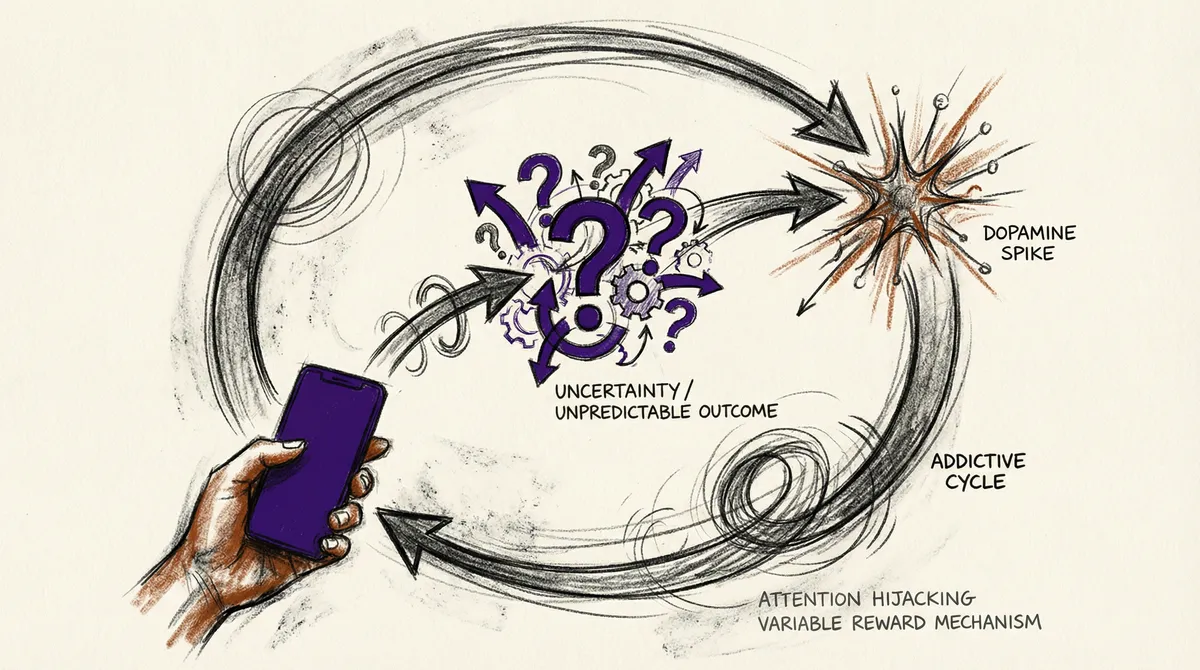
Your brain releases dopamine not when you get a like but when you’re uncertain whether you’ll get one. This is the same mechanism as slot machines. Pull the lever, uncertain outcome, dopamine spike. Refresh your feed, uncertain what you’ll see, dopamine spike.
Social media algorithms use variable reward schedules to hack this system. Infinite scroll removes natural stopping points. Pull-to-refresh creates the slot machine effect. Autoplay eliminates decision points.
These aren’t bugs; they’re features created by attention engineers who understand your dopamine system better than you do.
The numbers are stark. Among 18-to-22-year-olds, 40% self-report addiction symptoms.
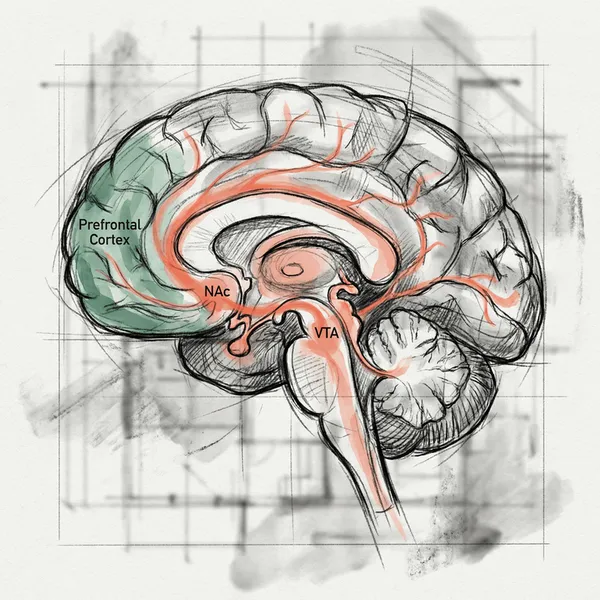
Heavy social media users (more than two hours per day) show a 35% drop in prefrontal impulse control. That’s the brain region handling rational decision-making.
When your prefrontal cortex gets overwhelmed, your amygdala takes over. The amygdala handles emotional reactivity and threat detection. This is why you make worse decisions when stressed or tired.
It’s also why many digital platforms try to keep you in heightened emotional states. Angry, anxious people click more.
THE COMPONENTS YOU NEED TO KNOW
You don’t need a neuroscience degree to defend yourself. You need to understand three core components.
NEURONS AND SYNAPSES. You have 86 billion neurons, each connected to thousands of others through gaps called synapses (20–40 nanometers wide). When you repeat an action or thought, those synaptic connections strengthen.
Donald Hebb’s principle: “Neurons that fire together, wire together.” This is the physical basis of habits.
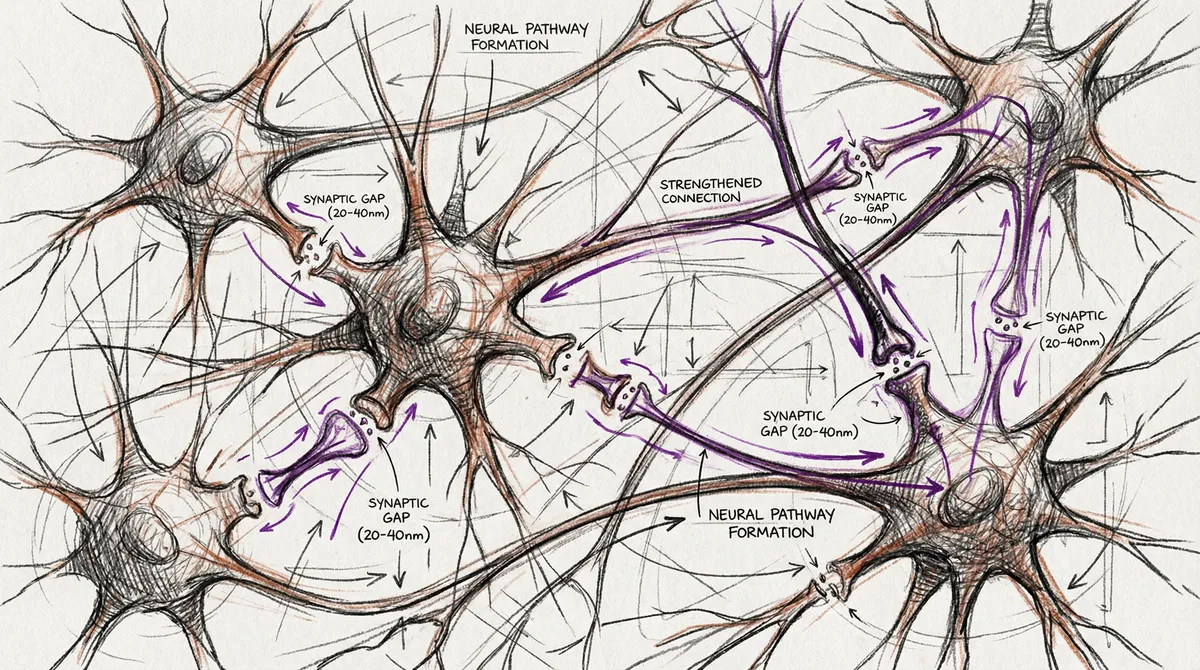
Breaking a bad habit requires building new neural pathways while weakening old ones. It’s not about willpower. It’s about understanding that your brain is literally rewiring based on repetition.
THE DOPAMINE SYSTEM. Dopamine isn’t the pleasure chemical. It’s the prediction error chemical.
When something better than expected happens, dopamine spikes. When something worse than expected happens, it drops. Social media exploits this by making outcomes unpredictable.
Variable rewards form habits four times faster than predictable ones. Every time you check your phone just in case something interesting happened, you’re training your dopamine system to expect uncertainty. The uncertainty itself becomes the reward.
NEUROPLASTICITY. Your brain isn’t fixed hardware. It’s adaptive software that rewrites itself constantly. This is your greatest asset and your greatest vulnerability.
Chronic stress reshapes your brain’s structure in maladaptive ways. Sustained focus reshapes it for concentration.
The brain doesn’t judge whether changes are good or bad. It optimizes for whatever you do most frequently.
In the age of constant connectivity, this matters more than ever. Your environment is specifically engineered to capture attention. If you don’t actively choose what to optimize for, algorithms will choose for you.
THE USER MANUAL YOU NEVER GOT
Understanding your brain isn’t academic. It’s practical.
When you know that dopamine responds to uncertainty, you can recognize when platforms manipulate that system. When you understand that your prefrontal cortex gets overwhelmed by stress and multitasking, you can create environments that support better decisions.
When you know that neuroplasticity means your brain physically changes based on what you practice, you can be intentional about what you practice.
The brain-as-OS metaphor isn’t perfect. Brains don’t literally rewire like electrical circuits. But the analogy captures something important: you’re running a system that can be influenced, optimized, or exploited depending on who understands it better.
Right now, the attention economy understands your brain better than you do. Platforms employ neuroscientists and behavioral psychologists to design interfaces that maximize engagement. They A/B test thousands of variations to find what keeps you scrolling longest.
You don’t need to become a neuroscientist to level the playing field. You just need to understand the basics of your own operating system.
That’s what this series is about. Not abstract theory, but practical knowledge you can use to recognize manipulation, make better decisions under pressure, and build a brain optimized for what you actually value instead of what algorithms profit from.
WHAT’S COMING
This is the roadmap. Over the next ten weeks, we’ll cover the components in depth.
THE FOUNDATIONS. We’ll start with how your brain actually works at the physical level. You’ll learn how 86 billion neurons communicate through synapses to create every thought you have.
You’ll understand the path from sensation to decision, and why that process is vulnerable to manipulation.
THE MECHANISMS. We’ll examine the systems that drive behavior. Memory: why you remember childhood but forget yesterday. Dopamine: the prediction chemical that controls motivation and addiction.
The stress response: what happens when your brain detects danger and gets stuck there.
THE MODERN THREATS. We’ll look at how digital environments exploit these systems. Social media and AI don’t just distract you. They hijack your dopamine pathways and keep your brain in fight-or-flight mode.
The stress epidemic isn’t a personal failing. It’s a predictable outcome of brains optimized for one environment running in another.
THE SOLUTIONS. We’ll end with neuroplasticity and recovery. Your brain can rebuild neural pathways at any age. You’ll learn what science says about taking your brain offline, and why nature and silence aren’t luxuries but requirements for cognitive health.
Understanding your brain isn’t optional anymore. It’s self-defense.
T.