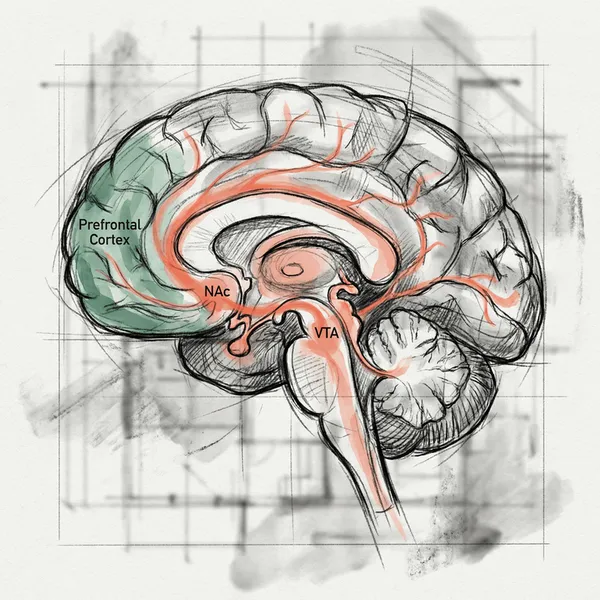
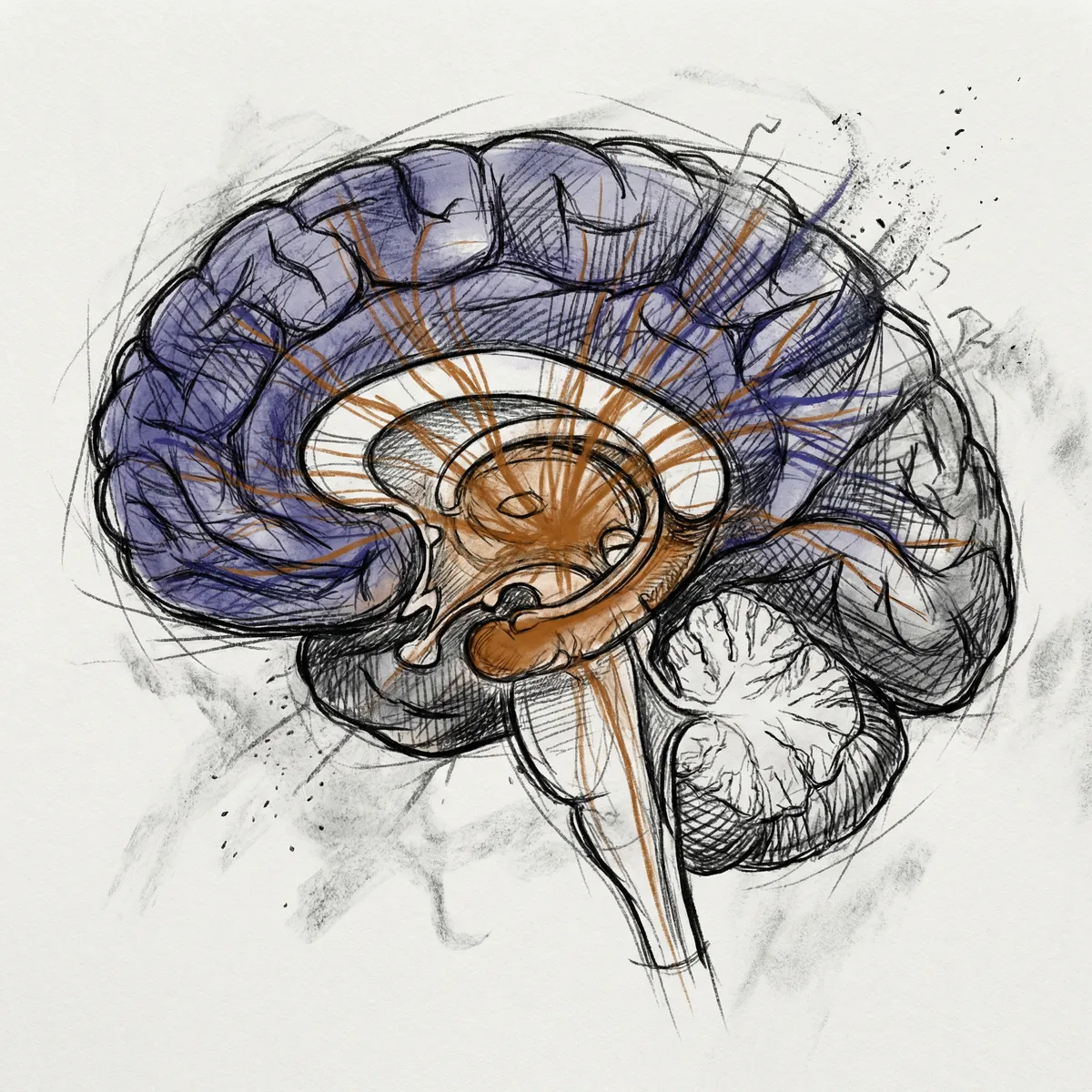
In the last article, I promised we would start with how your brain works at the physical level. I underestimated how strange the answer would be.
Your brain runs on electricity and chemicals. Not metaphorically.
Right now, billions of electrical spikes race through your skull at speeds ranging from walking pace to a Formula 1 car. Between each spike, molecules float across gaps so small that 50,000 of them would fit across the width of a human hair.
THE CELLS THAT THINK
You have 86 billion neurons. Not 100 billion, the number in most popular science books. That figure circulated for decades without anyone checking.
In 2009, Suzana Herculano-Houzel actually counted them. Her paper got rejected by four journals before publication.
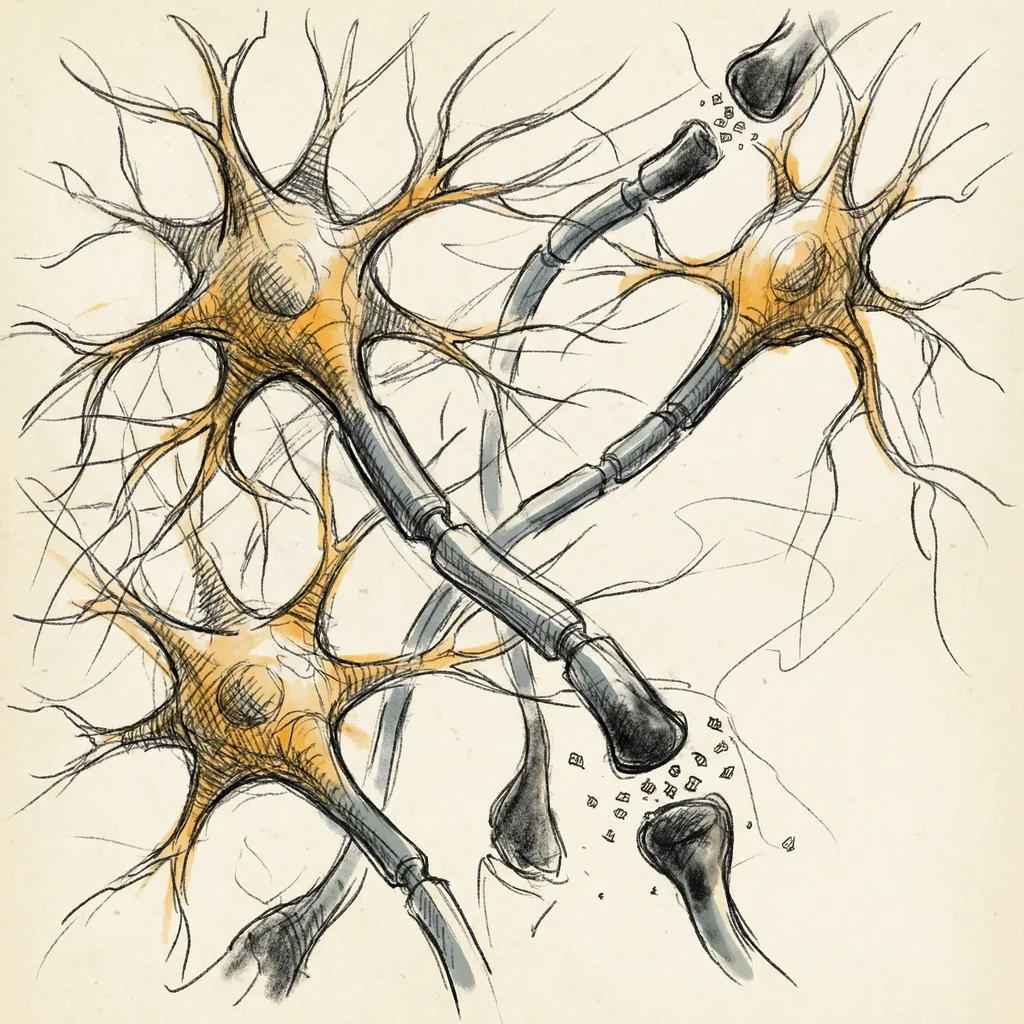
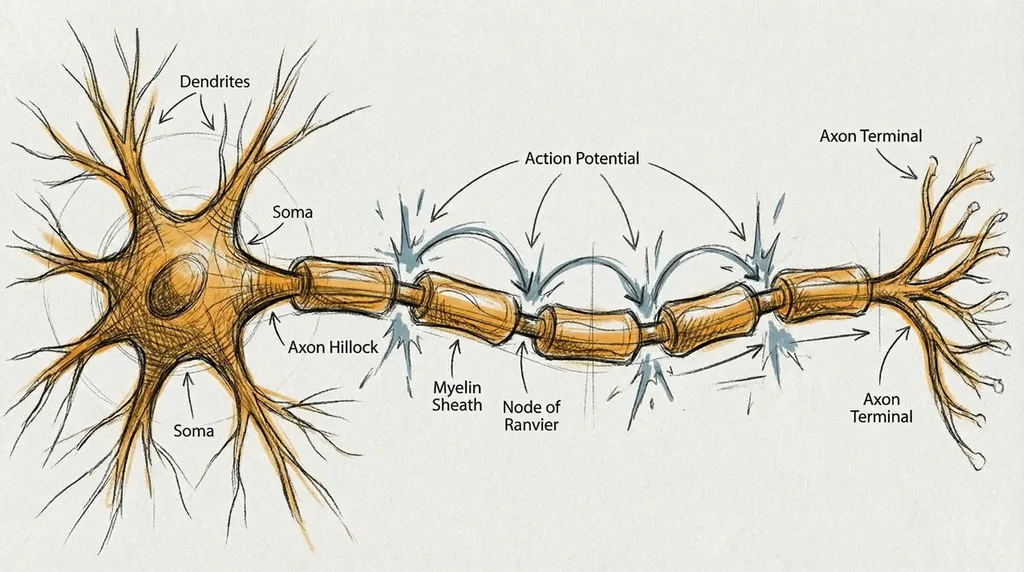
Each neuron has dendrites branching out like tree roots to collect signals, a cell body that processes everything, and an axon carrying the output to its targets.
Some axons stretch over 1.5 meters, like the sensory neurons running from your toes to your spinal cord. In a blue whale, the longest exceed 25 meters. These are likely the longest cells in nature.
THE ELECTRICAL SPIKE
Here is something I did not expect: the inside of your neurons is electrically negative. At rest, a neuron sits at about negative 70 millivolts, a charged battery on a shelf storing energy it is not currently using.
When enough incoming signals push past a threshold, sodium channels snap open and ions flood in. The voltage swings from negative 70 to positive 30 millivolts in about one millisecond.
This is the action potential. It is all or nothing, the same way lighting a fuse works: touch it and it burns all the way regardless of how big your flame was.
The brain encodes information through firing frequency, not spike size.
THE SPEED OF THOUGHT
Not all signals travel equally fast. Motor neurons wrapped in fatty myelin carry signals at 80 to 120 meters per second, roughly 270 miles per hour.
Think of express train service: the signal jumps from gap to gap in the myelin, skipping the insulated stretches entirely.
The small fibers carrying dull pain travel at just 0.5 to 2 meters per second, barely faster than walking. It is why you feel sharp pain first and a slower wave of throbbing arrives moments later.
If you flicked a blue whale’s tail, the sensory signal could take over six seconds to reach its brain. The whale might start swimming before it consciously knows why.
THE GAP
The signal races down the axon. Then it hits a problem.
Neurons do not touch each other. Between them sits a 20-nanometer gap, roughly one five-thousandth the width of a human hair.
So the brain switches languages. Electricity becomes chemistry.
The arriving signal triggers vesicles to spill neurotransmitter molecules into the gap. These drift across and lock onto receptors on the other side, the same way keys fit into locks.
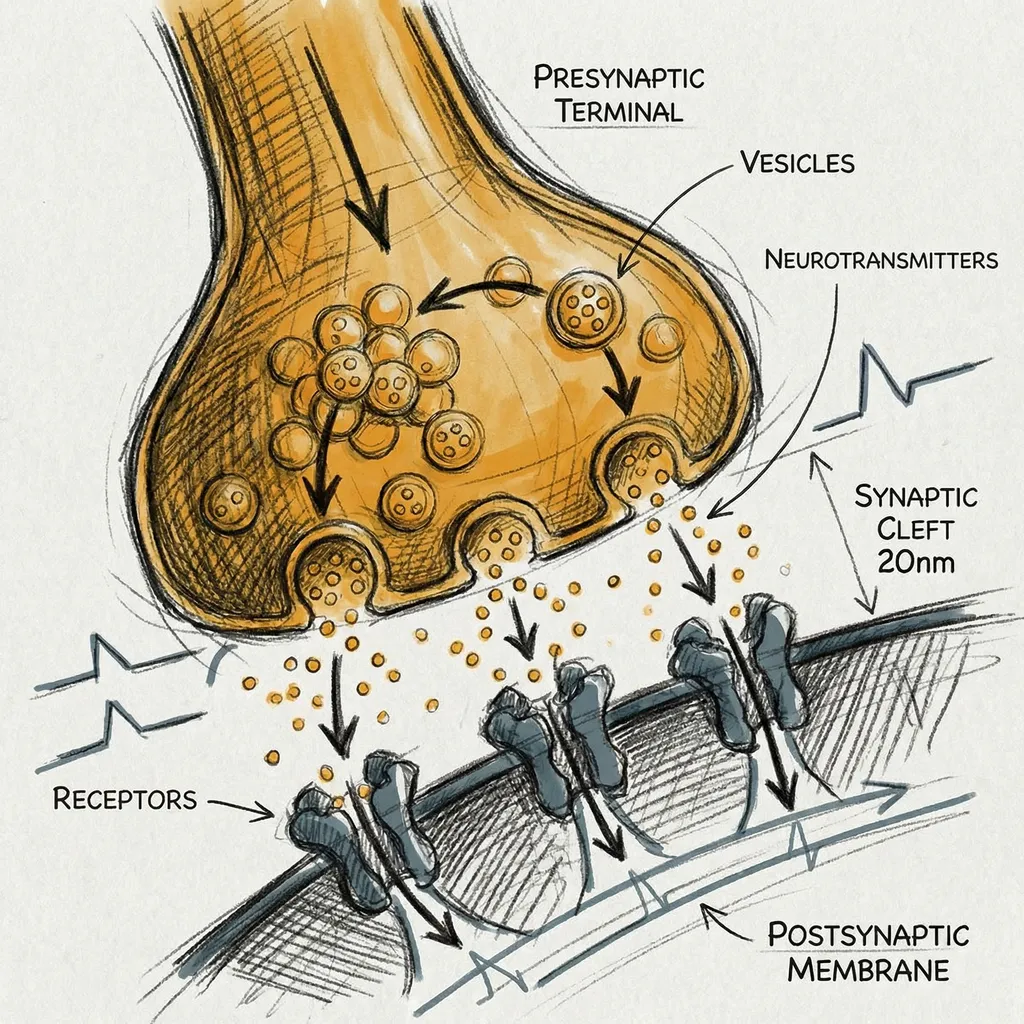
Excitatory signals push the receiving neuron toward firing. Inhibitory signals push it away. The neuron tallies thousands of competing votes simultaneously, a molecular town hall where everyone shouts at once.
My favorite detail: GABA, the brain’s main brake, is literally synthesized from glutamate, the brain’s main accelerator.
THE CHEMICAL MESSENGERS
Your brain uses dozens of neurotransmitters. Three deserve special attention.
DOPAMINE is not what you think. Wolfram Schultz monitored dopamine neurons in monkeys during the 1990s.
Unexpected reward: spike. Predicted reward: silence. Expected reward withheld: drop below baseline. It is a prediction error signal, the same math that drives reinforcement learning in AI.
SEROTONIN mostly lives in your gut, with 90 to 95 percent coming from intestinal cells. The popular low serotonin causes depression model took a hit from a 2022 review finding no consistent evidence for it.
Otto Loewi discovered ACETYLCHOLINE through a dream. He woke at 3 AM in 1921, connected two frog hearts, and proved chemical messengers carry neural signals. In Alzheimer’s, 70 to 80 percent of these neurons disappear, like an orchestra losing its conductor one musician at a time.
HOW CONNECTIONS LEARN
Neurons that fire together, wire together. Everyone attributes this to Donald Hebb. Carla Shatz coined it.
What Hebb actually wrote in 1949 was more precise: when neuron A repeatedly helps fire neuron B, the connection strengthens. Causation, not correlation.
The timing window is razor-thin. Fire 10 milliseconds before: strengthens. Fire 10 milliseconds after: weakens.
The mechanism involves calcium flooding through NMDA receptors and triggering physical changes. Dendritic spines swell by 200 to 390 percent within five minutes, a footpath widening into a road from heavy use.
The same calcium at lower doses weakens connections. Same ion, opposite outcomes. I find this astonishing.
ONE NEURON IS NOT ONE SWITCH
Ever seen a diagram of an artificial neural network? Simple nodes, weighted connections, activation functions.
In 2021, researchers tried replicating a single biological neuron with an artificial one. They expected three or four layers. It took 5 to 8 layers and roughly 1,000 artificial nodes, like discovering a pocket calculator is actually a smartphone.
Your brain runs all 86 billion of these on about 20 watts, the same as a dim LED bulb. Training GPT-4 consumed an estimated 50 gigawatt-hours.
Neurons fire 1 to 200 times per second while transistors switch billions of times per second, yet you recognize a face in 150 milliseconds. Massive parallelism compensates for slow parts.
WHAT THIS MEANS FOR YOU
Every habit is a set of synaptic connections that strengthened through repetition. What you pay attention to determines which connections grow and which weaken. This is not a metaphor.
When you scroll social media, you run a training algorithm on your own synapses. Dopamine prediction errors fire, NMDA gates open, and distraction-encoding connections grow stronger.
The same mechanism works in reverse with deliberate practice. Your synapses do not care whether they are building a useful skill or a destructive habit.
Next time, we trace what happens after neurons fire and signals cross synapses. How does the brain turn raw sensation into decisions? That path from photons hitting your retina to recognizing a face is full of vulnerabilities the attention economy knows how to exploit.
Understanding the hardware is step one. Understanding the software is step two.
T.
References
- Azevedo et al 2009 - Neuron count
- Beniaguev et al 2021 - Single neuron complexity
- Schultz 1998 - Dopamine prediction errors
- Bliss and Lomo 1973 - Long-term potentiation
- Melloni et al 2025 - Consciousness theories