In the last article, I traced how neurons fire and how synapses pass signals between them. I ended with a promise: next time, we would follow those signals forward. From photons hitting your retina to a face you recognize, from a sound you hear to a choice you make.
I said this path has vulnerabilities the attention economy knows how to exploit. I meant it.
Let me start with something you have probably experienced. You are driving a familiar route and you arrive without remembering most of the drive. Your hands steered, your foot braked, your eyes tracked the cars ahead. You did it all correctly.
But you were not there, not in the way you usually mean when you say “you.” The part that narrates your experience was off somewhere else. Your brain handled it without you.
This is not a malfunction. It is the system working as intended.
THE INPUT PIPELINE
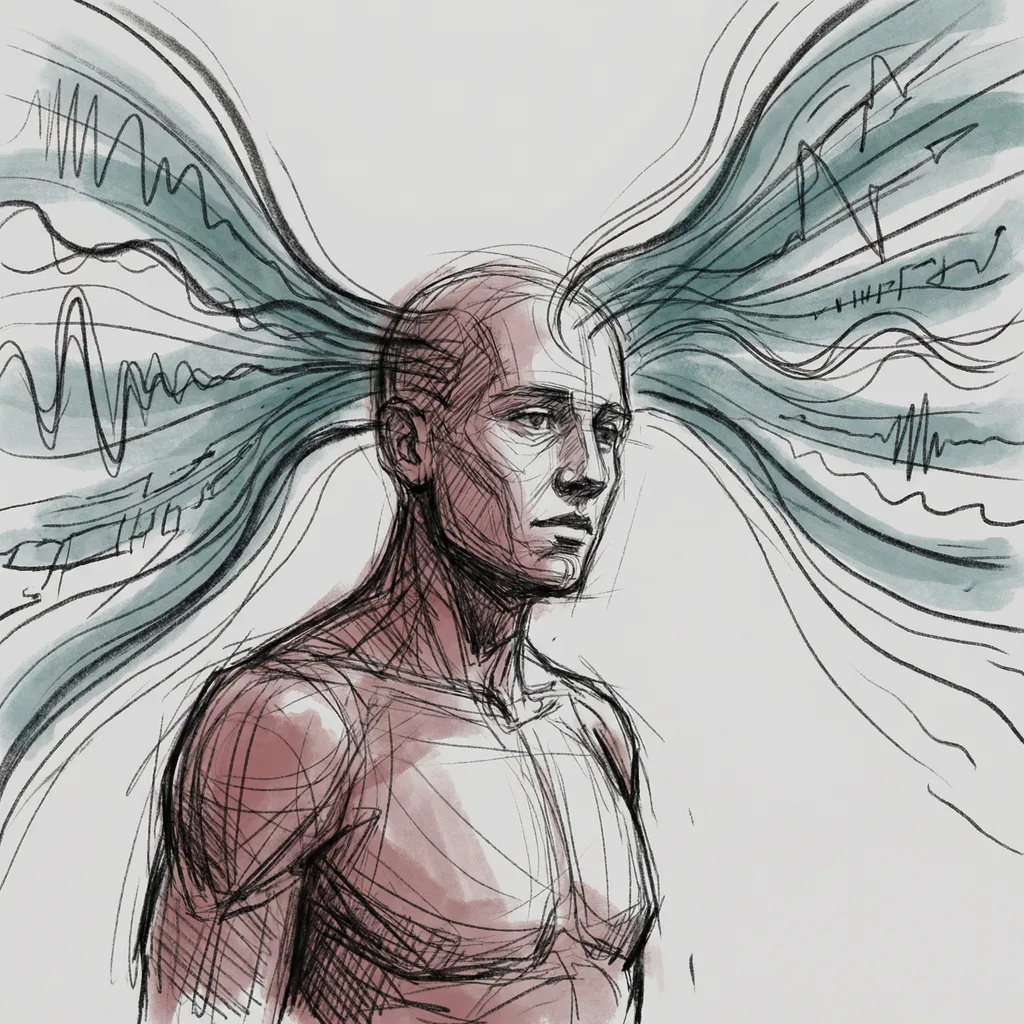
Your senses collect roughly 11 million bits of information every second. Your visual system accounts for about 10 million of those. Your skin, ears, nose, and taste buds share the remaining million between them.
Of all that, your conscious mind processes around 50 bits per second. Not 50 million, not 50 thousand. Fifty.
The gap between input and awareness is so large that filtering barely describes it. Your brain is discarding almost everything your senses detect, every moment of every day.
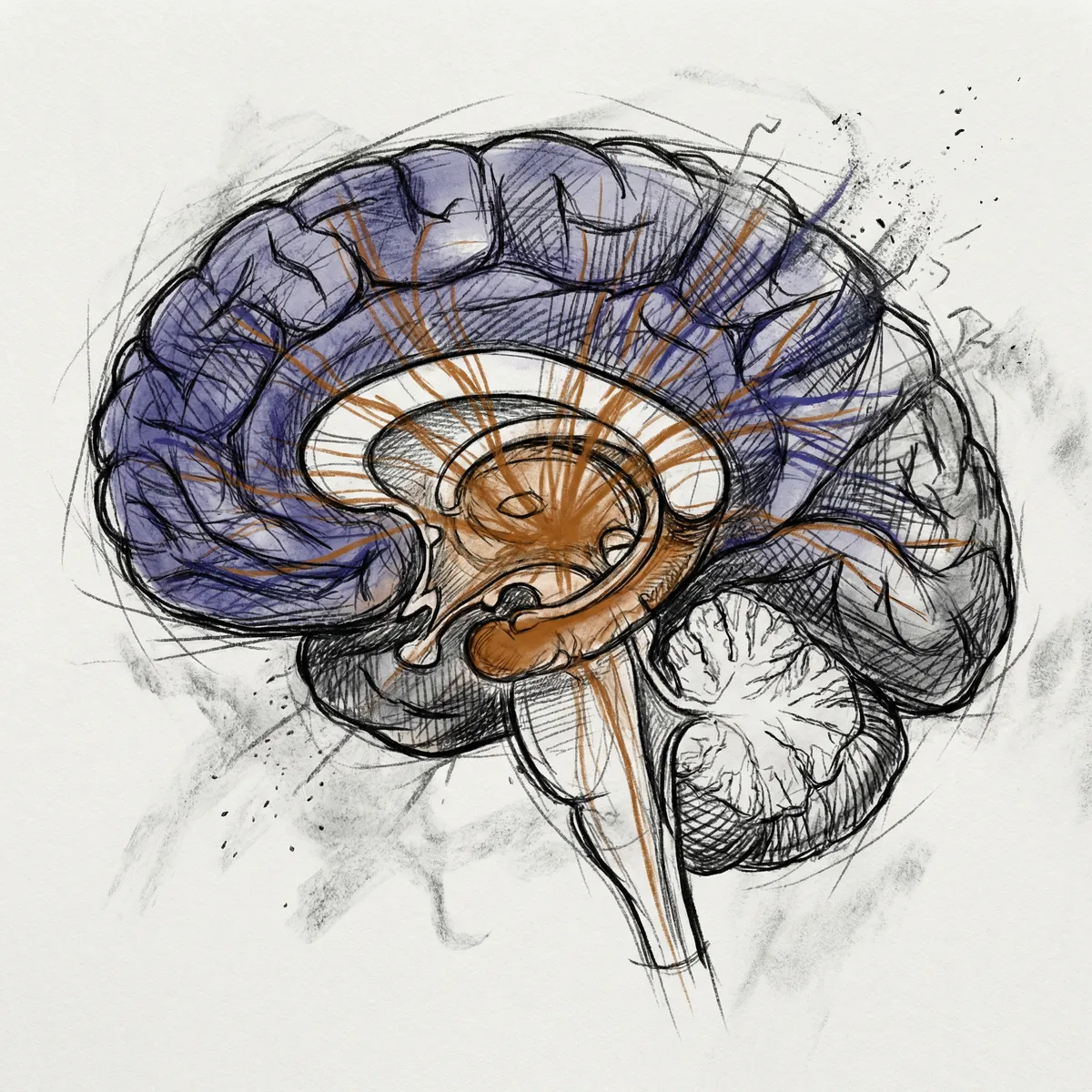
The thalamus, a small structure near the center of the brain, acts as the main relay for almost all sensory information on its way to the cortex. Think of it as a sorting office that reads every piece of incoming mail and decides what gets forwarded and what gets binned. Each sense has its own processing region in the cortex, and the thalamus routes signals to the right place, but it also decides how much of the signal gets through.
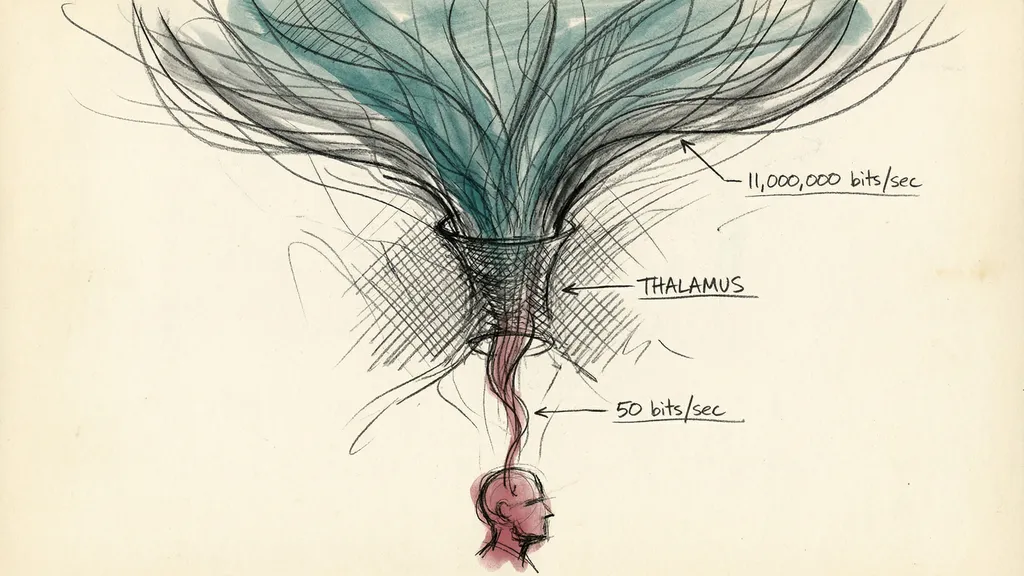
Why does your name cut through a noisy room when dozens of other words do not? Threat, novelty, expectation, and habit shape attention, and your name scores high on all four.
The feeling of your shoes on your feet right now did not exist in your awareness until I mentioned it. Your brain had the data the whole time. It just did not consider it worth forwarding.
PERCEPTION IS A GUESS
Here is the part that still surprises me every time I return to it. Signals traveling from the brain downward outnumber the signals traveling up from your eyes to your visual cortex, roughly 10 to 1. Honestly, I had to reread this the first time. It implies your brain is not reading the world, it is mostly narrating a story it already started writing.
Your brain does not wait for sensory input and then interpret it. It runs a constant internal model of the world and sends predictions downward through the hierarchy. What actually arrives from your senses is mostly correction, the gap between what the brain expected and what came in.
If predictions are accurate, the signal passing upward is small. If something unexpected happens, the mismatch signal is large, and the model updates.
Neuroscientists call this predictive coding. Karl Friston has spent years building a formal mathematical model of it, and it has grown into one of the more influential frameworks in modern neuroscience. The practical summary: you are not seeing the world.
You are seeing your brain’s best current model of the world, lightly edited by incoming data. Think of it like navigation software that mostly follows cached maps, only updating when it detects a road that no longer matches.
The consequences are stranger than they sound. Optical illusions work even after you know the trick because your high-level predictions override the low-level sensory data.
The famous photograph of a dress that looked white and gold to half the world and blue and black to the other half was not a disagreement about color. It was two different predictions about ambient lighting producing two different perceptual realities from identical photons. Neither group was wrong. They were both seeing what their brains had predicted.
Your experience of reality is personal in a neurological sense, not just a philosophical one.
THE DECISION
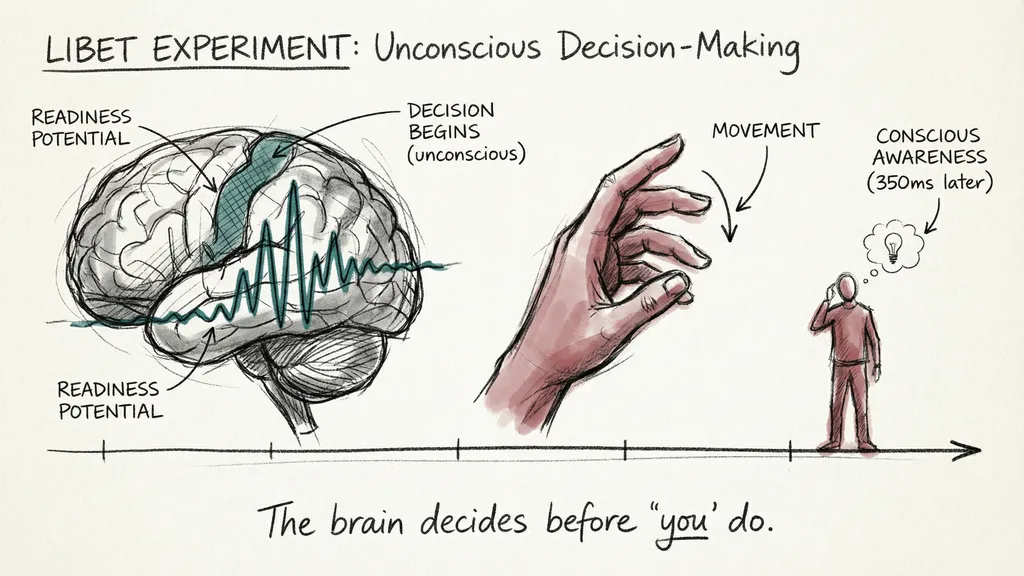
In 1983, Benjamin Libet ran a now-famous experiment. He asked subjects to flex their wrist whenever they felt like it, and to note the position of a clock hand at the exact moment they first felt the urge to move. He recorded their brain activity throughout the whole process.
Researchers have argued about the results ever since. The brain showed a measurable build-up of electrical activity, called the readiness potential, about 350 milliseconds before subjects reported feeling the urge.
The decision was already in progress before they were aware of deciding. Consciousness did not lead the action. It trailed it.
Researchers have refined and challenged Libet’s experiment many times. The timing varies in later studies, and the interpretation remains contested. But the basic direction of the finding has held across replications: the sense of consciously deciding comes after the underlying neural process is already underway.
What you experience as choosing may be closer to becoming aware of an ongoing process, with the option to stop it.
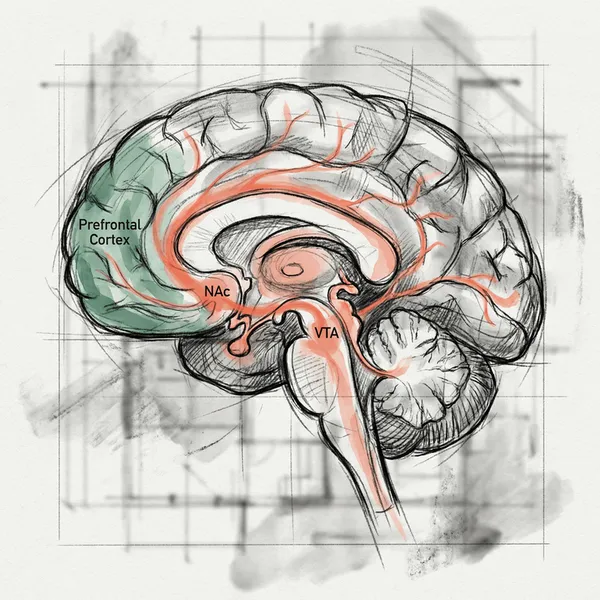
Two systems are at work here. Your limbic system, the older emotional brain, processes threat, reward, and social signals fast and mostly below conscious awareness. Your prefrontal cortex handles slower deliberate reasoning and can act as a brake or override.
Think of the limbic system as a reflex and the prefrontal cortex as a committee. The reflex moves first. The committee decides whether to veto. Most everyday decisions are already in motion before the committee even convenes.
Antonio Damasio studied patients with damage to the prefrontal cortex who had otherwise intact reasoning. They could analyze situations clearly, argue positions logically, and understand consequences. They could not make decisions.
Without emotional signals from the body feeding into the system, rational deliberation stalled completely. A patient who could not feel could not choose what to eat for lunch.
The idea that good decisions come from suppressing emotion is almost certainly wrong. Emotion is not noise interfering with the signal. In most cases, emotion is the signal.
WHAT THIS MEANS
The gap between 11 million bits and 50 bits is where the attention economy operates.
Every notification, autoplay queue, and algorithmically selected headline targets the same signals your nervous system prioritizes: movement in peripheral vision, potential social threat, unresolved questions, status signals, reward cues. Not because you are weak. Because evolution baked this wiring in hundreds of millions of years ago and no amount of deciding makes it stop.
The Libet gap is where habits live too. If you have ever resolved to stop checking your phone and found yourself mid-scroll before you consciously caught it, you experienced the readiness potential firing before your prefrontal cortex knew what was happening. The decision ran downstream of the pattern. What felt like intention was closer to witnessing.
I find this more clarifying than discouraging. Most of what feels like conscious thinking is actually post-hoc narration. The prefrontal cortex builds a story about a decision that was mostly made somewhere else, and presents it to you as if you authored it from the start.
Knowing that is not a reason to give up on deliberate thought. It is a reason to care more about what patterns you build, what environments you put yourself in, and what inputs you allow through the filter in the first place.
The hardware from the last article was the foundation. This is the software running on it.
Next article, we go into memory. What your brain actually stores, how it stores it, and why most of what you remember was at least partly reconstructed after the fact. Memory is not a recording. Understanding that changes how you think about learning, trauma, and confidence in your own past.
T.
References
- Libet et al, 1983 - Unconscious readiness potential precedes the reported urge to move by approximately 350ms
- Friston, 2010 - The free energy principle and predictive coding as a unified model of brain function
- Damasio, 1994 - Somatic marker hypothesis: emotion as an essential component of decision-making, not an obstacle to it
- Nørretranders, 1998 - The 11 million bits estimate and the bandwidth of conscious awareness
- Rees, Kreiman, Koch, 2002 - Neural correlates of consciousness and the relationship between attention and awareness