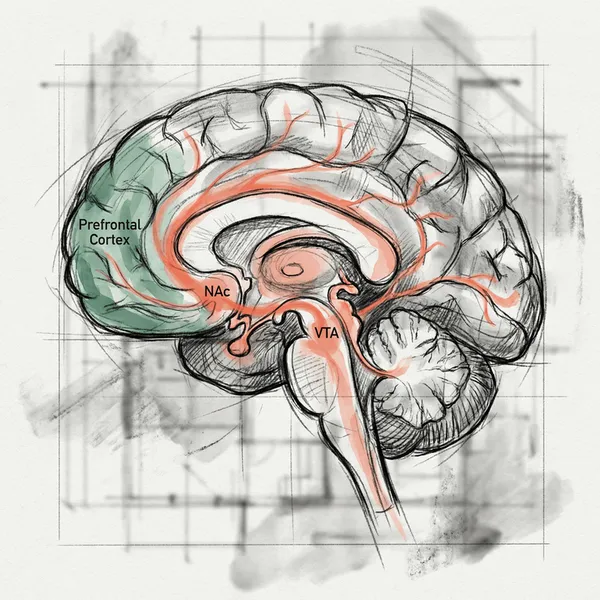
In the last article, I followed a signal from your senses to a decision. We saw how your brain filters 11 million bits per second down to about 50 that reach conscious awareness. But what happens after you become aware of something? How does that moment become a memory you can recall tomorrow, or next year, or decades later?
And why do you forget where you put your keys five minutes ago?
That question used to confuse me. I assumed forgetting was a failure, a broken file system.
Turns out, forgetting is a feature. Your brain is not a hard drive that writes everything to disk. It is a prediction machine that keeps what seems useful and discards the rest.
The problem is that modern life is breaking the system that decides what to keep.
HOW MEMORIES GET MADE
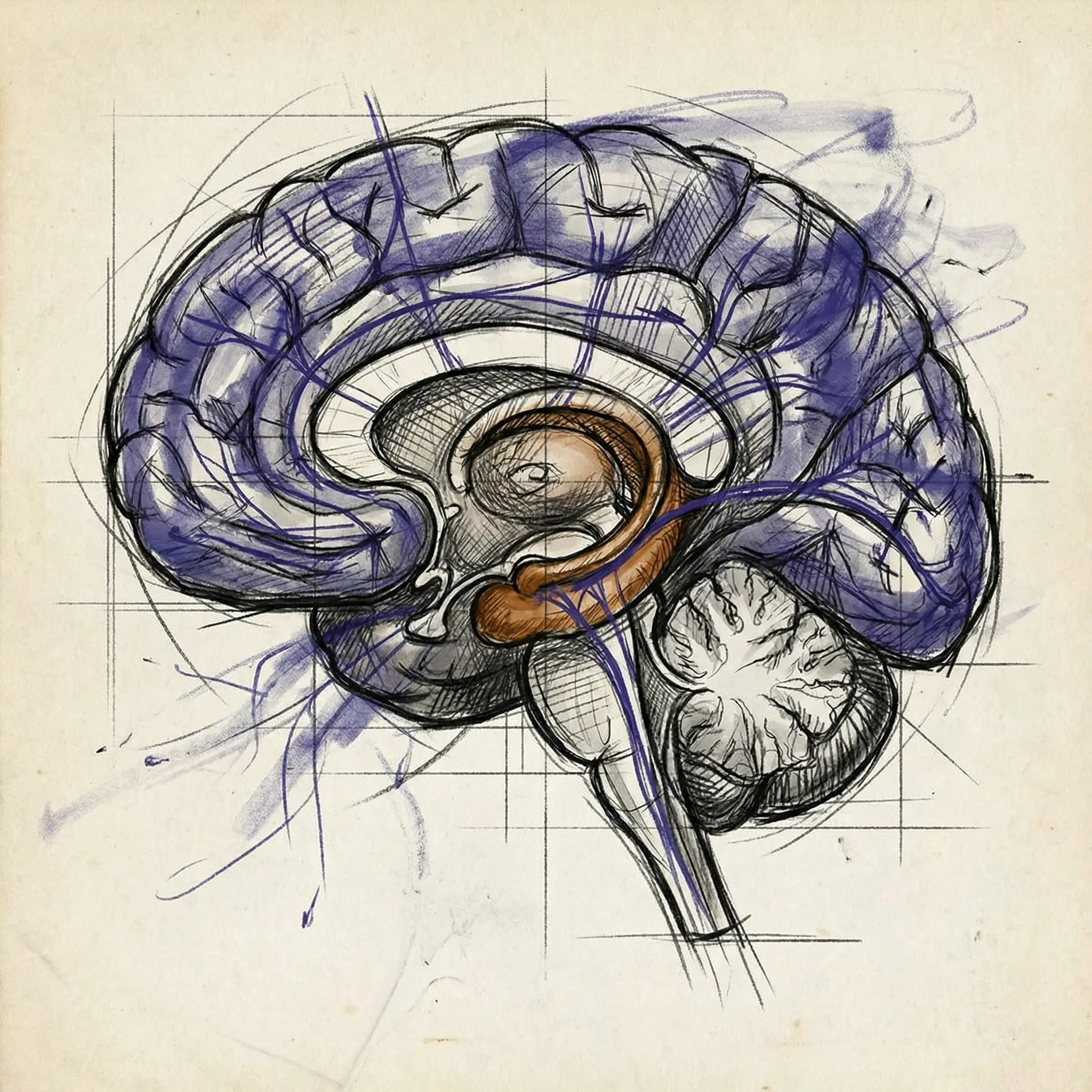
THE ENCODING PIPELINE. When something happens to you, your senses collect the raw data: visual details, sounds, emotions, physical sensations. These fragments get processed in different parts of your cortex, each region handling its own type of input.
So far, these are just signals. Not memories.
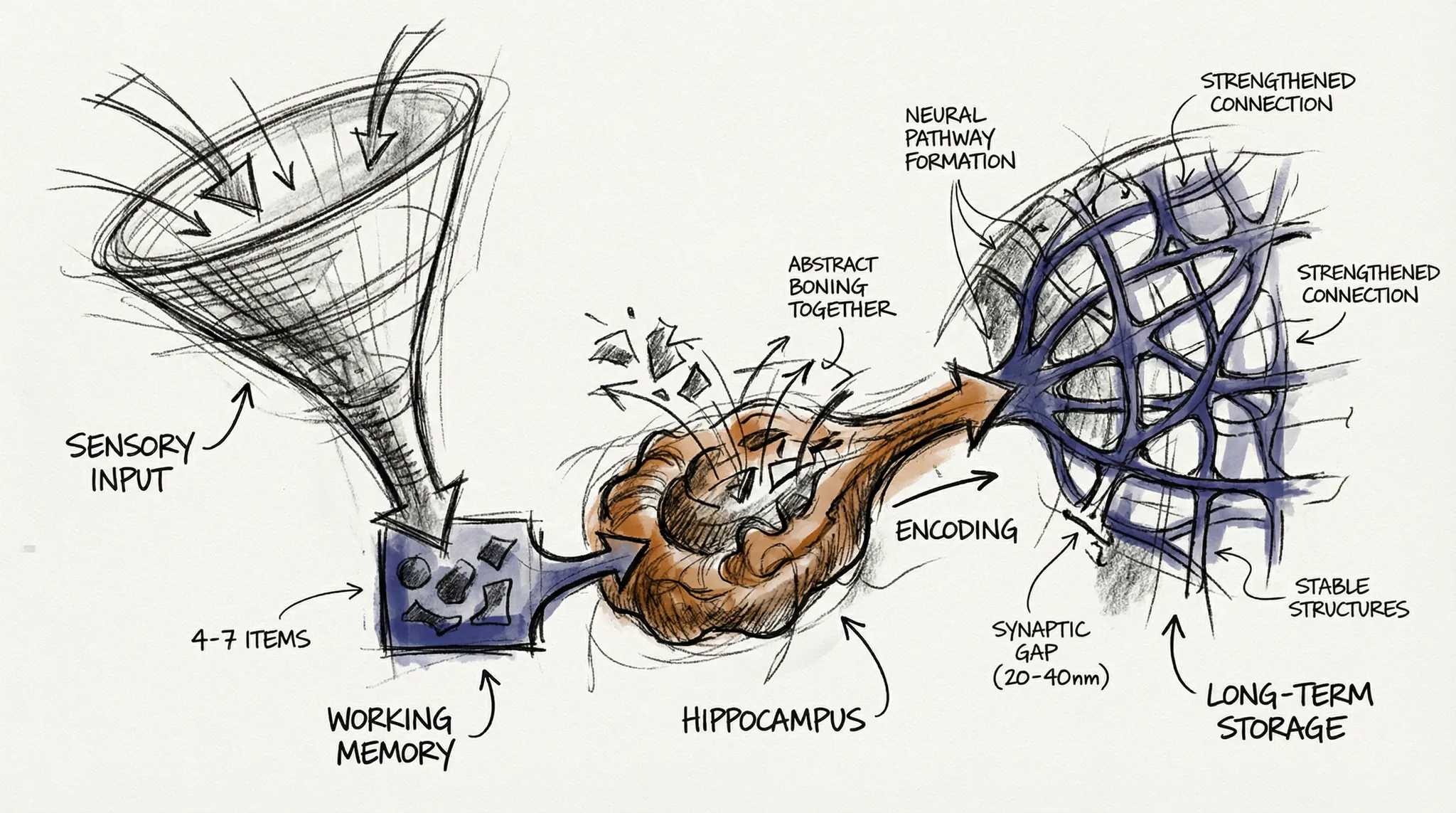
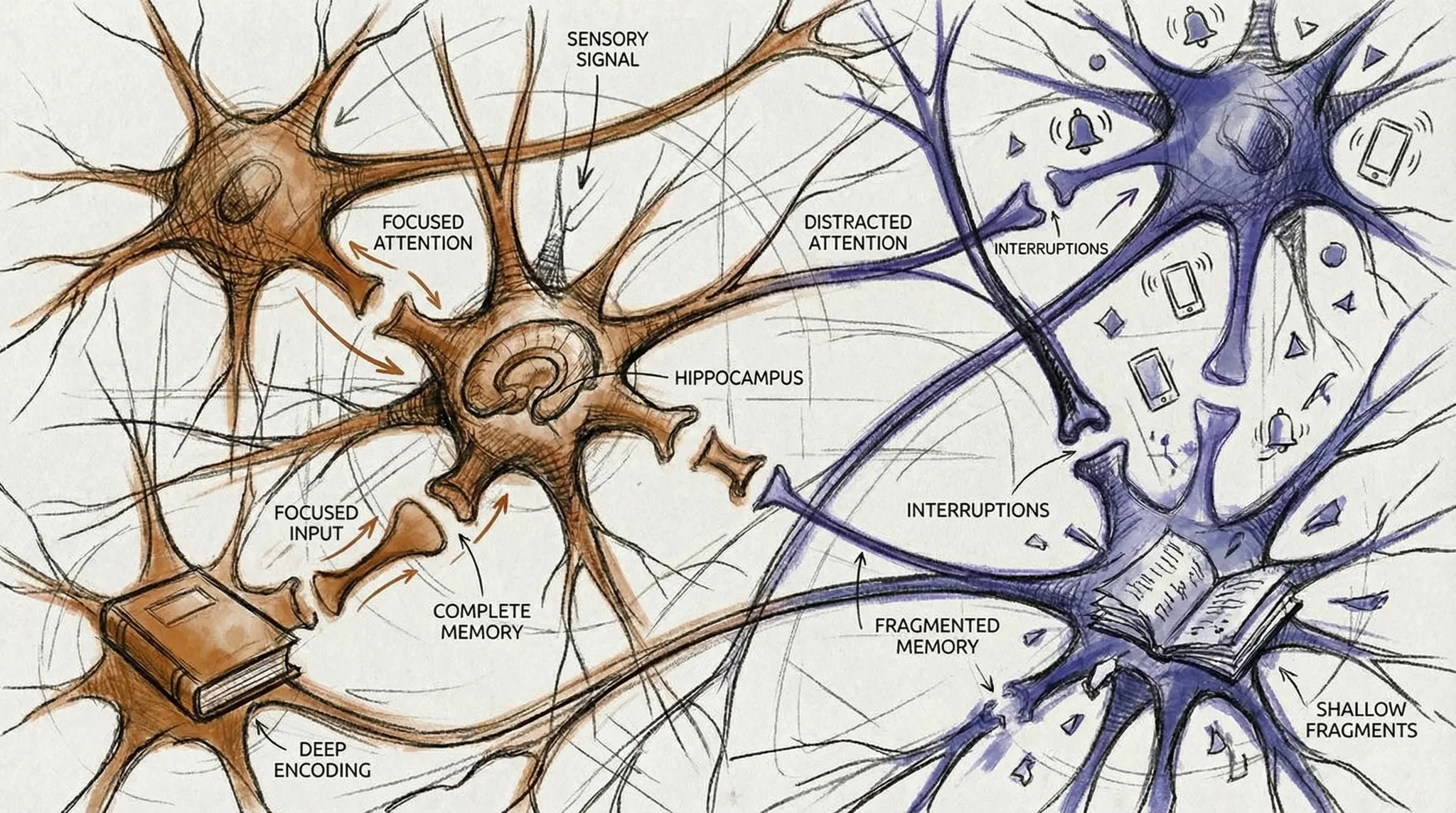
The pieces travel to the hippocampus, a small curved structure deep in your brain. Think of it as a librarian who takes scattered pages from different departments and binds them into a single book. The hippocampus links the fragments together into one coherent experience.
But here is the critical part: encoding requires attention. If you are half-watching a lecture while scrolling your phone, your hippocampus receives fragments with gaps. The book gets bound with missing pages. Later, when you try to recall that lecture, you get a partial, blurry version, if you get anything at all.
Deep processing, where you actually think about the meaning of what you learn, creates stronger memory traces than shallow processing, where you just skim the surface. This distinction matters more than most people realize.
THE THREE-STAGE SYSTEM
Your memory operates in stages. Sensory memory holds raw input for less than a second. Most of it vanishes before you notice it existed.
The small fraction that gets your attention moves into working memory, which holds roughly 4 to 7 items for about 20 to 30 seconds. Try remembering a phone number someone just told you. That ticking clock you feel? That is working memory draining.
For something to stick around longer, it needs to move into long-term memory through consolidation. This is where your brain physically changes. Synapses between neurons get strengthened and new proteins get synthesized. If encoding is writing a note on a whiteboard, consolidation is carving it into stone.
Sleep plays a huge role here. During deep sleep, your hippocampus replays the day’s experiences like a highlight reel. These replays, coordinated with slow brain waves and sleep spindles, gradually transfer memories from the hippocampus to the neocortex for long-term storage.
Skip the sleep, skip the consolidation.
Studies show that sleep deprivation before or after learning cuts memory performance significantly. It affects both your ability to encode new information and your ability to lock it down afterward.
Emotion matters too. When something scares you or excites you, your amygdala gets activated alongside your hippocampus. The amygdala acts like a priority stamp, telling the consolidation system: this one is important, store it well. This is why you remember your first car accident in vivid detail but not your commute last Tuesday.
WHY WE FORGET
Hermann Ebbinghaus ran an experiment on himself in the 1880s that still holds up. He memorized lists of nonsense syllables and tested his recall over time. The result was the forgetting curve: you lose roughly 50% of new information within an hour. After 24 hours, about 70% is gone.
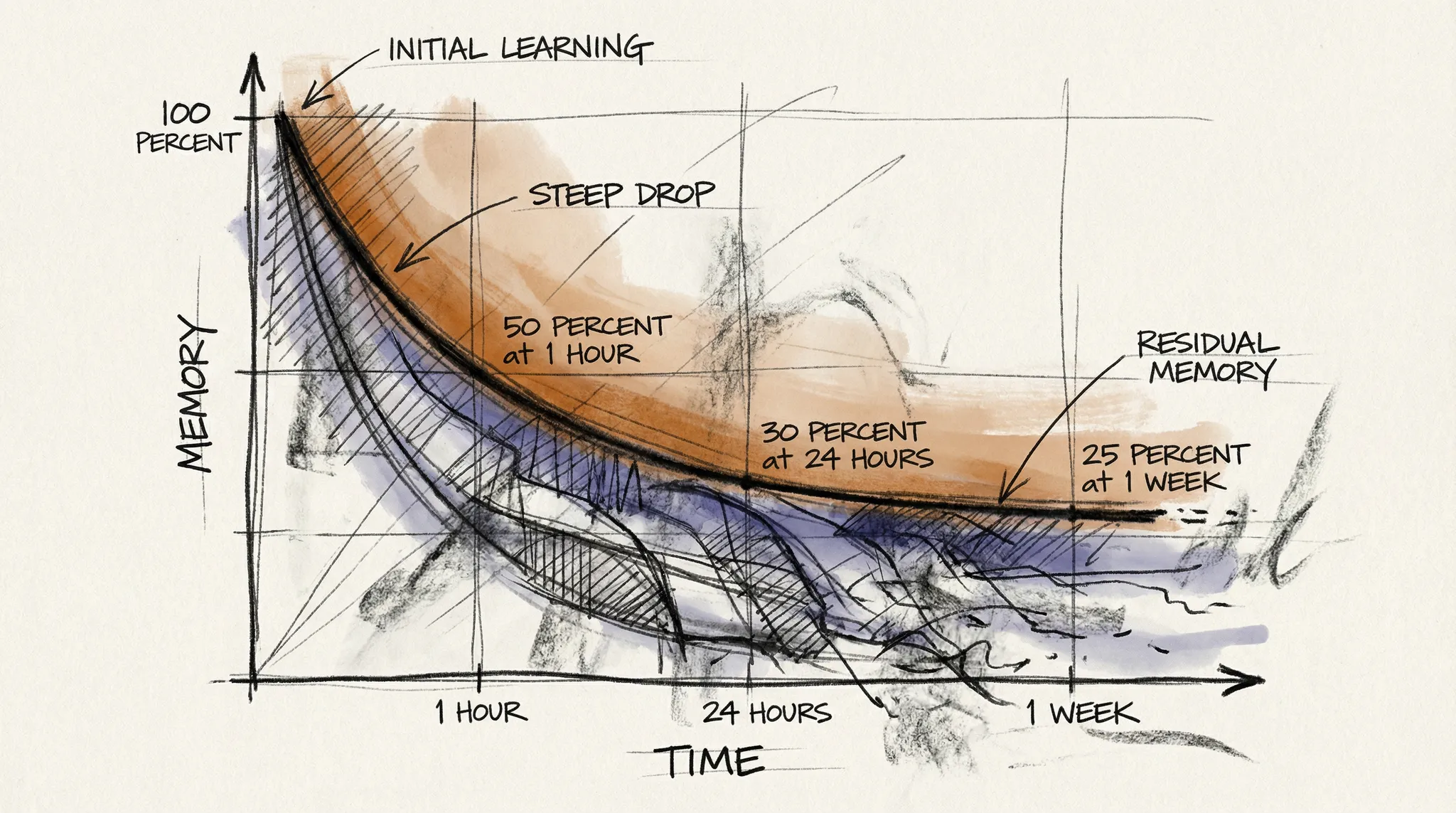
This sounds terrible. But your brain is not trying to record everything. It is trying to keep what matters.
Forgetting happens for multiple reasons. Decay is the simplest: memory traces weaken over time if they are not reinforced. But interference is probably more important in daily life. When you learn something new that is similar to something old, the two compete.
Old memories can block new ones (proactive interference), and new memories can overwrite old ones (retroactive interference). Ever learned a new phone number and suddenly could not remember the old one? That is retroactive interference at work.
Then there is retrieval failure. The memory exists in your brain, but you cannot find it, like a book in a library with no index entry. The right cue can bring it back instantly: a smell, a song, a location. This is why you walk into a room and forget why, but remember the moment you walk back to where you started.
THE DISTRACTION PROBLEM
Here is where modern life makes things worse.
Remember that encoding requires attention? Every notification on your phone is a small interruption to that process. Research on context switching shows it takes roughly 25 minutes to fully refocus after an interruption. If you get interrupted every few minutes, you never reach the deep processing state where strong memories form.
Betsy Sparrow and her colleagues at Columbia showed something unsettling in 2011. When people know they can look something up later, they do not bother encoding it in the first place. We remember where to find information rather than the information itself. They called it the Google effect.
I notice this in myself. I used to remember phone numbers, directions, recipes. Now I remember that the information is in my phone. My brain decided that remembering the location of the data is more efficient than remembering the data itself.
From an evolutionary standpoint, this makes sense. We have always used external memory, from cave paintings to books. But the scale is different now. When everything is a search away, your brain has less incentive to consolidate anything.
Combined with the constant stream of new information (social media feeds, news alerts, messages) your hippocampus is trying to bind thousands of fragments per day. Most of them are shallow, unconnected, emotionally neutral. They do not survive the forgetting curve.
WHAT ACTUALLY HELPS
The science is clear on this. Spaced repetition works. Instead of cramming information in one session, spreading it over multiple sessions with increasing gaps fights the forgetting curve directly. Each retrieval strengthens the memory trace and resets the decay clock.
Sleep is non-negotiable. Not just quantity but timing. The deep sleep stages in the first half of the night are critical for memory consolidation. Late-night scrolling does not just steal sleep hours, it fills your brain with shallow content right before the consolidation window.
Physical exercise increases a protein called BDNF in the hippocampus, which supports the growth of new neurons and strengthens synaptic connections. Regular exercise does not just protect your heart. It literally grows the part of your brain responsible for forming memories.
And attention might be the most important factor of all. A memory that never got properly encoded cannot be consolidated or retrieved. The first step of remembering is paying attention. That is exactly what the modern information environment works against.
The irony is not lost on me. We live in the age of infinite information and declining ability to remember any of it.
T.
References
-
Google Effects on Memory - Sparrow, Liu, and Wegner (2011) on how expecting to look things up later lowers recall of the information itself.
-
Replication of Ebbinghaus’ Forgetting Curve - Modern replication confirming exponential memory decay, with roughly half of learned material forgotten within an hour.
-
About Sleep’s Role in Memory - Review of how slow-wave sleep drives hippocampal-neocortical memory transfer and long-term consolidation.
-
Sleep Deprivation and Memory - Meta-analysis showing sleep loss impairs both encoding and consolidation across multiple memory types.
-
Amygdala-Hippocampal Interactions in Memory - How emotional arousal via the amygdala strengthens memory consolidation in the hippocampus.