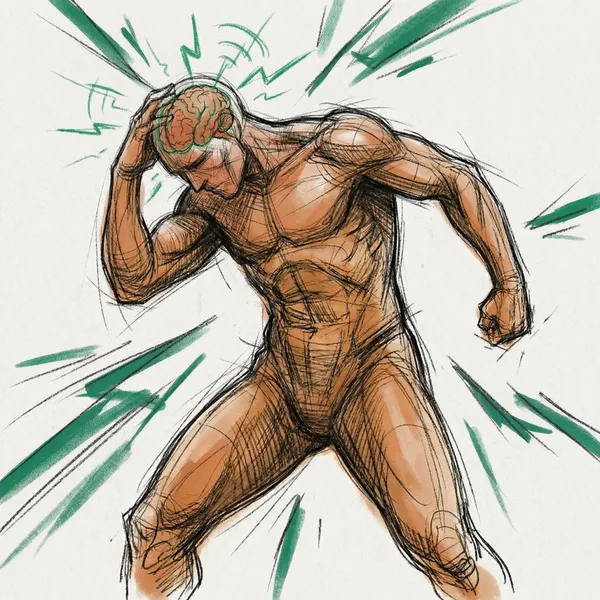
In the last article we talked about your stress response and how it fires over things that cannot kill you. Chronic stress shrinks your prefrontal cortex and makes your amygdala more reactive. That sounds like permanent damage.
But your brain is not a fixed machine. It changes its own structure every day, based on what you do with it. The same property that makes it vulnerable to stress also makes it capable of recovery.
Neuroscientists call this neuroplasticity. I think it is the most important concept in this entire series, because it means the brain you have right now is not the brain you are stuck with.
WHAT NEUROPLASTICITY ACTUALLY IS
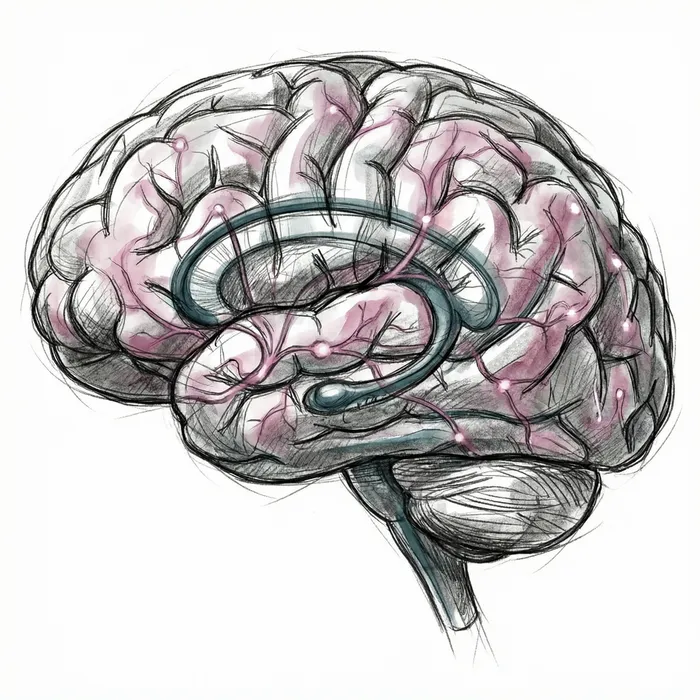
THE BASIC IDEA. Your brain contains roughly 86 billion neurons connected by trillions of synapses. These connections are not fixed like wires in a wall. They strengthen, weaken, form, and disappear based on how you use them.
Donald Hebb described this in 1949 with a principle that still holds up: neurons that fire together, wire together. When two neurons activate at the same time repeatedly, the connection between them gets stronger. Stop using that connection, and it fades.
Think of it like a dirt path through a field. Walk the same route every day and the path gets wider, easier to travel. Stop walking it and grass grows back. Your brain works the same way, except the paths are synaptic connections and the walking is repeated neural activity.
This is not a metaphor for something abstract. It is a physical, measurable process. Brain scans show actual structural changes in people who learn new skills, practice instruments, or even think differently about their problems over time.
HOW THE REWIRING WORKS
There are several mechanisms behind neuroplasticity, and they operate at different speeds.
SYNAPTIC PLASTICITY. This is the fastest type. When you learn something new, the synapses involved get temporarily stronger through a process called long-term potentiation. The neurons release more neurotransmitter, the receiving neuron becomes more sensitive, and the signal passes more easily.
The reverse process, long-term depression, weakens connections you stop using. Your brain runs both processes constantly, like a city that builds new roads to busy areas while letting abandoned ones crack and crumble.
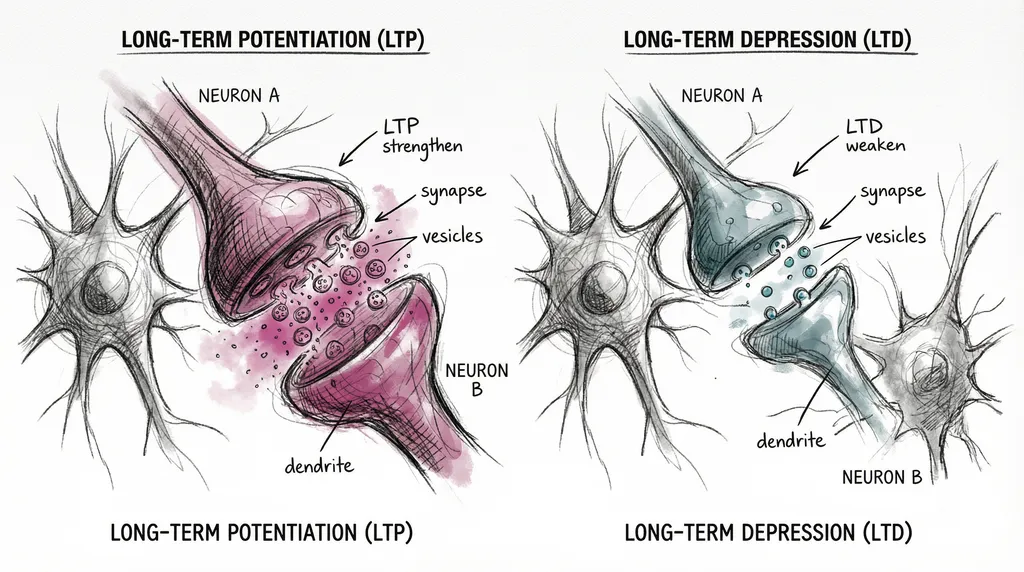
Every time you practice a skill, you run this process. The first time feels slow and effortful because the synaptic pathways are weak. With repetition, those pathways get stronger and the skill becomes easier.
STRUCTURAL CHANGES. Over weeks and months, your brain goes further than just adjusting existing connections. Neurons grow new dendrites, the branch-like extensions that receive signals from other neurons. Axons sprout new terminals and entirely new synaptic connections form where none existed before.
The most famous evidence comes from Eleanor Maguire’s study of London taxi drivers. Before GPS, these drivers spent years memorizing London’s 25,000 streets and 20,000 landmarks. Brain scans showed their posterior hippocampus, the region handling spatial navigation, was significantly larger than average.
Their brains literally grew to meet the demand.
MYELINATION. Your brain also speeds up frequently used pathways by wrapping them in myelin, a fatty coating that makes electrical signals travel faster. Unmyelinated signals travel at about 2 meters per second. Myelinated ones hit 100 meters per second, a 50x speed increase.
This is why experts seem to react without thinking. Their most-used neural pathways are so well myelinated that the signals travel almost instantly. What looks like intuition is actually speed.
WHAT HELPS AND WHAT BLOCKS IT
Not everything affects neuroplasticity equally. Some things accelerate it. Others shut it down.
EXERCISE is one of the strongest drivers. Physical activity increases a protein called BDNF (brain-derived neurotrophic factor) in the hippocampus. BDNF acts like fertilizer for neurons: it supports the growth of new connections and helps existing ones survive.
Regular exercise does not just protect your body. It builds the physical infrastructure your brain needs to change.
SLEEP is when consolidation happens. During deep sleep, your brain replays the day’s learning and strengthens the synaptic changes that started while you were awake. Skip the sleep and you skip the consolidation.
Research shows that a single night of sleep deprivation can cut learning efficiency by up to 40%. If learning is like saving a file, sleep is like pressing the save button. Without it, the work is still in temporary memory and can be lost.
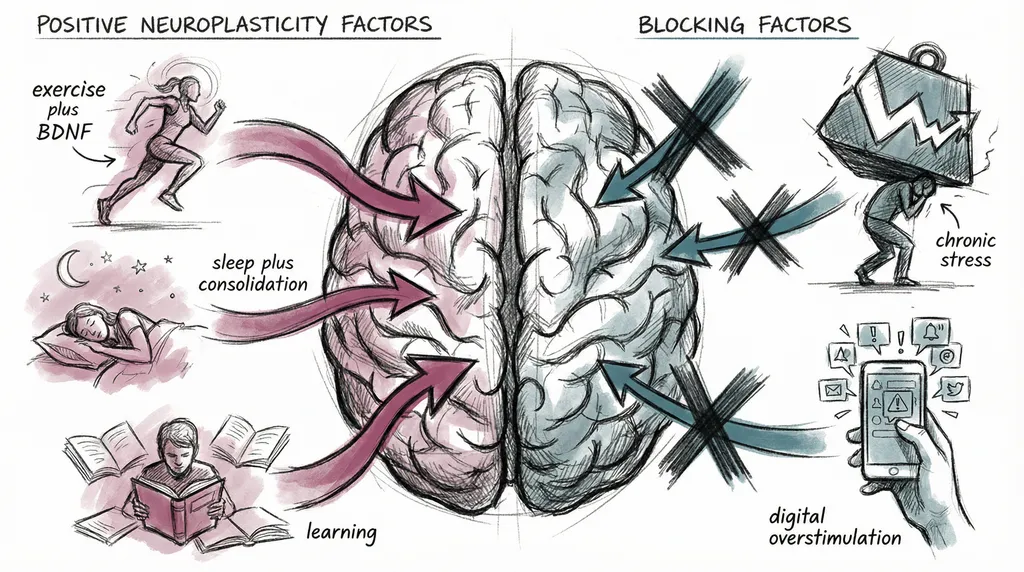
CHRONIC STRESS works against you. Cortisol, the stress hormone we discussed in the fight-or-flight article, suppresses BDNF production and impairs synaptic plasticity in the hippocampus. Short-term stress can actually sharpen focus and aid memory formation. But chronic stress does the opposite: it makes your brain less able to form new connections right when you need them most.
Ever tried to install new software on a computer that is already overheating and running at full capacity? That is what learning under chronic stress feels like at a biological level. Cortisol keeps your brain in threat-mode, and in threat-mode the rewiring machinery shuts down.
HOW LONG DOES REWIRING TAKE
People ask this question constantly and there is no single answer. It depends on what you are trying to change.
Initial synaptic changes happen within hours of learning something new. You can measure long-term potentiation in a lab within minutes. But these early changes are fragile. Without reinforcement, they fade.
Behavioral changes, like building a new habit or breaking an old one, typically need consistent practice for 3 to 8 weeks before the underlying pathways are strong enough to feel automatic. The often-cited number is 66 days on average, though individual variation is large.
Structural changes, new dendrites, axon growth, increased myelination, develop over months. The London taxi drivers did not grow larger hippocampi overnight. It took years of daily navigation practice.
My honest take: most people give up before the rewiring has a chance to take hold. They try a new behavior for two weeks, it still feels hard, and they conclude it is not working. But two weeks is barely enough for the synaptic changes to stabilize, let alone for structural remodeling to begin.
The discomfort of a new behavior is not a sign that it is failing. It is a sign that the rewiring has started but is not yet complete. The old pathway is still stronger than the new one.
WHY THIS MATTERS NOW
I mentioned at the start of this series that your brain optimizes for whatever you do most. Neuroplasticity is the mechanism behind that statement.
If you scroll your phone for three hours a day, your brain strengthens the pathways for short attention, quick reward-seeking, and shallow processing. If you spend that time reading, exercising, or practicing a skill, your brain strengthens pathways for focus, patience, and deep thinking.
The brain does not judge. It just builds whatever you use most.
This is both the problem and the solution. The same property that lets algorithms reshape your attention also lets you reshape it back. Neuroplasticity does not stop working because you are 30 or 40 or 60. It slows down with age, but it never stops.
You are not stuck with the brain you have. But you have to actually do the work to change it.
T.
References
-
The Organization of Behavior - Donald Hebb (1949). The foundational text proposing that synaptic connections strengthen through repeated co-activation, forming the basis for modern neuroplasticity research.
-
Navigation-related Structural Change in the Hippocampi of Taxi Drivers - Maguire et al. (2000). Brain imaging study showing London taxi drivers have significantly larger posterior hippocampi, with size correlating to years of navigation experience.
-
Neuroplasticity in the Adult Human Brain - Review of current evidence for structural and functional brain plasticity throughout adulthood, covering synaptic, dendritic, and myelination changes.
-
Exercise and BDNF in the Adult Hippocampus - Research on how physical exercise increases brain-derived neurotrophic factor, supporting neurogenesis and synaptic plasticity in the hippocampus.