In the last article, we looked at how social media and AI recommendation engines hijack your dopamine system and weaken your prefrontal cortex. Screens are one part of the problem. But there is something bigger happening underneath, something that affects people who barely use social media too.
Chronic stress.
THE ALARM THAT NEVER STOPS
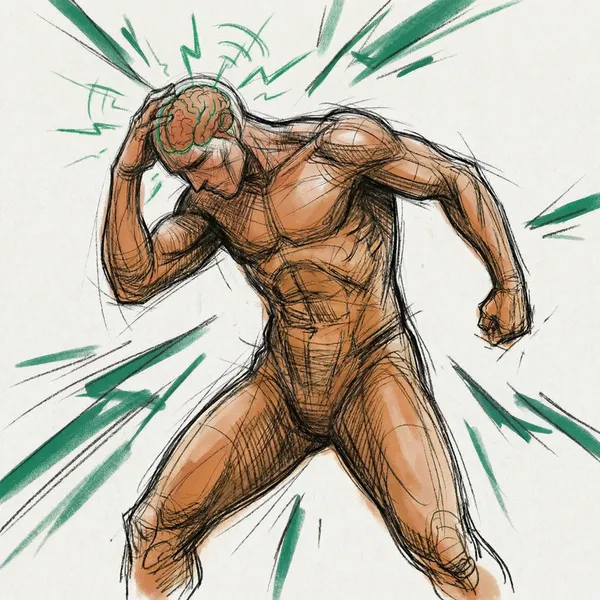
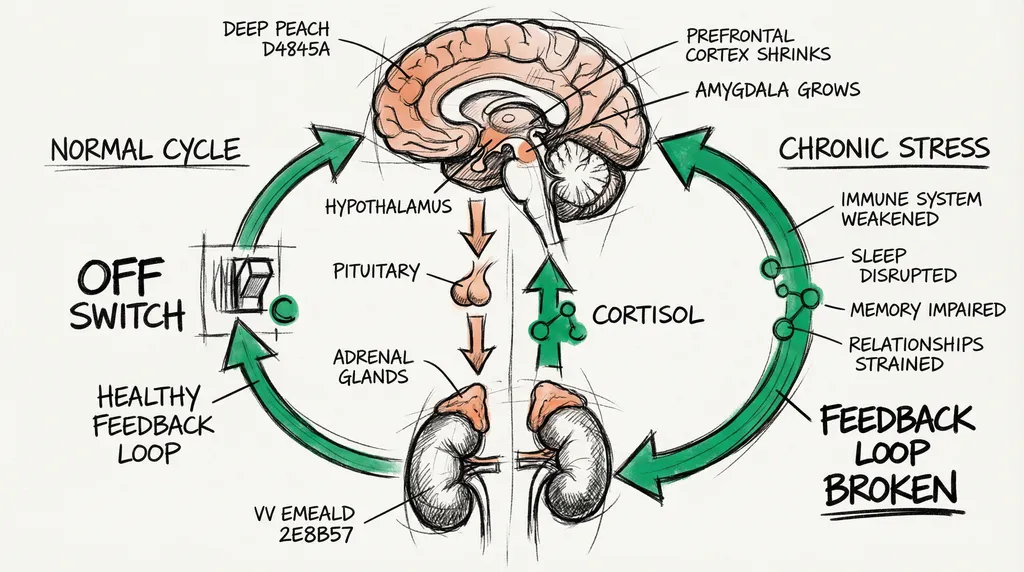
Your stress response works like a fire alarm. When your brain detects danger, the hypothalamus sends a chemical signal called CRH to your pituitary gland. The pituitary releases ACTH into your bloodstream, which travels to your adrenal glands and triggers a flood of cortisol.
This chain, the HPA axis, sharpens your focus, raises your blood sugar, and suppresses anything not immediately useful like digestion and immune function. It prepares your body to fight or run. When the threat passes, cortisol drops. The alarm stops.
The problem is that your HPA axis cannot tell the difference between a bear and a work email at 11pm. It triggers the same cascade for both. Unlike the bear, the emails never stop coming.
Under chronic stress, cortisol levels stay elevated for weeks, months, years. Robert Sapolsky at Stanford has spent decades studying what this does to the brain.
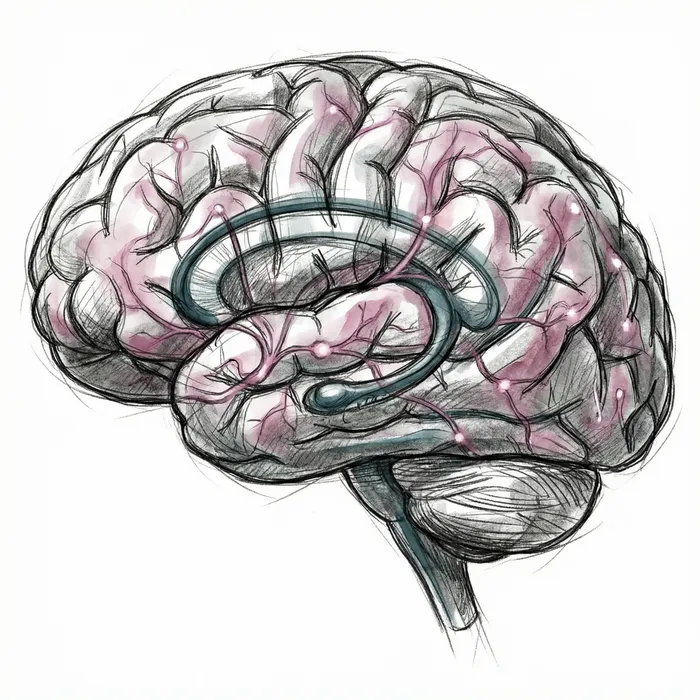
Your hippocampus, the region critical for memory and learning, physically shrinks. Bruce McEwen at Rockefeller University showed that chronic cortisol damages hippocampal neurons and blocks the growth of new ones, like a tree losing limbs in a storm.
Your amygdala, on the other hand, grows. The part of your brain responsible for fear and emotional reactivity gets stronger under chronic stress. Meanwhile your prefrontal cortex, the part you need for planning and impulse control, loses synaptic connections. Your memory center weakens, your alarm center gets louder, and your braking system degrades.
This is why chronically stressed people make worse decisions. Chronic stress damages the hardware itself.
BURNOUT IS NOT TIREDNESS
In 2019, the World Health Organization added burnout to the ICD-11 with three dimensions: emotional exhaustion, depersonalization, and reduced personal accomplishment. But burnout is not just a psychological state. It shows up on brain scans.
A 2014 study by Golkar and colleagues found that burnout patients had thinned prefrontal cortex and weakened connections between the prefrontal cortex and amygdala. Their amygdala overreacted to negative stimuli, and their prefrontal cortex could not dampen those responses.
Think of it like a car with a stuck accelerator and worn brake pads. The engine revs higher, the brakes work less, and you are heading toward a wall.
Surveys put burnout symptoms somewhere between 50% and 77% of the workforce. The American Institute of Stress estimates workplace stress costs the US economy over $300 billion per year. These numbers represent brains running in emergency mode long past the point where that mode serves a purpose.
THE MODERN STRESS MACHINE
Your ancestors had stress too. Predators, famine, tribal conflict. But their stress came in bursts.
A lion appears, you run, you survive, cortisol drops, you rest. The system worked because the threat ended.
Modern stress does not end.
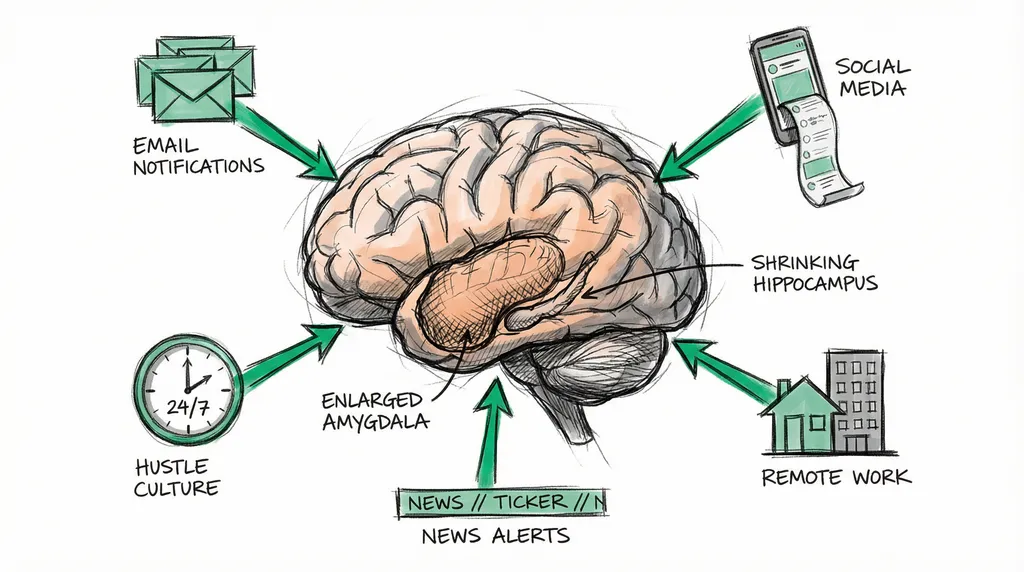
ALWAYS-ON WORK CULTURE. The average worker receives 121 emails per day. Slack and Teams add a constant stream on top.
A study from UC Irvine found that it takes 23 minutes to refocus after an interruption. If you get interrupted every 15 minutes, you never fully recover your focus.
Remote work made it worse. When your office is your home, there is no physical boundary between work stress and rest. The American Psychological Association found that remote workers report higher difficulty disconnecting.
THE HUSTLE MYTH. Social media glamorizes overwork with slogans like “rise and grind” and “sleep when you’re dead.”
This tells people that chronic stress signals dedication, not damage. I think this is one of the most dangerous ideas of our time.
INFORMATION OVERLOAD. Your brain processes an estimated 74 gigabytes of information per day, five times what it handled in 1986. Every notification triggers a micro stress response.
None of them are bears. Your amygdala treats each one as potentially important anyway.
YOUR BODY KEEPS THE SCORE
Chronic stress does not stay in your brain. It spreads.
IMMUNE SYSTEM. Cortisol suppresses your immune system, which is useful for a short fight but destructive over months. Elizabeth Blackburn and Elissa Epel showed that chronic stress shortens telomeres, the protective caps on your chromosomes. Caregivers of chronically ill children had telomeres equivalent to someone 10 years older.
INFLAMMATION. When a suppressed immune system rebounds, it often overshoots. Chronic stress drives up inflammatory markers like C-reactive protein and interleukin-6. Chronic inflammation connects to heart disease, diabetes, depression, and possibly Alzheimer’s.
GUT-BRAIN AXIS. Your gut has its own nervous system with over 100 million neurons. Stress disrupts the gut microbiome and changes gut permeability.
The vagus nerve directly connects your brain to your gut, and stress signals travel both directions. Ever felt nauseous before a big presentation? That is the gut-brain axis.
THE WAY BACK
The neuroplasticity we covered in article seven works in your favor here. Your brain can recover from chronic stress. It needs specific conditions.
VAGAL TONE. The vagus nerve controls your parasympathetic nervous system, the “rest and digest” counterpart to fight-or-flight. You can activate it through slow breathing where you exhale longer than you inhale, cold water exposure, and even humming.
Higher vagal tone means faster recovery from stress. Stephen Porges’ polyvagal theory explains how it acts as the brake pedal for your entire stress response.
NATURE. MaryCarol Hunter at the University of Michigan found that just 20 minutes in a natural setting reduced cortisol levels significantly. Roger Ulrich’s classic 1984 study showed hospital patients healed faster when their window faced trees instead of a brick wall.
Nature is not a luxury. For your brain, it is maintenance.
SLEEP. During deep sleep, your brain clears cortisol and other stress hormones. Sleep deprivation raises cortisol by roughly 37 to 45 percent the next evening.
One bad night makes you more reactive to stress, which makes it harder to sleep, which raises cortisol further. This loop is why stressed people feel trapped.
EXERCISE. Physical activity increases BDNF, brain-derived neurotrophic factor, which grows new neurons and repairs existing ones. The hippocampal damage from chronic stress is partially reversible with regular exercise. Even a 30-minute walk reduces cortisol and improves mood.
Breathe slowly. Go outside. Sleep enough. Move your body.
The hard part is not knowing what to do. The hard part is doing it inside a system designed to keep you wired, reactive, and staring at a screen.
In the next article, we bring this series together and talk about defending your brain in an age that profits from overloading it.
T.
References
-
Why Zebras Don’t Get Ulcers, Robert Sapolsky (2004) - Foundational text on chronic stress physiology, HPA axis dysregulation, and the difference between acute and chronic stress responses.
-
Reduced Prefrontal-Amygdala Connectivity in Burnout, Golkar et al. (2014) - fMRI study showing weakened prefrontal-amygdala connectivity and enlarged amygdala reactivity in burnout patients.
-
The Telomere Effect, Blackburn & Epel (2017) - Nobel laureate research on how chronic stress shortens telomeres, with caregiver studies showing 10-year equivalent aging.
-
Urban Nature Experiences Reduce Stress, Hunter et al. (2019) - Study establishing that 20 minutes in nature significantly reduces cortisol levels.
-
The Cost of Interruption, Mark et al. (2008) - UC Irvine research measuring 23-minute refocus time after workplace interruptions.