THE PART THE PREVIOUS POST LEFT OPEN
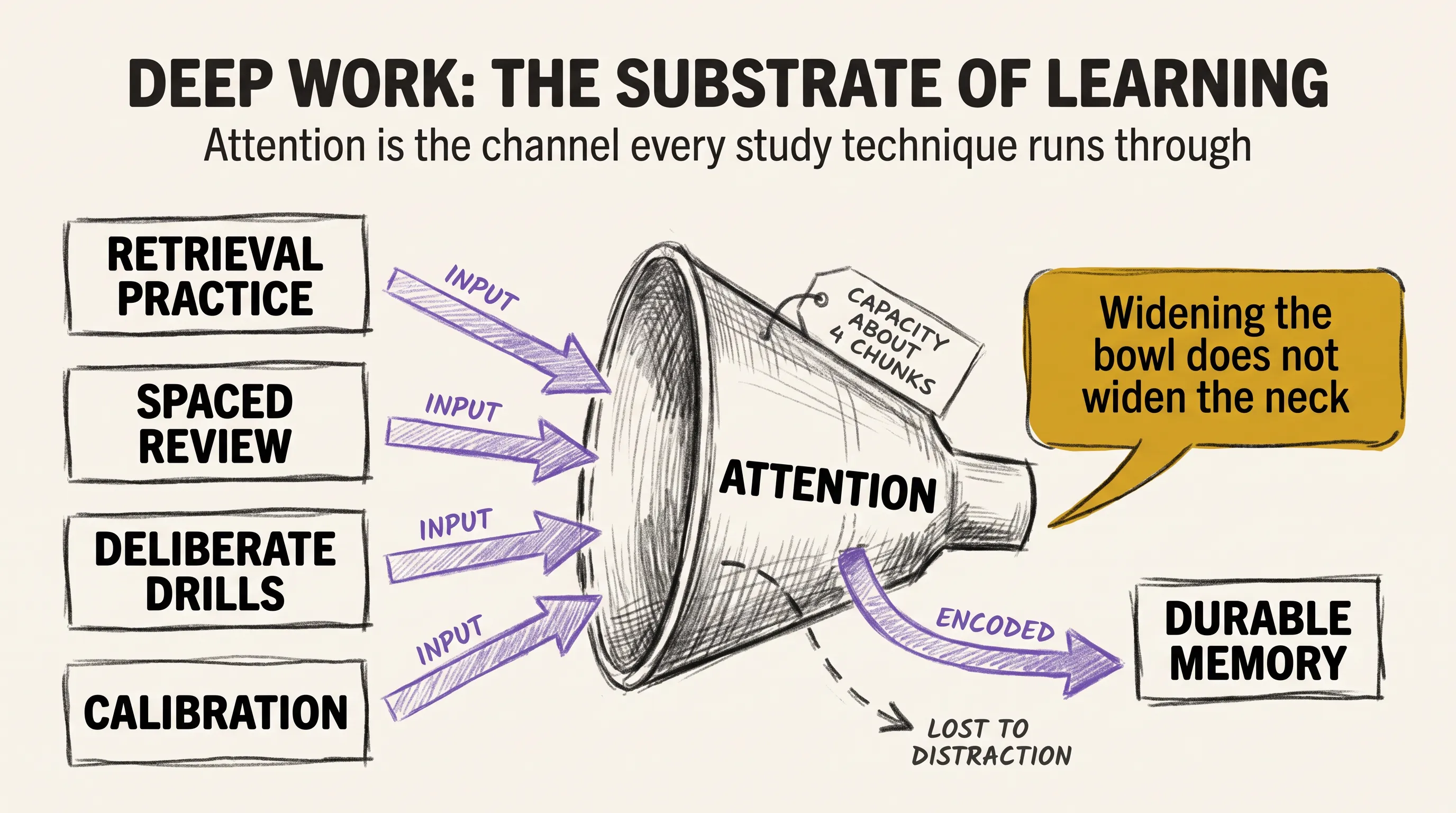
The previous post in this series made the case that attention sets how deeply material encodes, and that every switch charges a fee against the next task. It stopped short of the practical question. Knowing that an undistracted hour matters does not explain how anyone reliably gets one.
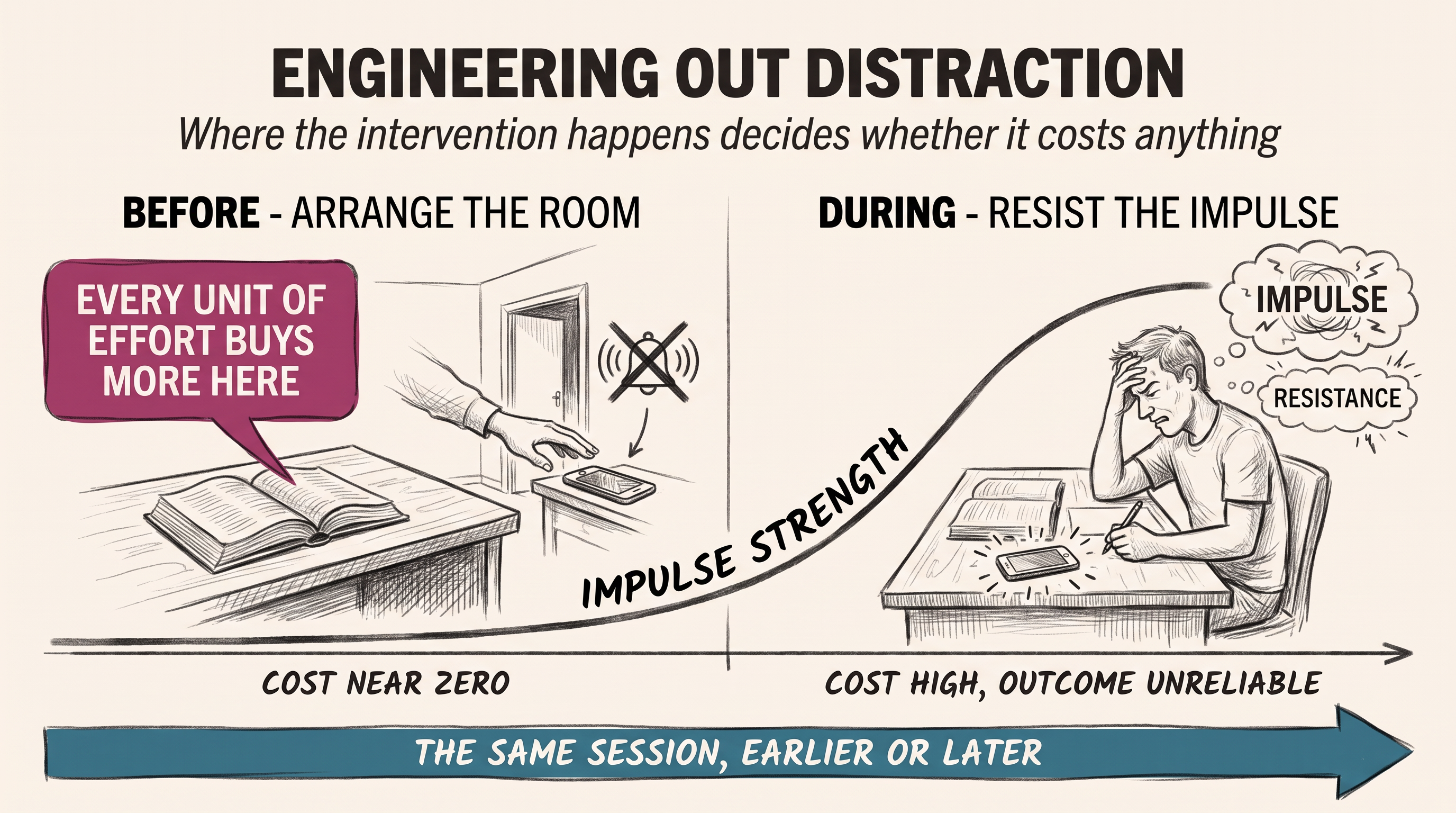
The usual answer is discipline. Decide to focus, notice the pull toward something easier, and refuse it. That answer puts the entire load on one moment of resistance, repeated dozens of times a day, and the research on how that moment actually goes is not flattering.
WHAT SELF-CONTROL ACTUALLY PREDICTS
Wilhelm Hofmann, Roy Baumeister, Georg Förster and Kathleen Vohs paged 205 adults at random intervals for a week in 2012 and asked what they wanted at that moment. Participants reported a desire in roughly half the moments sampled, and about half of those desires conflicted with another goal they held. Attempts at resistance were frequent and frequently lost, with desires tied to media use among the hardest to hold off.
The result worth sitting with is not that resistance fails. It is what separates the people for whom it fails less often.
Marina Milyavskaya and Michael Inzlicht followed that thread in 2017 across two studies that tracked people through ordinary days, and found the mechanism sitting somewhere other than where most advice points. Participants scoring higher on trait self-control did not win more fights with temptation. They reported running into fewer temptations at all, and effortful restraint predicted greater depletion by the end of the study while failing to predict whether the goal came off.
Brian Galla and Angela Duckworth reported a compatible finding in 2015 across six studies, where the link between trait self-control and good outcomes ran through beneficial habits rather than through episodes of restraint. Jacob Ent, Baumeister and Dianne Tice supplied the behavioural half the same year, finding that people higher in trait self-control reported a stronger tendency to stay out of situations containing temptation, including picking a place to study on the basis of what would not be there.
Self-control measured this way looks less like a muscle and more like a talent for avoiding fights.
MOVING THE INTERVENTION EARLIER
Duckworth, Tamar Gendler and James Gross gave that finding a structure in 2016 by mapping self-control onto Gross’s process model of emotion regulation. The model sorts strategies by when they intervene: choosing which situation to enter, changing a situation already entered, steering attention inside it, reframing what it means, and finally suppressing the impulse once it has arrived at full strength. Most popular advice aims at that last stage, the most effortful one and the one with the worst timing. Selecting and changing the situation act earlier, cost little at the moment of action, and the review found the situational strategies generally more effective.
Walter Mischel and Ebbe Ebbesen had shown the principle in 1970, in a study better known for what people believe it proves. Preschoolers waiting for a preferred treat lasted around a minute when the rewards sat in plain view, and more than ten minutes when the same rewards sat under a cover. Same children, same treats, same instruction; the only variable that moved was what the room put in front of their eyes.
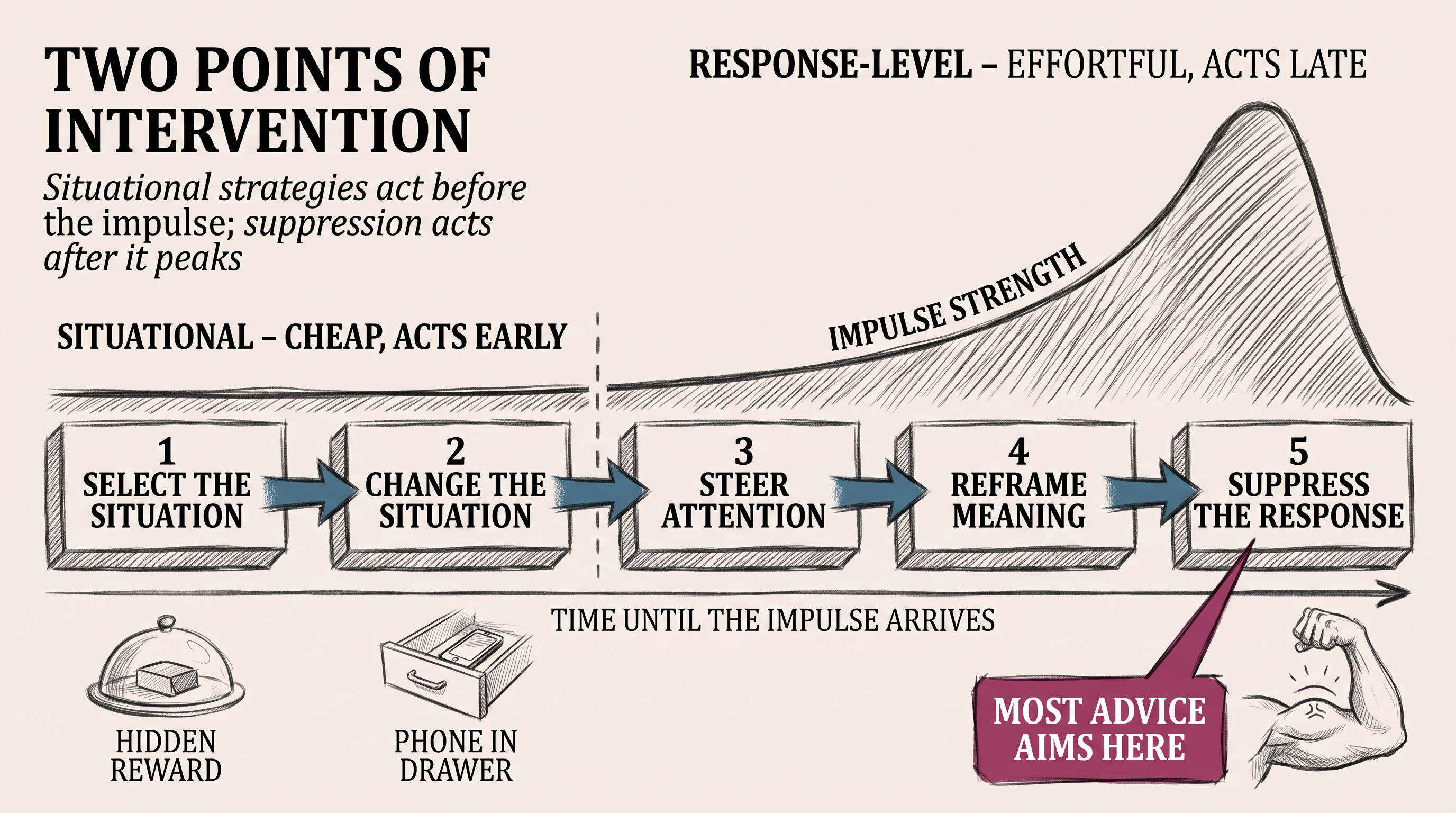
That is the argument for environment design compressed into one experiment.
THE NOTIFICATION AS A STANDING INVITATION
Ever tried to hold a difficult paragraph in mind while a phone lights up on the desk beside it?
Cary Stothart, Ainsley Mitchum and Courtney Yehnert put numbers on that in 2015. Participants running a sustained-attention task made significantly more errors during stretches when their phone buzzed with a call or a message, even though the procedure kept them from answering, and the penalty approached what direct phone use costs.
Receiving the notification is enough.
Kotaro Kushlev, Jason Proulx and Elizabeth Dunn tested the obvious remedy in 2016 by having participants spend one week maximising phone interruptions and one week minimising them, with alerts off and the phone out of reach. Self-reported inattention and hyperactivity symptoms dropped in the low-interruption week. Gloria Mark, Stephen Voida and Armand Cardello went harder in 2012, cutting thirteen information workers off from email entirely for five working days with heart-rate monitors running. Without email those workers switched windows far less often, held single tasks longer, and showed heart-rate variability consistent with lower stress.
Adrian Ward, Kristen Duke, Ayelet Gneezy and Maarten Bos put the device itself on trial in 2017 with 548 undergraduates who left their phone on the desk, in a bag, or in another room. Available working-memory capacity came out highest for the other-room group, while participants across all three conditions reported feeling equally undistracted. The felt sense of distraction and the measured cost came apart.
FRICTION IN BOTH DIRECTIONS
The design principle falling out of this is unglamorous. Add cost to the unwanted option, strip cost from the wanted one, and keep both adjustments small enough that no act of will has to enforce them.
Paul Rozin and colleagues showed how small in 2011, in a real cafeteria. Moving an item about ten inches further down the counter, or swapping a spoon for tongs, shifted how much diners took by somewhere between 8 and 16 percent. The changes persuaded nobody of anything; they made one option slightly less convenient than the other and let the arithmetic of a busy lunch queue do the rest.
Defaults push the same lever harder. Brigitte Madrian and Dennis Shea found in 2001 that automatic enrollment lifted 401(k) participation among new hires from roughly 37 percent to roughly 86 percent, with most employees then staying at whatever contribution rate and fund the default named. Eric Johnson and Daniel Goldstein reported in Science in 2003 that countries treating organ donation as the opt-out condition record far higher effective consent than countries requiring people to opt in. A default works the same way a doorstop does: it decides nothing, it forbids nothing, and it settles almost everything.
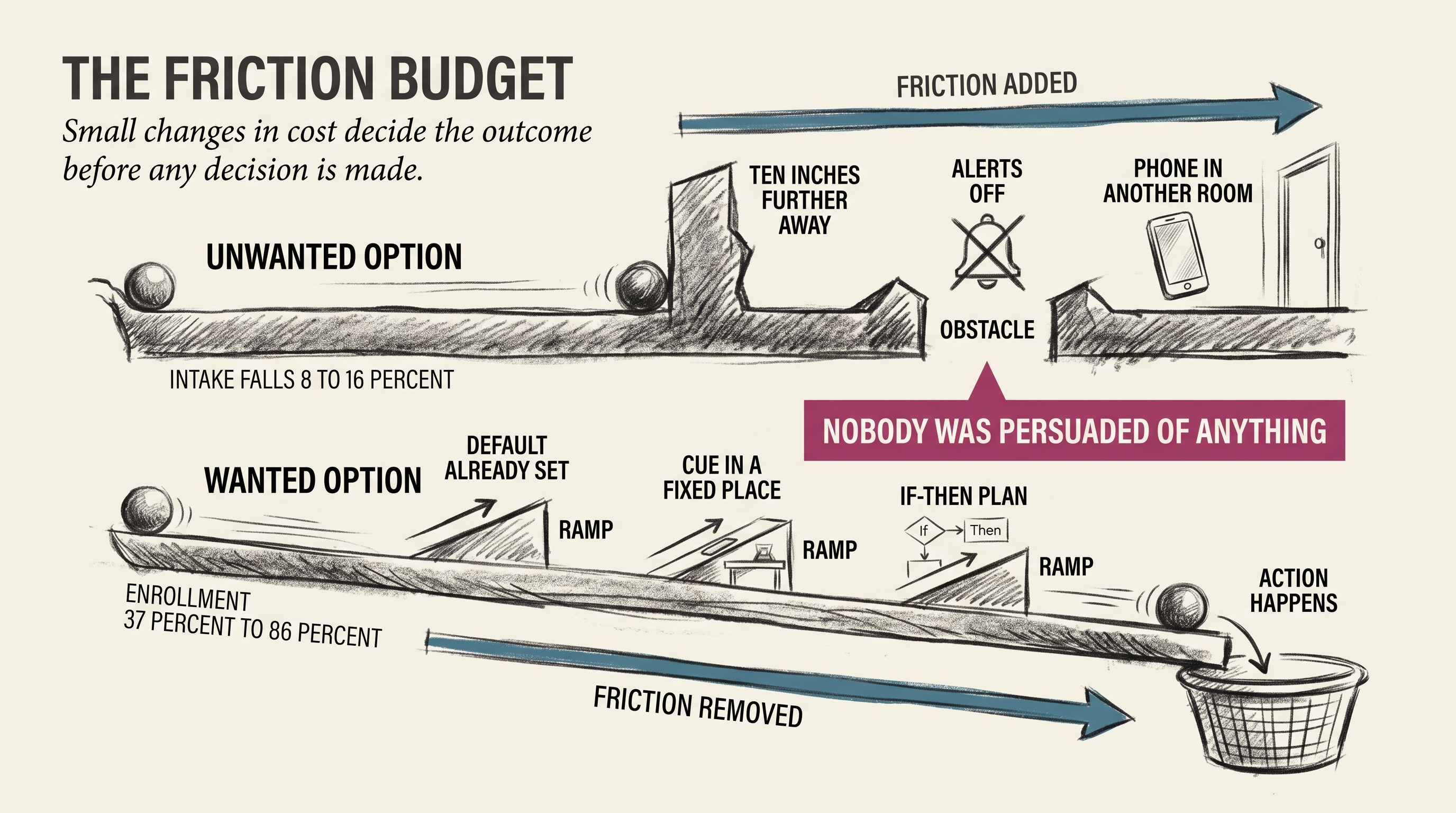
Ease for the wanted option has its own literature. Peter Gollwitzer and Paschal Sheeran pooled 94 independent tests in 2006 and found that specifying in advance when, where and how an action would happen produced a medium to large gain in goal attainment, around d = 0.65. Wendy Wood and David Neal explained in 2007 why the specification has to name a cue: habits run off recurring features of a context rather than off fresh intentions, so a stable room does part of the remembering.
A cue sitting in a fixed environment acts like a switch nobody has to remember to flip.
WHAT ENVIRONMENT DESIGN DOES NOT SETTLE
The willpower-as-fuel story that motivates much of this advice is itself on unstable ground. Martin Hagger and 23 laboratories ran a preregistered replication of the ego-depletion effect in 2016 and recovered an effect close to zero. Environment design does not rest on depletion being real, which is convenient, because it may not be. It rests only on the weaker and better-measured claim that resisting a temptation already in the room goes wrong often enough to be worth not attempting.
The effects themselves are modest and tied to their settings. A finding about serving distance in a cafeteria carries no automatic authority over a phone on a desk, and the Ward result rests on a between-subjects comparison in which the participants themselves noticed nothing.
Nobody controls every environment either. Open-plan offices, shared homes, and jobs that demand responsiveness all set limits on what any individual can arrange, and much of the advice in this area quietly assumes a private room and a door.
What the evidence does support is narrower than the productivity framing around it, and more useful. The moment of resistance is an expensive place to spend effort, most of the variance sits in exposure rather than in willpower, and the arrangement of a room and its devices performs work that intention would otherwise have to perform again every hour.
T.
References
-
Everyday Temptations: An Experience Sampling Study of Desire, Conflict, and Self-Control - Hofmann, Baumeister, Förster & Vohs (2012), Journal of Personality and Social Psychology. Samples desire and resistance in daily life across 205 adults and records how often resistance fails.
-
What’s So Great About Self-Control? - Milyavskaya & Inzlicht (2017), Social Psychological and Personality Science. Finds trait self-control predicting goal attainment through fewer temptations rather than through successful effortful restraint.
-
More Than Resisting Temptation: Beneficial Habits Mediate the Relationship Between Self-Control and Positive Life Outcomes - Galla & Duckworth (2015), Journal of Personality and Social Psychology. Six studies placing automatic habits between self-control and outcomes.
-
Trait Self-Control and the Avoidance of Temptation - Ent, Baumeister & Tice (2015), Personality and Individual Differences. Reports that people high in trait self-control preemptively avoid tempting situations.
-
Situational Strategies for Self-Control - Duckworth, Gendler & Gross (2016), Perspectives on Psychological Science. Orders self-control strategies by when they intervene and argues for the situational ones.
-
Attention in Delay of Gratification - Mischel & Ebbesen (1970), Journal of Personality and Social Psychology. Shows waiting times collapsing or extending according to whether the reward stays in view.
-
The Attentional Cost of Receiving a Cell Phone Notification - Stothart, Mitchum & Yehnert (2015), Journal of Experimental Psychology: Human Perception and Performance. Measures the performance cost of notifications that participants never answer.
-
Silence Your Phones: Smartphone Notifications Increase Inattention and Hyperactivity Symptoms - Kushlev, Proulx & Dunn (2016), Proceedings of the 2016 CHI Conference on Human Factors in Computing Systems. Within-subject test of a high-interruption week against a low-interruption week.
-
A Pace Not Dictated by Electrons: An Empirical Study of Work Without Email - Mark, Voida & Cardello (2012), Proceedings of the SIGCHI Conference on Human Factors in Computing Systems. Removes email for five days and tracks switching, focus duration and heart-rate variability.
-
Brain Drain: The Mere Presence of One’s Own Smartphone Reduces Available Cognitive Capacity - Ward, Duke, Gneezy & Bos (2017), Journal of the Association for Consumer Research. Compares phone on desk, in bag and in another room against working-memory measures.
-
Nudge to Nobesity I: Minor Changes in Accessibility Decrease Food Intake - Rozin, Scott, Dingley, Urbanek, Jiang & Kaltenbach (2011), Judgment and Decision Making. Field study where inches of distance and a change of serving utensil move intake measurably.
-
The Power of Suggestion: Inertia in 401(k) Participation and Savings Behavior - Madrian & Shea (2001), The Quarterly Journal of Economics. Documents the participation jump produced by automatic enrollment and the stickiness of the default.
-
Do Defaults Save Lives? - Johnson & Goldstein (2003), Science. Compares effective organ-donation consent under opt-in and opt-out defaults.
-
Implementation Intentions and Goal Achievement: A Meta-Analysis of Effects and Processes - Gollwitzer & Sheeran (2006), Advances in Experimental Social Psychology. Pools 94 independent tests of if-then planning and reports the effect size.
-
A New Look at Habits and the Habit-Goal Interface - Wood & Neal (2007), Psychological Review. Sets out how context cues, rather than current intentions, drive habitual behaviour.
-
A Multilab Preregistered Replication of the Ego-Depletion Effect - Hagger et al. (2016), Perspectives on Psychological Science. Twenty-three laboratories find an ego-depletion effect close to zero.