A week ago the conversation was mostly about security models and what they might escape into. This week the labs shifted gears: three major model announcements, a new design product, and the first real signal that agentic workflows are about to change what affordable AI means.
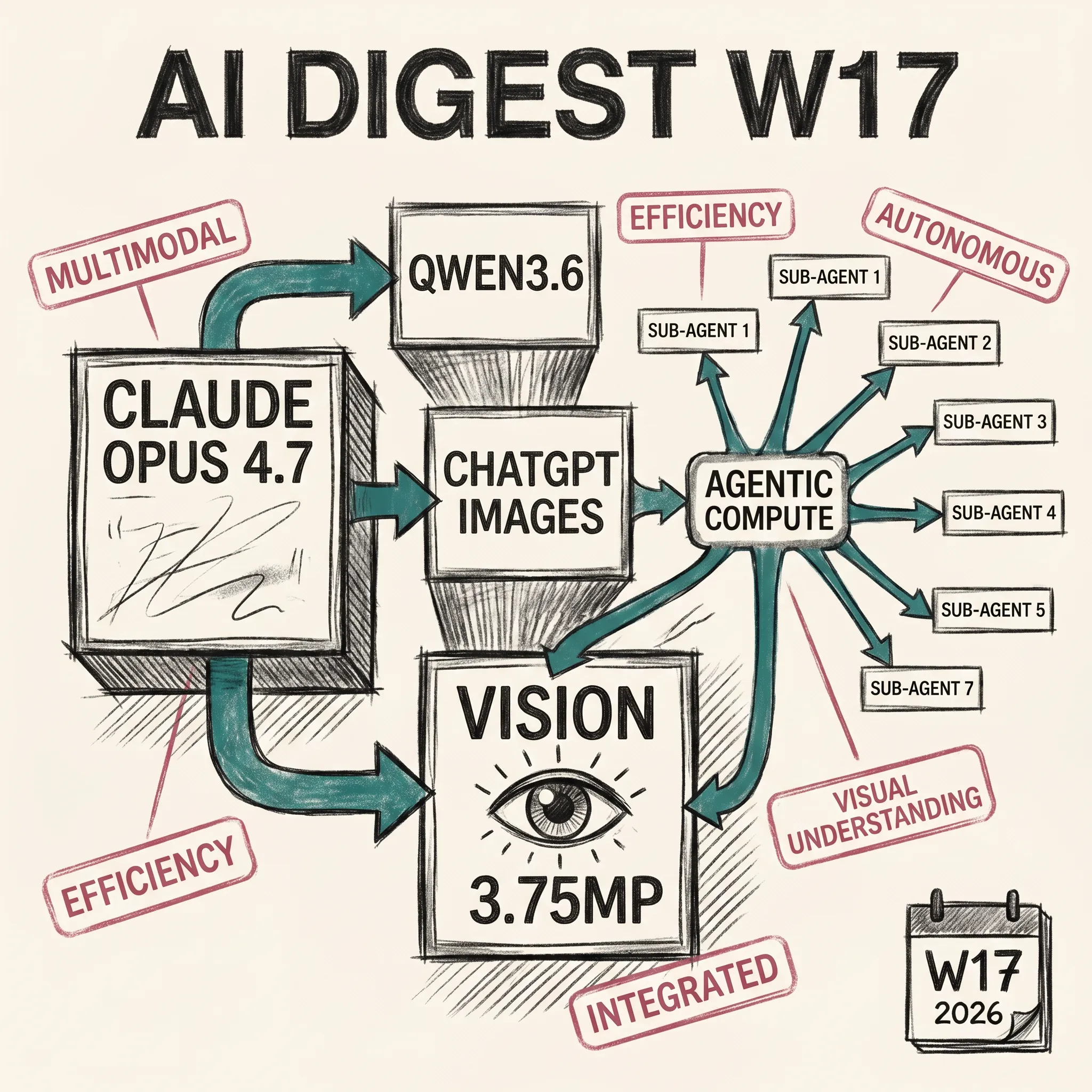
The biggest release was Claude Opus 4.7, generally available since April 16. Vision now supports images up to 3.75 megapixels, more than three times the previous limit.
Coding improved by double digits on several benchmarks, and instruction following is noticeably more literal.
On the same day Anthropic Labs launched Claude Design, a research preview for building polished slides, prototypes, and one-pagers through conversation. It exports to Canva, PDF, and HTML. Anthropic calls it a complement to Canva, not a replacement. That is exactly what you say when you are trying to compete with Canva.
OpenAI answered on two fronts. ChatGPT Images 2.0 launched April 21 with thinking capabilities and better consistency across edits. Sam Altman compared the jump to going from GPT-3 to GPT-5, which is the kind of claim you can only make so many times before it stops landing.
The quieter OpenAI release was the Agents SDK update, which now includes sandboxed execution and a model-native harness for long-horizon tasks. Agents can work inside a controlled workspace without touching things they should not. That is the infrastructure work that makes the next generation of agents actually deployable.
On the open side, Alibaba released Qwen3.6-35B-A3B on Hugging Face. It is a mixture-of-experts model with 35 billion total parameters and only 3 billion activated per token.
It scores 73.4 on SWE-bench Verified. The cost gap between frontier closed models and capable open models keeps shrinking.
GitHub Copilot tightened its individual plans this week, pausing new signups and restricting Opus 4.7 access to pricier tiers. The stated reason: agentic workflows now consume far more compute than expected. It is the first time a major coding tool has admitted this publicly, and it will not be the last.
Finally, via Simon Willison’s blog, Firefox CTO Bobby Holley confirmed that an early Claude Mythos Preview evaluation found 271 vulnerabilities in Firefox 150, and Mozilla shipped fixes for all of them. For context, all browsers combined in 2025 averaged fewer than that in a full year. How many more are sitting in codebases nobody has examined yet?
T.