A NUMBER THAT TRAVELED FARTHER THAN THE RESEARCH BEHIND IT
Ten thousand hours became shorthand for mastery. The number appears in coaching manuals, corporate training decks, and casual advice to anyone starting a new skill, usually stripped of the study it came from and the conditions attached to it.
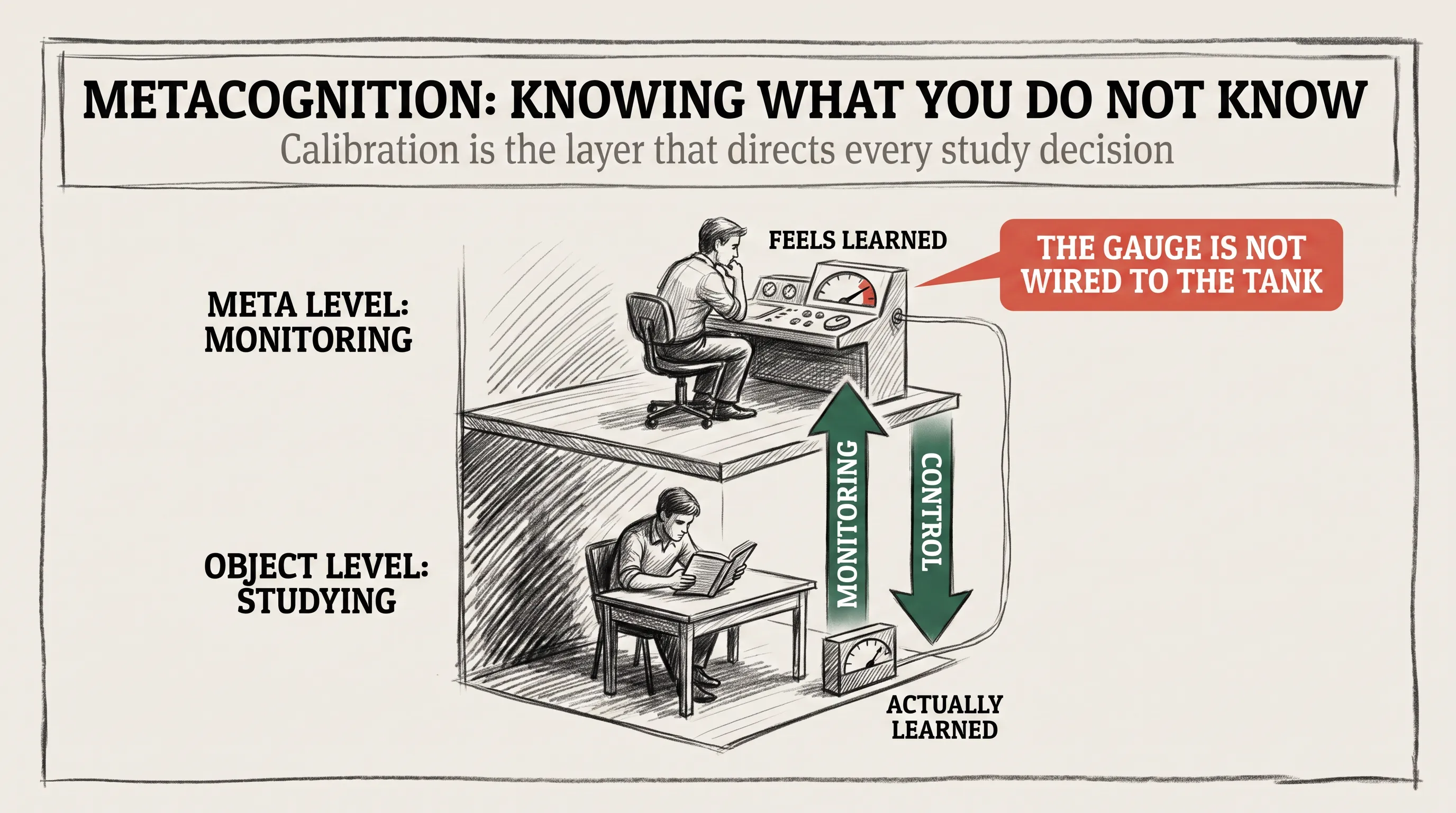
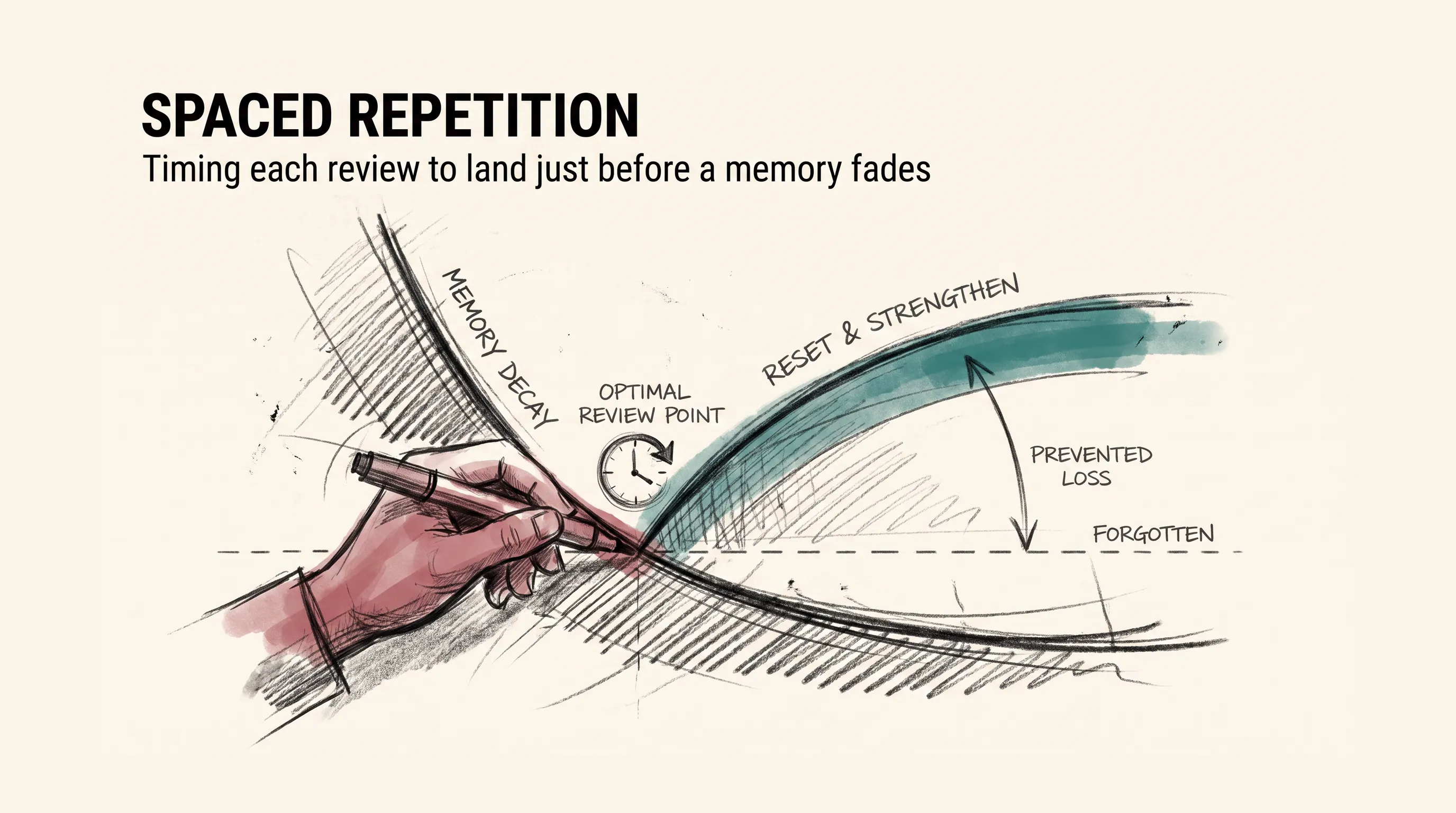
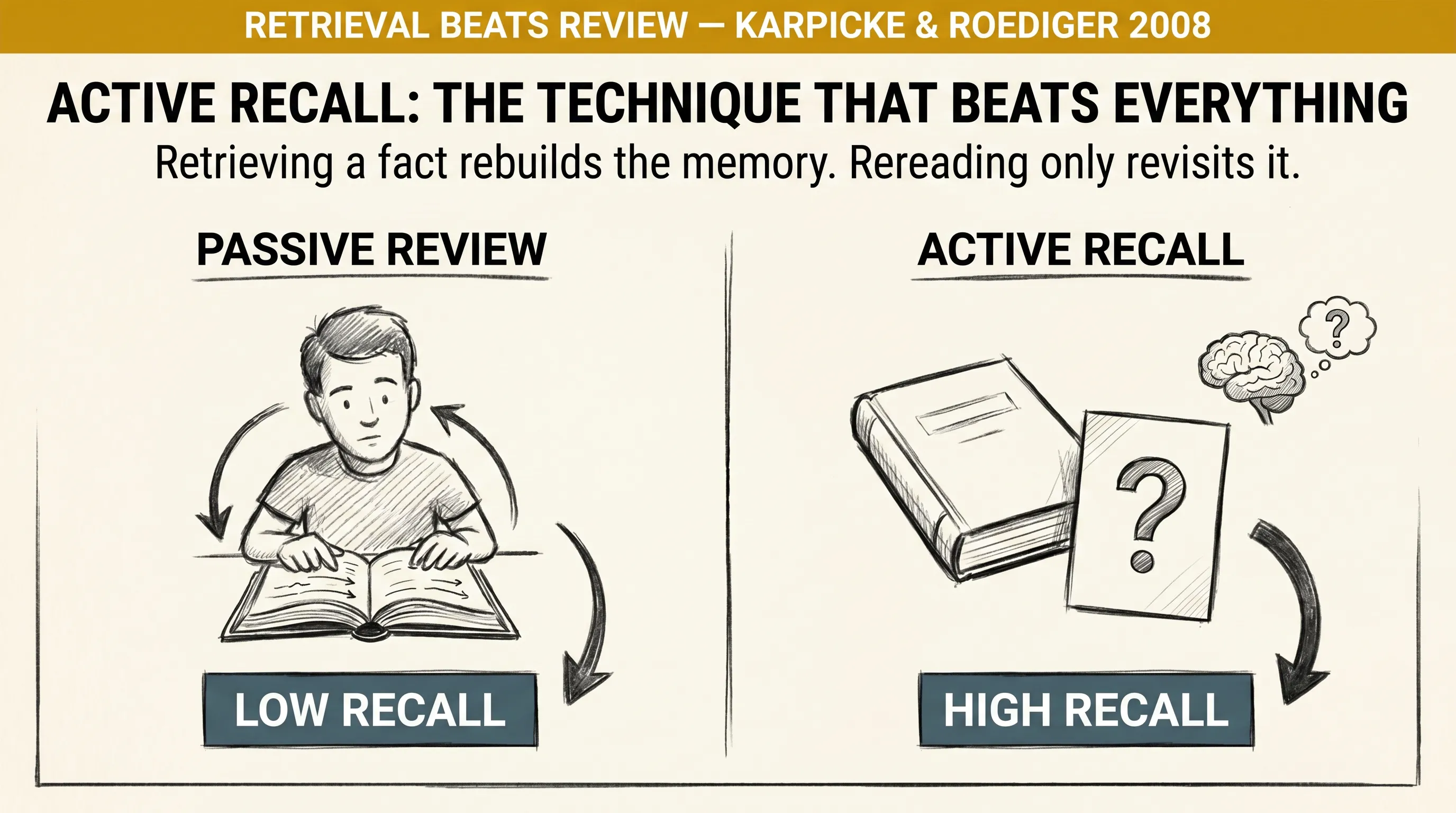
The earlier posts in this series covered active recall and spaced repetition, both aimed at retaining facts. This post covers something different: how skills get built, and why repeating an action thousands of times does not, by itself, build one.
The 10,000-hour figure traces to a 1993 study by Anders Ericsson, Ralf Krampe, and Clemens Tesch-Römer at the Berlin University of the Arts. The researchers compared violinists at a music academy, sorting them into groups by teacher-rated skill, and tracked how each group spent its practice time. By age twenty, the best group had accumulated an average of about 10,000 hours of solitary practice, the good group about 7,800, and the least accomplished group about 4,600. The number was a group average from one narrow population, not a threshold that guarantees expertise once crossed.
Malcolm Gladwell’s 2008 book Outliers took that average and turned it into a rule: 10,000 hours of practice, in any field, produces mastery. The book sold widely and the phrase entered common use faster than the nuance could follow it. Ericsson spent much of the following decade correcting the record, and the correction matters more than the number ever did.
WHAT ERICSSON ACTUALLY MEASURED
The 1993 study did not measure hours spent on the instrument. It measured a specific activity Ericsson called deliberate practice, and the definition carries most of the weight the “10,000 hours” phrase lost.
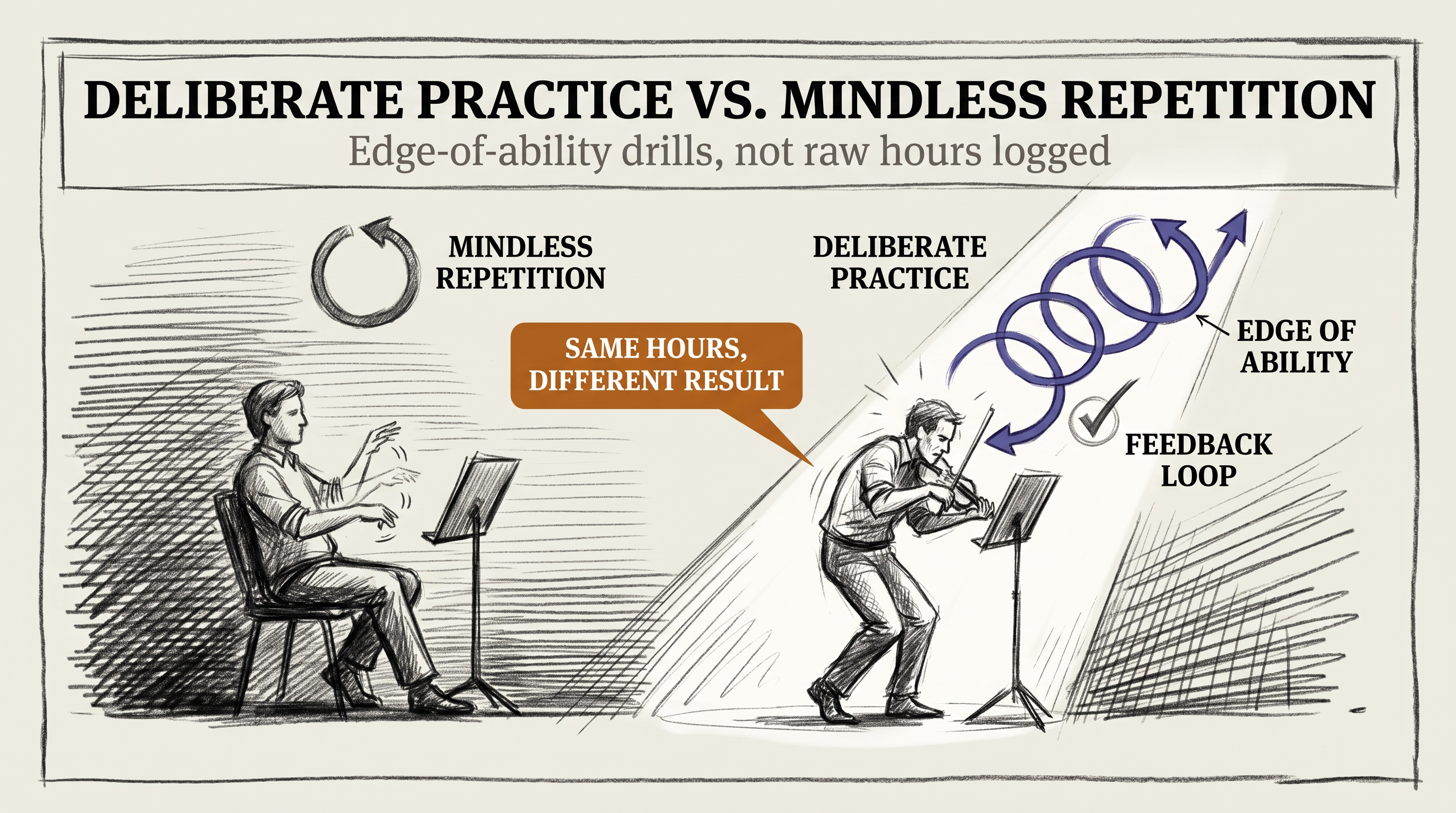
Deliberate practice has four features, according to the original paper. It targets a specific weakness rather than repeating what already works. It generates immediate feedback on performance. It is mentally effortful, not automatic or relaxing.
It is usually structured by a teacher or coach who can see gaps the practitioner cannot see alone. A violinist running through a piece she already plays well, for an hour, at a comfortable tempo, is practicing in the loose sense of the word. Under Ericsson’s definition, she is not doing deliberate practice, because nothing in that hour targets a weakness or produces new information about her playing.
This is the gap mindless repetition falls into. Hours of driving do not make someone a better driver past a certain basic competence, because ordinary driving offers almost no corrective feedback and rarely targets a known weak point. The same applies to typing, cooking, or running the same jogging route for years.
Volume alone plateaus fast once a skill reaches “good enough to get by.”
PRACTICING AT THE EDGE OF ABILITY
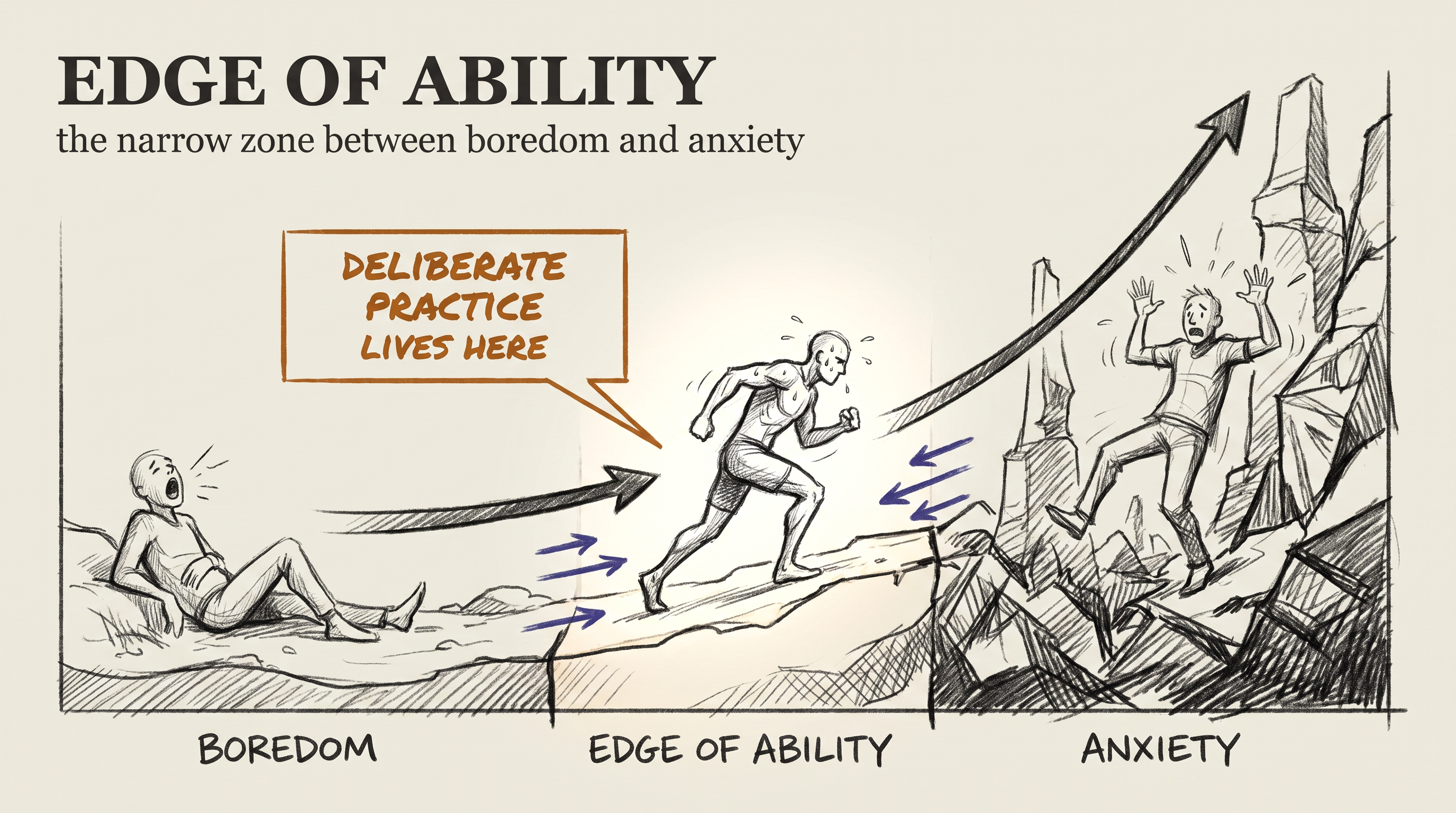
The psychologist Mihaly Csikszentmihalyi described a state he called flow, which occurs when the challenge of a task sits just above current skill, not far below it and not wildly beyond it. Task a beginner far past their ability and the result is anxiety; task them well below it and the result is boredom. Deliberate practice lives in the narrow channel between those two, deliberately uncomfortable but not overwhelming. A drill performed easily changes nothing, because the nervous system has no reason to adapt.
The discomfort itself is the mechanism.
A drill performed at the edge of failure, where the outcome is genuinely uncertain each attempt, forces adjustment. Weightlifters call this progressive overload; chess players call it studying openings one rating band above their own; musicians call it playing a passage slightly faster than they can play it cleanly. Different vocabulary, same structure: find the point where success is not guaranteed, and work there.
Finding that point requires knowing the current skill level with some precision, which is why deliberate practice is difficult to run alone. A coach, a scoring system, or a recorded benchmark tells the practitioner where the edge actually is. Guess wrong and the practice either coasts below the edge, which is comfortable and useless, or jumps past it into pure frustration, which produces no learning either.
FEEDBACK LOOPS THAT ACTUALLY CLOSE
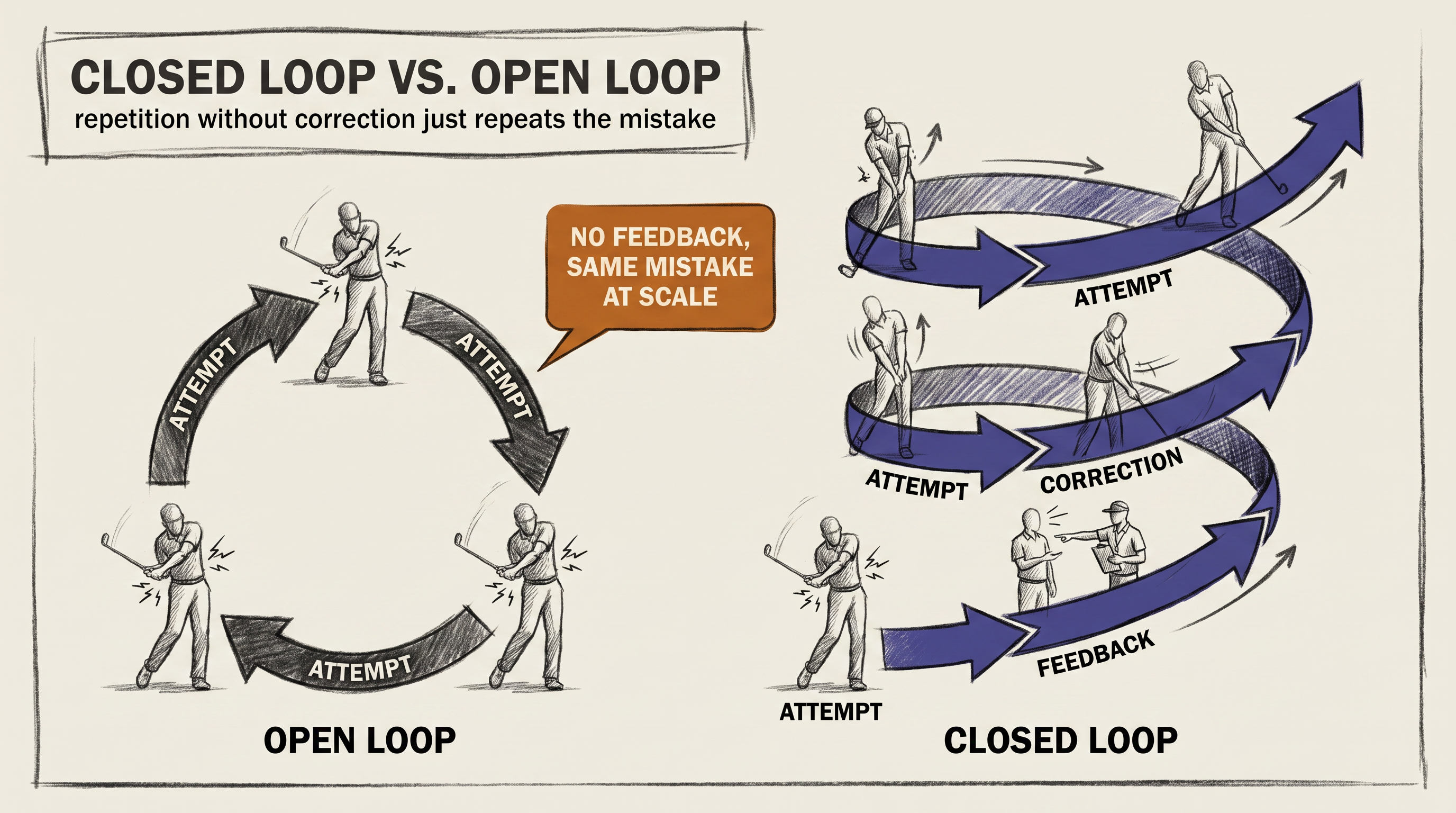
Repetition without feedback grooves whatever pattern already exists, mistakes included. A golfer with a flawed swing who hits five hundred balls a week is not correcting the flaw, only reinforcing it with more conviction. Feedback is what turns a repeated action into a corrected one, but feedback quality varies enormously, and a large body of research shows it can backfire.
Avraham Kluger and Angelo DeNisi’s 1996 meta-analysis of feedback interventions found that more than a third of the interventions studied actually made performance worse. The failure mode was usually feedback aimed at the person rather than the task, praise or criticism that told someone how they were doing overall without telling them what to change on the next attempt. Effective feedback is specific, immediate, and tied to the action just taken: not good job or try harder, but the left elbow drops on the downswing, keep it tucked.
This is why solitary repetition struggles to build skill even when the practitioner is trying hard. Video review, a coach’s correction, a scoreboard, a compiler error, all close the loop between action and consequence quickly enough for the next attempt to actually be different from the last. Remove the loop and volume just accumulates the same mistake at scale.
DESIGNING DRILLS FOR SKILLS, NOT FACTS
The tools from earlier in this series, active recall and spaced repetition, work well for facts: vocabulary, dates, syntax, anything with a single correct answer that can be tested and re-tested. Skills resist that format because a skill is rarely one atomic unit, it is a bundle of subcomponents executed together under time pressure, and the weak subcomponent is often invisible until isolated.
Designing a drill starts with breaking a skill into those subcomponents and finding which one fails first. A basketball player who misses free throws under fatigue is not failing at “shooting,” a debugging session on the mechanics usually finds a narrower cause: legs not driving the shot, or a rushed release when tired. The drill that fixes it targets that one link, repeated with enough variation that the fix generalizes rather than becoming a trick that only works in the exact drill conditions.
Programmers debugging a slow code review process face a comparable structure. General “write more code” repetition does not sharpen review skill, but a drill built around spotting a specific class of bug across many small, varied examples does, because each repetition targets the actual weak subcomponent with fast feedback on whether the spot was correct. The domain changes, the structure of a good drill does not: isolate the failing link, work at the edge of managing it, get fast feedback on each attempt, vary the conditions so the fix is not just memorized for one scenario.
THE HONEST LIMITS OF THE MODEL
Deliberate practice is not the whole story of expertise, and treating it as sufficient by itself repeats the same oversimplification as the 10,000-hour rule, just with better vocabulary. A 2014 meta-analysis by Brooke Macnamara, David Hambrick, and Frederick Oswald, covering 88 studies across games, music, sports, education, and professions, found that deliberate practice explained roughly 26 percent of the variance in chess performance, about 21 percent in music, roughly 18 percent in sports, and closer to 1 percent in professional performance. A related paper by Hambrick and colleagues the same year made the point directly in its title, asking whether deliberate practice is really all it takes to become an expert, and answering no.
None of that erases the original finding.
Deliberate practice remains one of the few practice methods with a documented, causal-looking relationship to skill gains, and it consistently outperforms unstructured repetition in every domain researchers have tested it in. The correction is about ceiling, not floor: practice this way and skill improves faster than it would otherwise, but starting point, domain, and factors outside any drill still shape how far that improvement goes. Ericsson’s own later writing, including his 2007 article for Harvard Business Review, made the same argument the original 1993 paper made before Gladwell simplified it: the structure of practice matters more than the count of hours, and nobody gets to skip the structure by logging enough time.
T.
References
-
The Role of Deliberate Practice in the Acquisition of Expert Performance - Ericsson, Krampe & Tesch-Römer (1993), Psychological Review. The original Berlin violin study that produced the 10,000-hour average and defined deliberate practice.
-
The Making of an Expert - Ericsson, Prietula & Cokely (2007), Harvard Business Review. A practitioner-facing account of deliberate practice’s structural requirements: feedback, coaching, and targeted weaknesses.
-
Deliberate Practice and Performance in Music, Games, Sports, Education, and Professions: A Meta-Analysis - Macnamara, Hambrick & Oswald (2014), Psychological Science. Quantifies how much deliberate practice explains skill variance across domains, from about 26 percent in chess to about 1 percent in professions.
-
Deliberate Practice: Is That All It Takes to Become an Expert? - Hambrick, Oswald, Altmann, Meinz, Gobet & Campitelli (2014), Intelligence. A direct critique of the claim that deliberate practice alone accounts for expert performance.
-
The Effects of Feedback Interventions on Performance: A Historical Review, a Meta-Analysis, and a Preliminary Feedback Intervention Theory - Kluger & DeNisi (1996), Psychological Bulletin. Meta-analysis showing over a third of feedback interventions studied reduced performance, and why specific task-focused feedback works better.
-
Flow (psychology) - Overview of Mihaly Csikszentmihalyi’s flow concept and the challenge-skill balance underlying edge-of-ability practice.
-
10,000-Hour Rule - Background on the rule’s origin in Malcolm Gladwell’s Outliers and the subsequent academic critique of the popularized version.