THE CURVE THAT MAKES FORGETTING PREDICTABLE
Forgetting is not random.
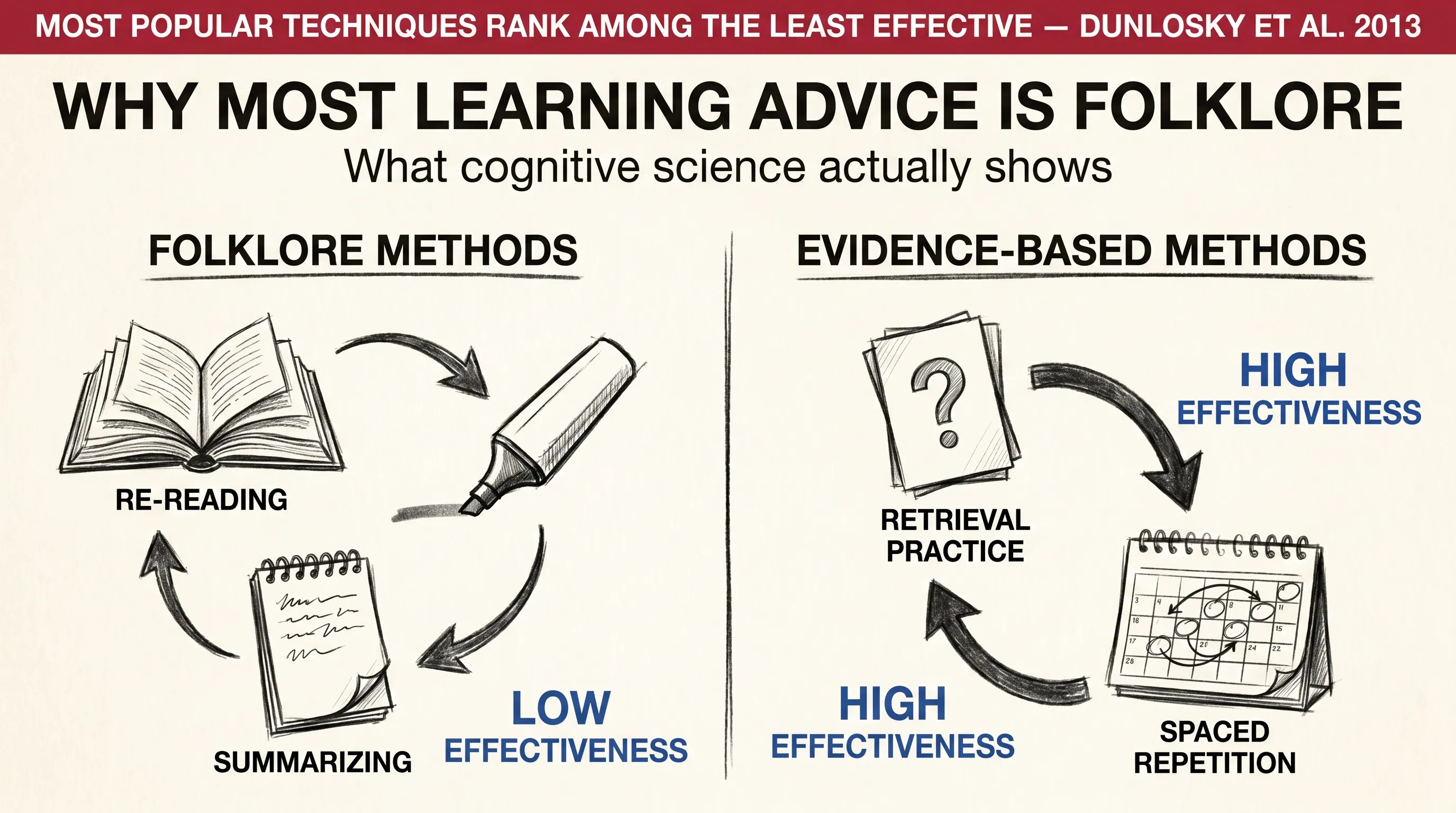
It follows a curve steep enough to measure, model, and, with the right schedule, exploit. The previous post in this series covered active recall, the act of retrieving information from memory instead of re-reading it.
This post covers the second half of the system: when to retrieve. Spaced repetition is the technique of timing each review to land just before a memory would otherwise fade, and it turns the mathematics of forgetting into a scheduling problem that software now solves automatically.
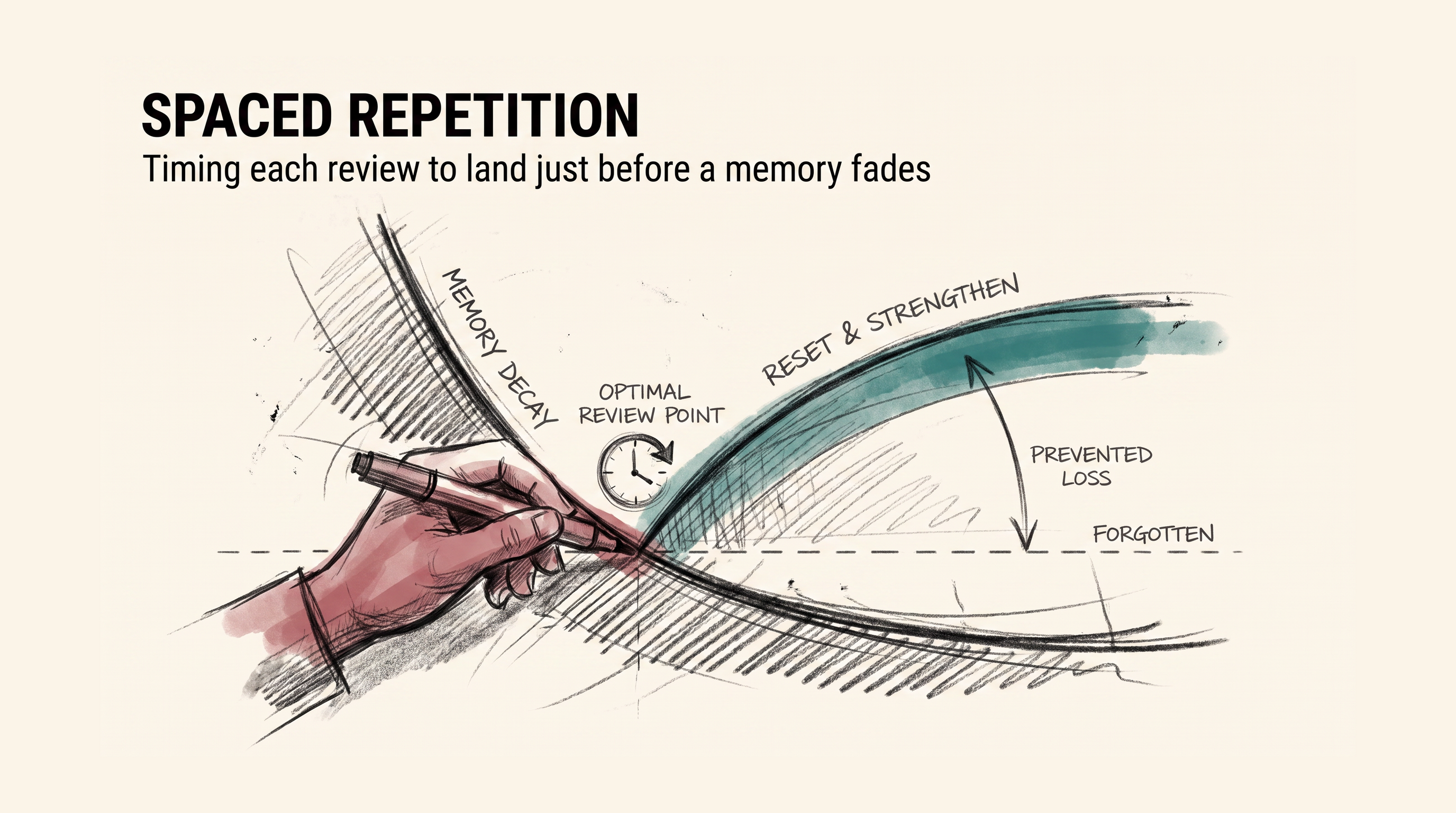
The underlying data is old. In the 1880s, Hermann Ebbinghaus memorized lists of nonsense syllables, waited, and then measured how much effort relearning them required. Retention collapsed fastest in the first hours: roughly 58 percent remained after 20 minutes, about a third after a day, and near a fifth after a month.
The resulting plot became known as the forgetting curve, and its shape is approximately exponential. Memory decays the same way a hot drink cools: fastest at the start, then ever more slowly.
A finding from 1885 could reasonably be doubted, since Ebbinghaus tested exactly one subject: himself. In 2015, Murre and Dros repeated the original procedure under controlled modern conditions and reproduced the curve almost exactly. Forgetting really does follow the shape Ebbinghaus drew by hand 130 years earlier.
WHY SPACING BEATS CRAMMING
The spacing effect is the finding that the same number of reviews produces stronger memory when the reviews spread out over days than when they pack into a single session. It is one of the oldest and most replicated results in experimental psychology; Ebbinghaus himself noted it in the same 1885 monograph. A 2006 meta-analysis by Cepeda and colleagues, covering 254 studies and more than 14,000 participants, confirmed that spaced practice reliably outperforms massed practice on delayed tests across materials, ages, and retention intervals.
Cramming works like a sprint: it covers ground quickly and leaves little behind. A crammer and a spacer can score identically on an exam the next morning, and weeks later the spacer retains most of the material while the crammer retains a fraction of it.
The mechanism connects directly to the previous post. Each spaced review is a retrieval attempt made after some forgetting has occurred, which makes the retrieval harder, and in Bjork’s framework of desirable difficulties, that added difficulty is precisely what strengthens the memory trace. Reviewing material five minutes after learning it is easy and changes little. Reviewing it three days later forces a genuine reconstruction, and the reconstruction is what does the work.
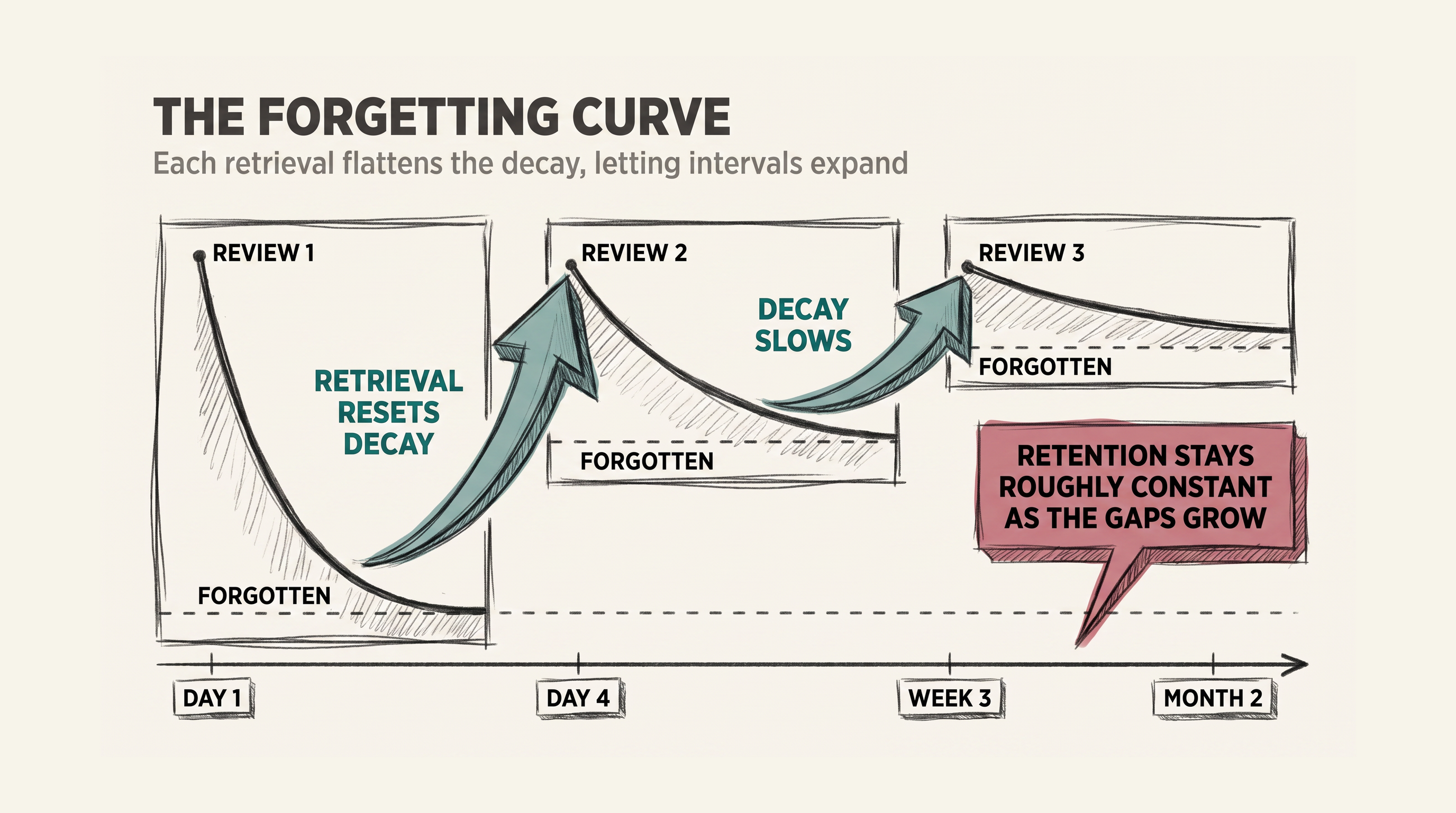
Each successful spaced retrieval also flattens the forgetting curve itself. After the first review, the memory decays more slowly; after the second, more slowly still. The practical consequence is that review intervals can expand, a day, then several days, then weeks, then months, while retention stays roughly constant.
HOW LONG THE GAPS SHOULD BE
The optimal gap between reviews depends on one variable above all: how long the material needs to last. In 2008, Cepeda and colleagues ran a large study in which over 1,300 participants learned trivia facts, reviewed them after gaps ranging from minutes to months, and took a final test up to a year later. The results formed a ridgeline: for every retention goal there was a best-performing gap, and the gap grew with the goal.
The ratios are the useful part. To remember material for about a week, the best single review came roughly a day after learning. To remember it for nearly a year, the best review came about three weeks after learning. As the retention goal stretches, the optimal gap becomes a smaller fraction of it, on the order of 5 to 10 percent for year-long retention.
Nobody needs to memorize those ratios, because software has handled the scheduling for decades. The point of knowing them is calibration: gaps that feel uncomfortably long usually sit closer to optimal than gaps that feel safe. Under-spacing wastes reviews on material in no danger of fading.
THE SOFTWARE THAT RUNS THE SCHEDULE
Spaced repetition predates computers. In the 1970s, Sebastian Leitner described a paper system of numbered boxes: a correctly answered flashcard moves to a box reviewed less often, a failed card moves back to the frequent box. The design already contains the core idea, expanding intervals for known material and rapid retries for weak material.
Software replaced the boxes with per-card scheduling. In 1987, Piotr Wozniak built the SM-2 algorithm for his SuperMemo program: a card starts with an interval of one day, then six days, and each subsequent interval multiplies by an ease factor that rises or falls with the learner’s self-graded answers. Easy cards drift toward reviews months apart; difficult cards stay close.
Anki, the most widely used free spaced repetition tool, ran on an SM-2 variant for most of its history and now ships FSRS, a scheduler fitted to a memory model trained on hundreds of millions of real reviews. The practical workflow is the same in every tool: the learner writes cards, answers the handful the scheduler serves up each day, and grades each answer honestly. A steady 15 to 20 minutes per day can maintain a deck of several thousand cards indefinitely.
The honesty requirement is structural, not moral. The scheduler only sees the grades; inflated grades push intervals out too far, and the card fails silently weeks later.
WHAT BELONGS IN A DECK, AND WHAT DOES NOT
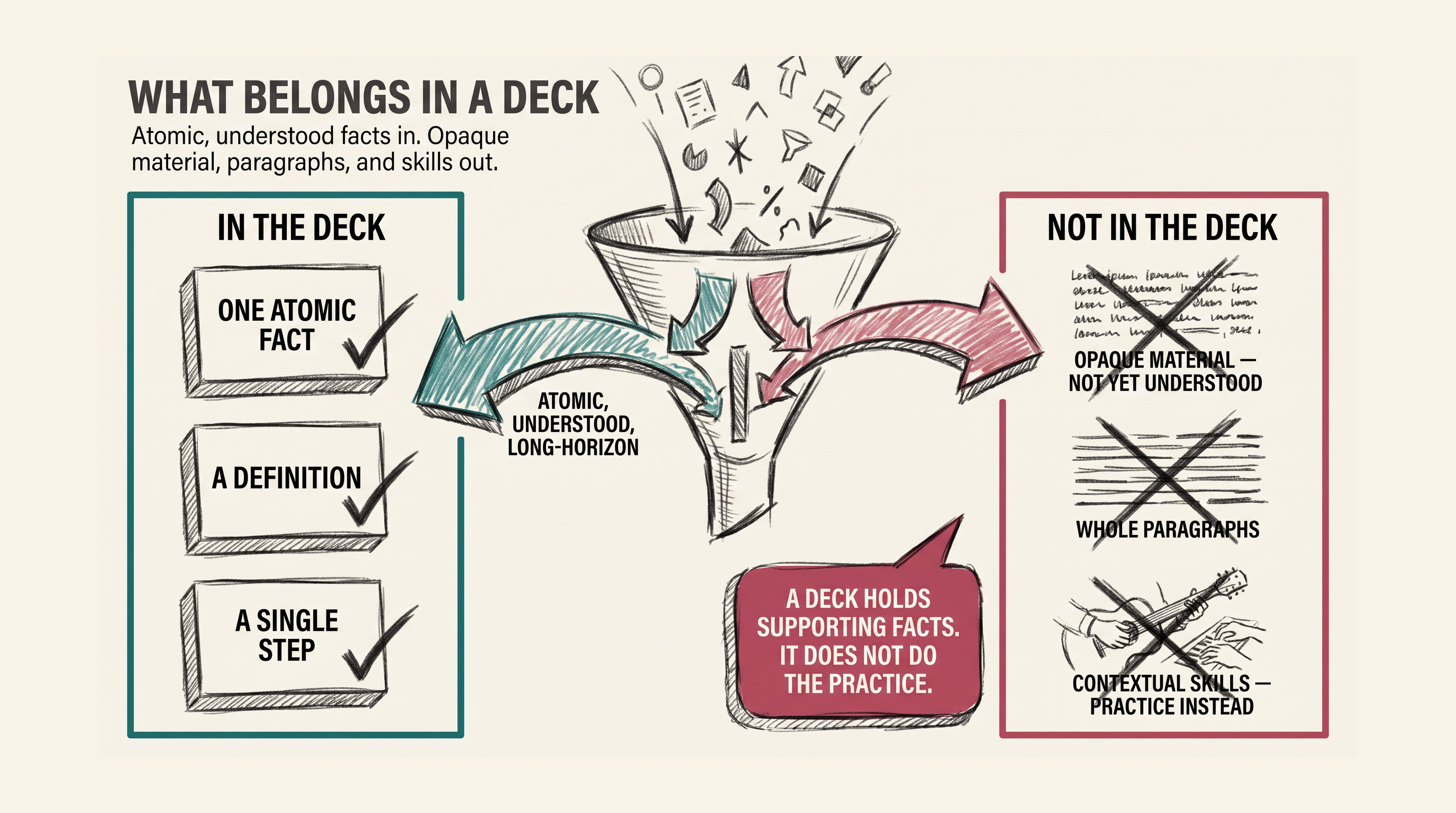
Spaced repetition systems fail most often at the authoring step, not the scheduling step. Wozniak’s widely cited Twenty Rules of Formulating Knowledge opens with the two constraints that matter most: do not memorize what has not been understood, and keep each item as small as possible. A card should test one atomic fact with an unambiguous answer, a definition, a threshold, a name, a formula, a single step of a procedure.
Content that fits the format includes vocabulary, technical terminology, anatomy, dosages, syntax, standards, dates, and any field where a large base of discrete facts must stay retrievable for years. Medical education adopted the method at scale for exactly this reason.
Three categories do not belong. Material the learner does not yet understand belongs in study, not in a deck, because rehearsing an opaque sentence produces fluent recitation without comprehension. Whole paragraphs and multi-part answers belong nowhere; they violate the minimum information principle and produce cards that never earn a clean grade.
And skills that live in context, writing, debugging, playing an instrument, improve through practicing the skill itself. A deck holds the supporting facts the same way a toolbox holds tools; the toolbox does not do the carpentry.
The combined system from these three posts is compact. Encode material through understanding, retrieve it through active recall, and schedule the retrievals so each one lands just before the forgetting curve wins. Ebbinghaus measured the curve in 1885; the schedule that beats it now fits in a pocket.
T.
References
-
Memory: A Contribution to Experimental Psychology - Ebbinghaus (1885, translated 2013), Annals of Neurosciences. The original forgetting curve experiments and the first documented observation of the spacing effect.
-
Replication and Analysis of Ebbinghaus’ Forgetting Curve - Murre & Dros (2015), PLOS ONE. A controlled modern replication that reproduced the shape of the 1885 forgetting curve.
-
Distributed Practice in Verbal Recall Tasks: A Review and Quantitative Synthesis - Cepeda, Pashler, Vul, Wixted & Rohrer (2006), Psychological Bulletin. Meta-analysis of 254 studies confirming spaced practice reliably outperforms massed practice.
-
Spacing Effects in Learning: A Temporal Ridgeline of Optimal Retention - Cepeda, Vul, Rohrer, Wixted & Pashler (2008), Psychological Science. Large-scale study mapping optimal review gaps to retention goals, from days to a year.
-
Effective Learning: Twenty Rules of Formulating Knowledge - Wozniak (1999), SuperMemo. The canonical guide to authoring flashcards, including the minimum information principle.
-
Anki Manual: Deck Options and FSRS - Anki documentation. Describes the current FSRS scheduler and its configuration in the most widely used spaced repetition tool.