THE ONE TECHNIQUE THE RESEARCH KEEPS CONFIRMING
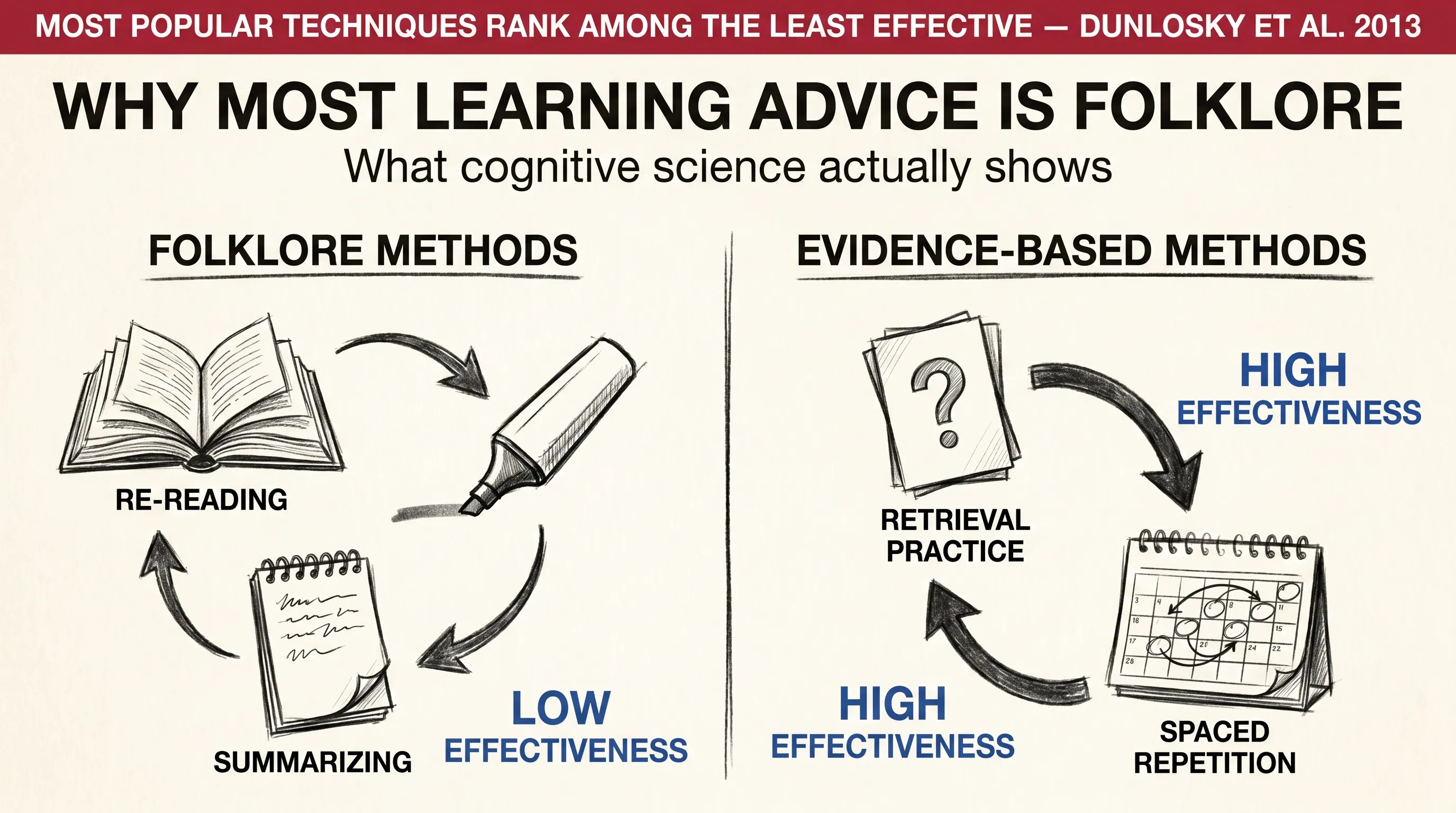
Of the study techniques cognitive scientists have tested, one keeps outperforming the rest across subjects, ages, and formats: active recall, the act of retrieving information from memory rather than looking it up. The prior post in this series covered why re-reading and highlighting rate poorly. This post covers the technique that consistently rates highest, why it works at the level of memory mechanics, and how to convert any material, a textbook chapter, a set of lecture notes, a technical manual, into a set of recall prompts that actually build retention.
Active recall is not a single method so much as a category. Practice testing, flashcards, free recall, closed-book summarization, and self-generated questions all belong to it. What unites them is a single structural feature: at the moment of study, the learner accesses information from internal memory rather than from an external source.
Reading a fact off a page is not active recall. Reciting that fact from memory, with the page closed, is.
WHY RETRIEVAL BUILDS WHAT REVIEW CANNOT
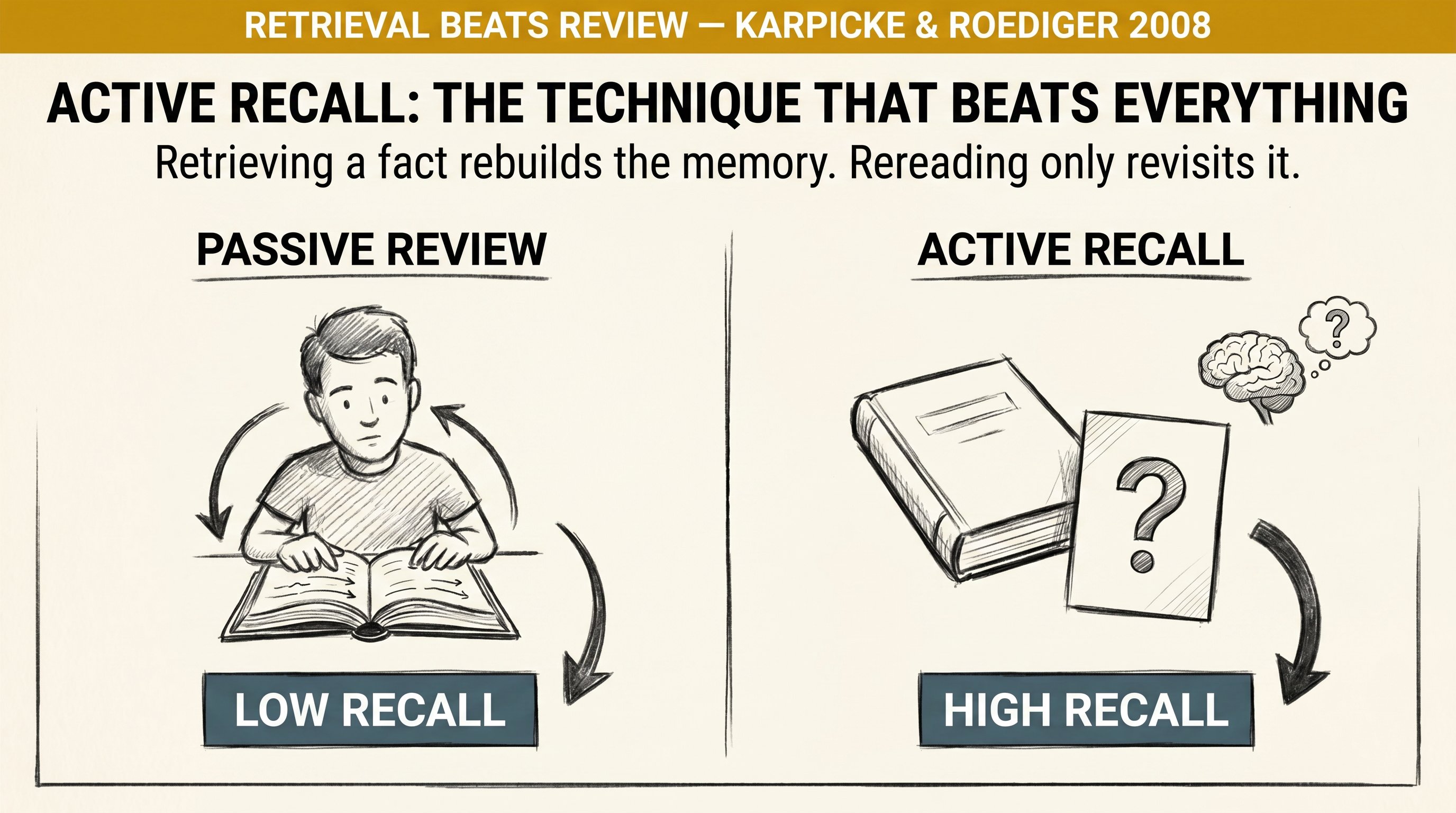
The mechanism behind active recall’s advantage has a name in the research literature: the testing effect. Karpicke and Roediger demonstrated it directly in a 2008 study published in Science. Students studied word pairs under several conditions; the researchers dropped some pairs from further study after one correct recall, and dropped others from further testing after one correct recall.
The result reversed a common assumption. Repeated testing after initial learning produced far better long-term retention than repeated study, even though repeated study felt more thorough at the time.
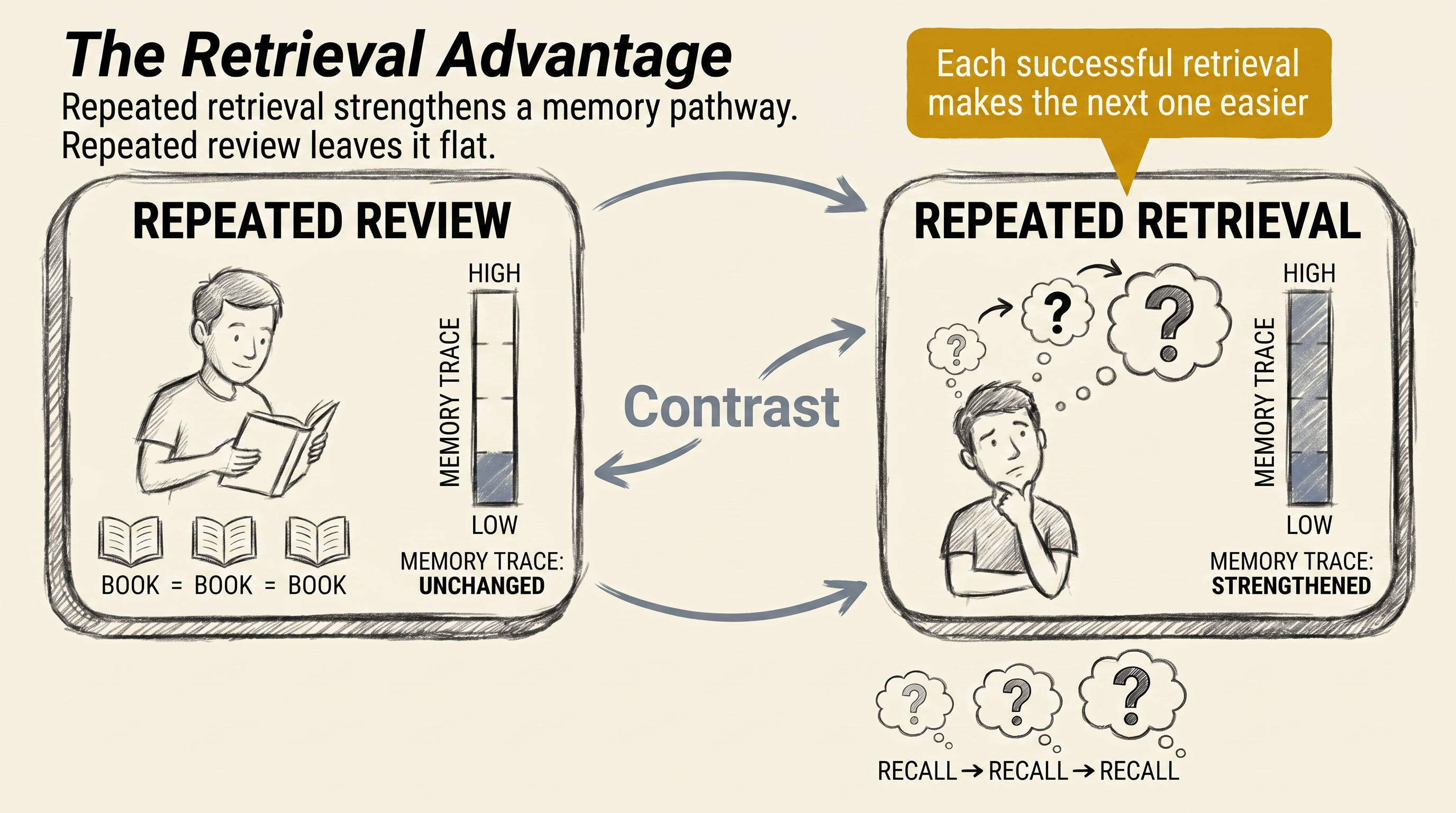
Retrieval strengthens memory in a way that review does not, because retrieval does more than check what a learner already knows. It changes the underlying memory trace directly. Each successful retrieval makes the next retrieval easier and more durable, a property researchers call retrieval-induced facilitation.
Reviewing a fact leaves the memory trace largely unchanged. Retrieving that same fact updates it, strengthens the pathways to it, and makes it more resistant to forgetting.
Karpicke and Blunt extended this finding in 2011, comparing retrieval practice directly against elaborative studying with concept mapping, a technique widely considered a deep and effortful method of studying. Students who practiced retrieval outperformed the concept-mapping group on a test one week later, including on questions that required inference rather than simple fact recall. The result mattered because it ruled out a common explanation for the testing effect: that retrieval wins merely by forcing more total study time. Retrieval practice beat a method that was, by design, more elaborate and time-consuming.
CONVERTING MATERIAL INTO RECALL PROMPTS
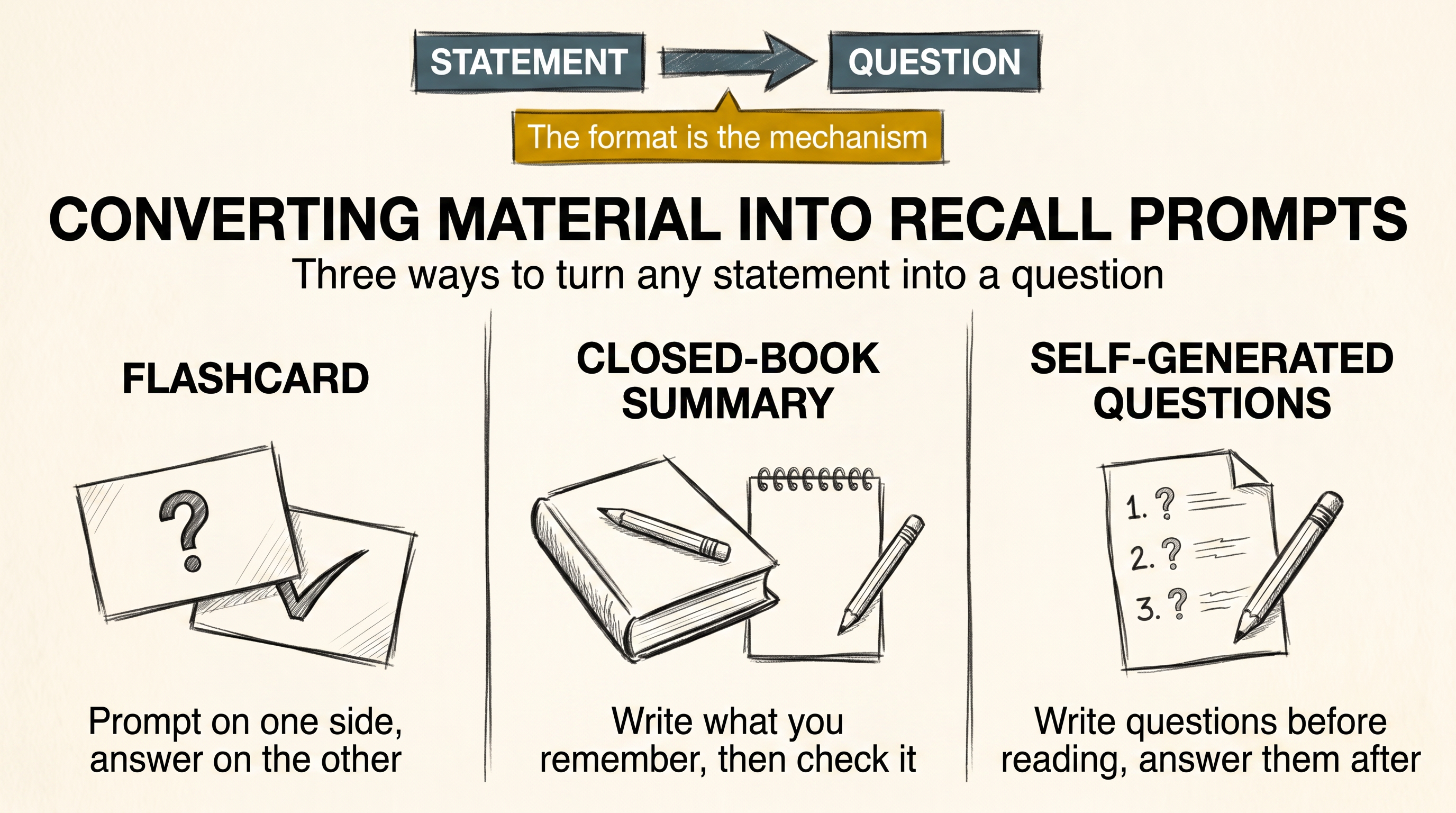
Applying active recall to any material follows a simple conversion: turn each statement into a question. A textbook sentence such as the mitochondria is the site of cellular respiration becomes a prompt such as what is the site of cellular respiration?
The conversion sounds trivial, but the format carries the entire mechanism. A reader can only read a statement. A question forces the reader to answer from memory before checking the answer.
Three conversion methods cover nearly everything a learner encounters.
THE FLASHCARD CONVERSION
Every fact, definition, or discrete relationship becomes a two-sided card: prompt on one side, answer on the other. This works best for vocabulary, formulas, dates, named concepts, and any content with a clear one-to-one mapping between a cue and a fact. Spaced repetition software automates the scheduling of these cards, though the scheduling itself is a separate technique covered later in this series.
THE CLOSED-BOOK SUMMARY
After reading a section, the book closes and the learner writes, from memory, everything retained: the main argument, the supporting evidence, the structure of the reasoning. This method suits material with connected ideas rather than isolated facts, a journal article, a chapter of argument-driven prose, a case study. The summary is then checked against the original text, and gaps become the next round of targeted review.
THE SELF-GENERATED QUESTION SET
Before reading a chapter, the learner previews the headings and writes questions each section should answer. After reading, the learner attempts the questions from memory. This method works particularly well for procedural or technical material, since it forces engagement with structure before the details arrive, and it produces a personalized question bank that mirrors how the material will likely be tested or applied later.
None of these methods requires special tools. A stack of index cards, a blank document, or a whiteboard accomplishes the conversion equally well. The tool matters far less than the structural shift from reading a statement to answering a question.
WHY IT FEELS HARDER, AND WHY THAT IS THE POINT
Active recall consistently feels less pleasant than review. Retrieving a half-remembered fact under uncertainty produces a genuine sense of struggle, sometimes outright failure, that re-reading never does.
This discomfort is often the reason students abandon the technique after a few attempts, concluding it does not work as well as the smoother alternative.
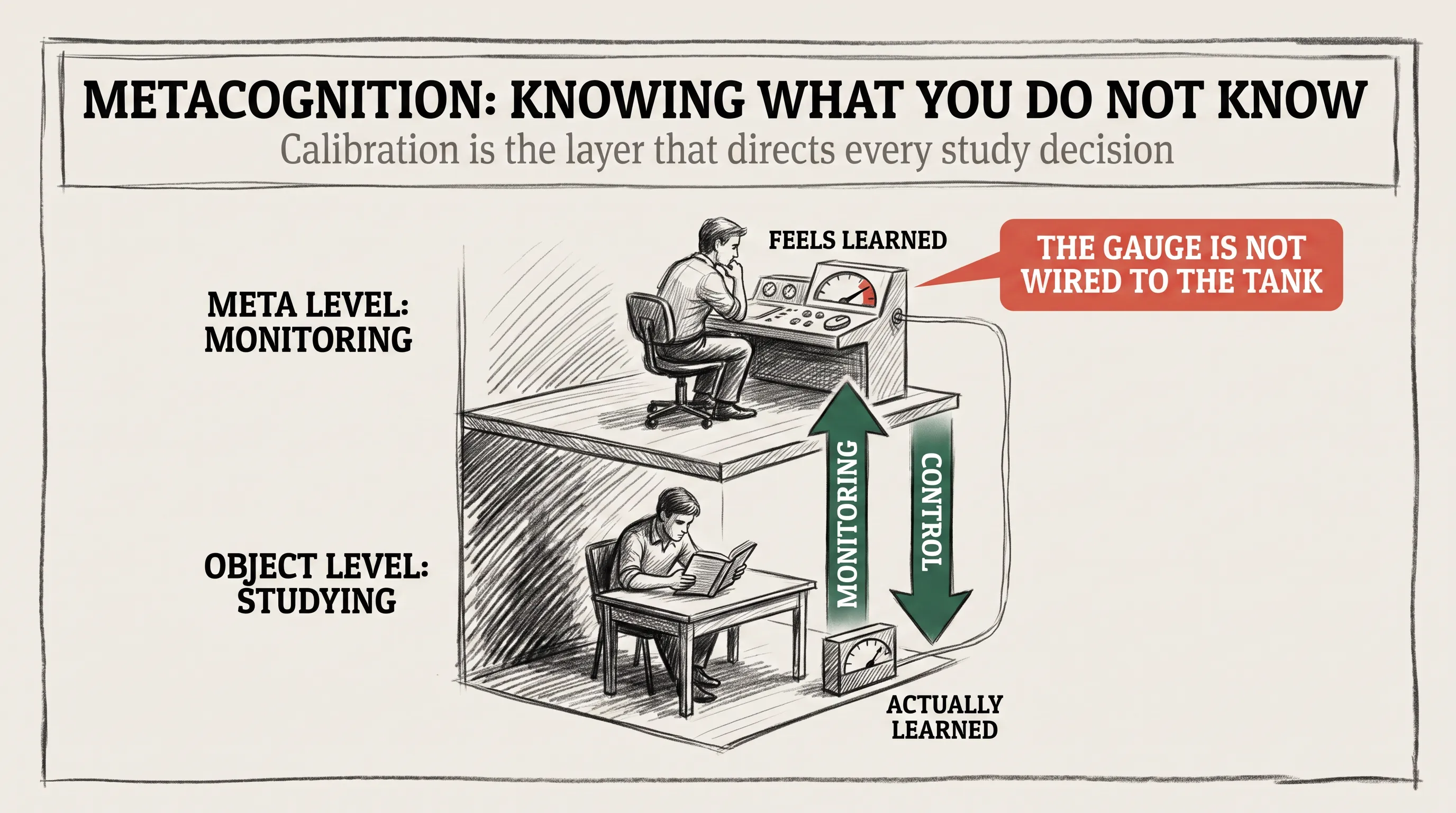
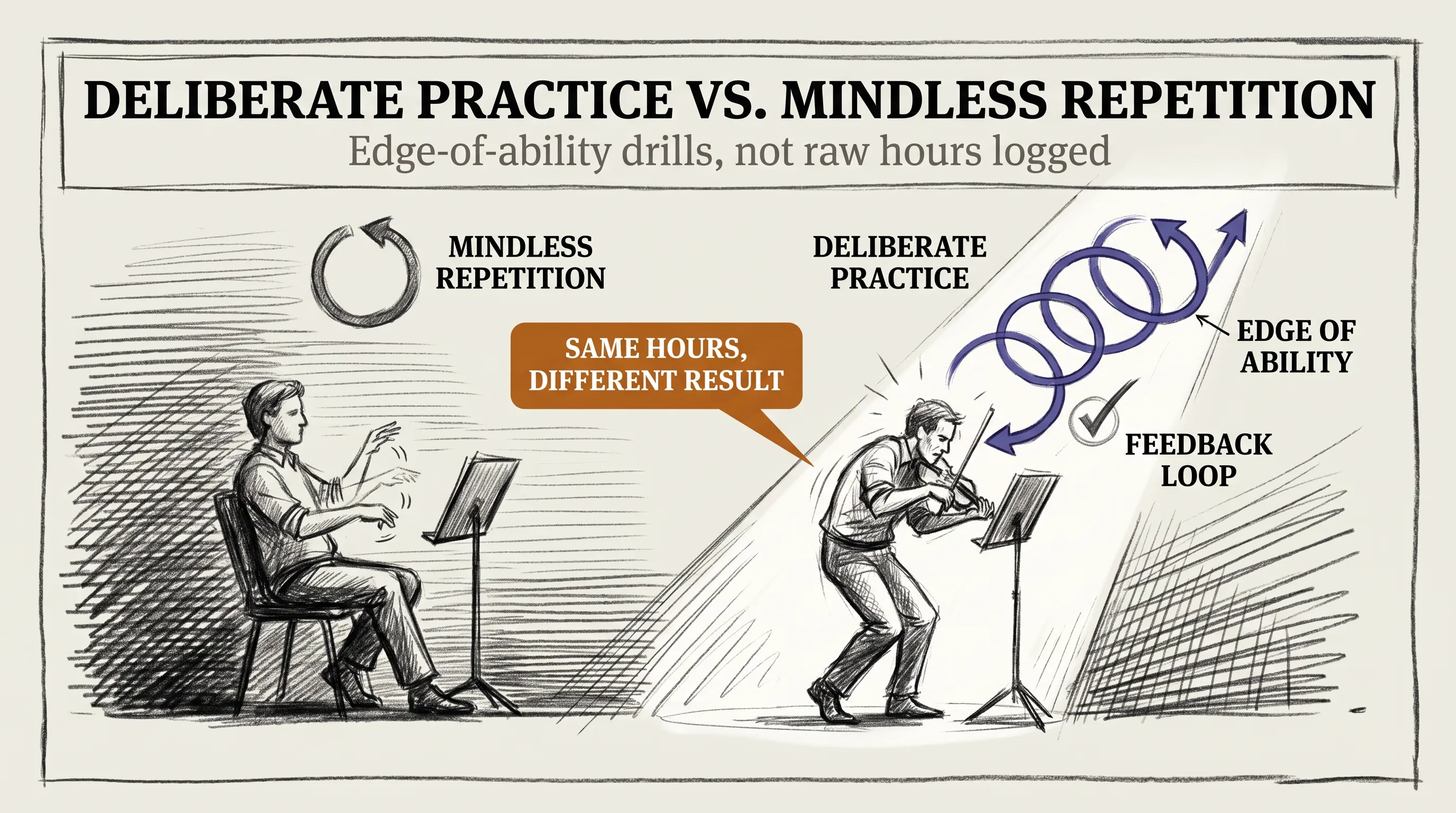
The discomfort is not a sign of failure. Bjork’s framework of desirable difficulties, discussed in the previous post, predicts precisely this pattern: conditions that make retrieval harder in the moment tend to produce stronger long-term retention, provided the retrieval eventually succeeds or corrective feedback follows it.
Difficulty during practice and durability after practice move together, not apart.
Agarwal, Bain, and Chamberlain documented this gap between subjective experience and actual outcome directly in classroom settings.
Across multiple studies with middle and high school students, low-stakes retrieval practice, quizzes with no grade weight, improved unit test performance substantially compared to equivalent time spent reviewing material, and the effect held across subjects and grade levels. Students in these studies often rated the retrieval sessions as more effortful and less enjoyable than review sessions covering the same content, and their test scores told the opposite story.
Medical education research reaches the same conclusion. Larsen, Butler, and Roediger compared testing-based review against re-studying in a group of medical residents learning about neurological disorders. Six months later, the group that used retrieval practice retained significantly more material than the group that re-studied the same content for the same amount of time, in a field where retention has direct consequences for patient care.
The evidence converges on a specific claim, not a general one: struggle correlates with durability only when the retrieval attempt is genuine and eventually corrected. Guessing without feedback, or abandoning a difficult recall attempt before checking the answer, does not produce the same benefit. The technique requires closing the book, attempting the answer, and then checking it, in that order, every time.
T.
References
-
The Critical Importance of Retrieval for Learning - Karpicke & Roediger (2008), Science. Repeated retrieval after initial learning produces far greater long-term retention than repeated study of the same material.
-
Retrieval Practice Produces More Learning than Elaborative Studying with Concept Mapping - Karpicke & Blunt (2011), Science. Retrieval practice outperformed concept mapping, a more time-consuming and elaborate study method, on delayed tests including inference questions.
-
The Critical Role of Retrieval Practice in Long-Term Retention - Roediger & Butler (2011), Trends in Cognitive Sciences. Review of the mechanisms behind the testing effect and its consistency across memory research.
-
The Value of Applied Research: Retrieval Practice Improves Classroom Learning and Recommendations from a Teacher, a Principal, and a Scientist - Agarwal, Bain & Chamberlain (2012), Educational Psychology Review. Low-stakes classroom quizzing improved test performance across subjects and grade levels even though students rated it more effortful.
-
Test-Enhanced Learning in Medical Education - Larsen, Butler & Roediger (2008), Medical Education. Retrieval-based review produced significantly better six-month retention than re-studying among medical residents.