THE PROBLEM WITH POPULAR STUDY ADVICE
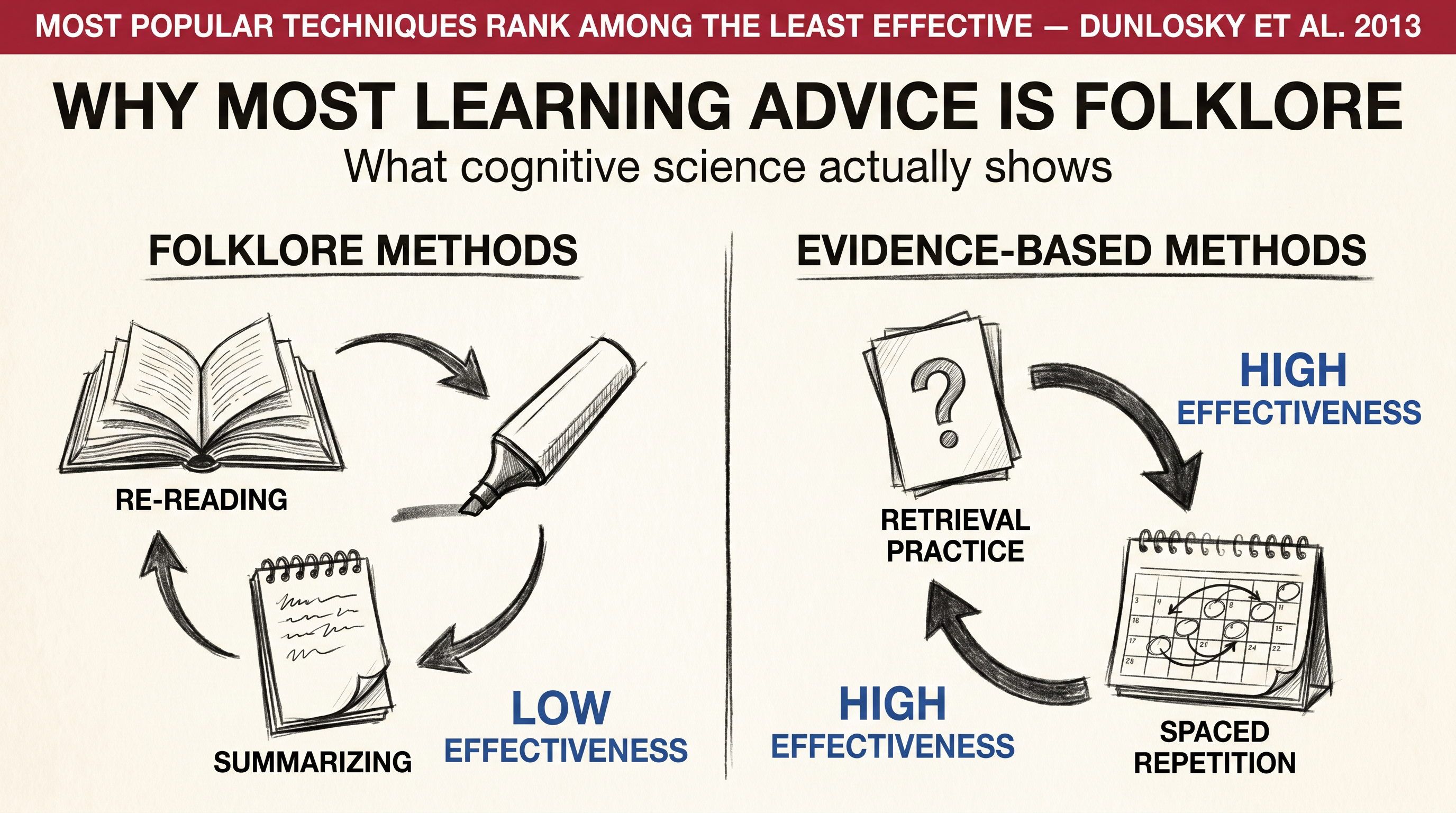
When students seek guidance on how to study, they typically receive the same advice: re-read your notes, highlight key passages, summarize chapters in your own words. This advice has persisted across generations of educational culture, passed from teachers to students with the confidence of settled science. It is not settled science. A substantial body of cognitive psychology research, much of it conducted over the past three decades, consistently shows that these methods rank among the least effective techniques available for building durable long-term memory.
The disconnect between popular belief and scientific evidence in learning is not a minor calibration issue. In a landmark 2013 meta-analysis published in Psychological Science in the Public Interest, John Dunlosky and colleagues evaluated ten widely used study techniques across five dimensions of utility.
Dunlosky and colleagues rated re-reading low in utility. They rated highlighting and underlining low as well. They rated summarization low too. Yet students rarely use the techniques that earned high utility ratings, practice testing and distributed practice, and mainstream study guides rarely emphasize them.
Popular study advice behaves like a chain letter: it convinces on each retelling, but almost nobody checks it against the original evidence.
This series, Learn Hard, Focus Harder, examines what cognitive science actually shows about learning and attention. This first post addresses the foundational question: why does so much popular learning advice fail, and what mechanism explains the persistence of ineffective methods despite clear evidence against them?
THE ENCODING-RETRIEVAL GAP
Understanding why popular study methods underperform requires understanding how memory actually works. Memory is not a single unified system. Cognitive psychologists distinguish between encoding (taking information in and forming an initial memory trace) and retrieval (pulling that information back out when needed). Think of encoding and retrieval as two separate skills, not two names for the same one: the two processes are related but not equivalent, and conflating them causes most ineffective study behavior.
When a student re-reads a chapter, encoding occurs. Familiarity with the material increases. The text feels more recognizable on each pass. This familiarity is real and measurable, but it is not the same as the ability to retrieve information independently.
Familiarity comes from the ease with which the current perceptual input matches a stored trace, what researchers call perceptual fluency. Retrieval, by contrast, requires reconstructing information from internal cues without the external support of the text itself.
The gap between these two processes is the encoding-retrieval gap. High encoding quality does not automatically produce high retrieval quality. Recognizing a face in a photograph is far easier than describing that person from memory without the photograph present.
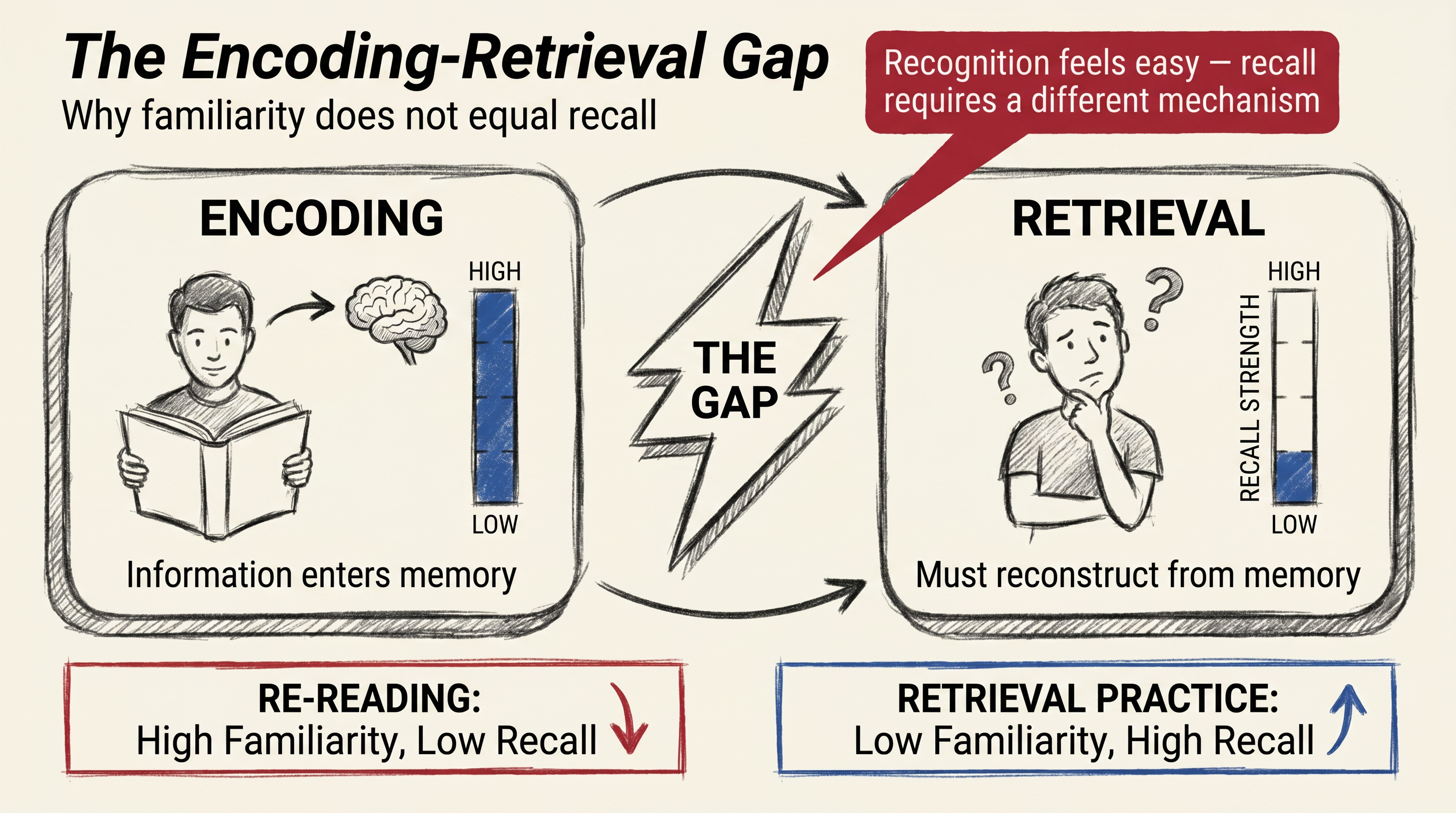 The same logic applies to textbook material: a student can encode a passage fifty times and still fail to recall its central argument without the text in front of them. What builds retrieval strength is the act of retrieval itself, not the act of re-encoding.
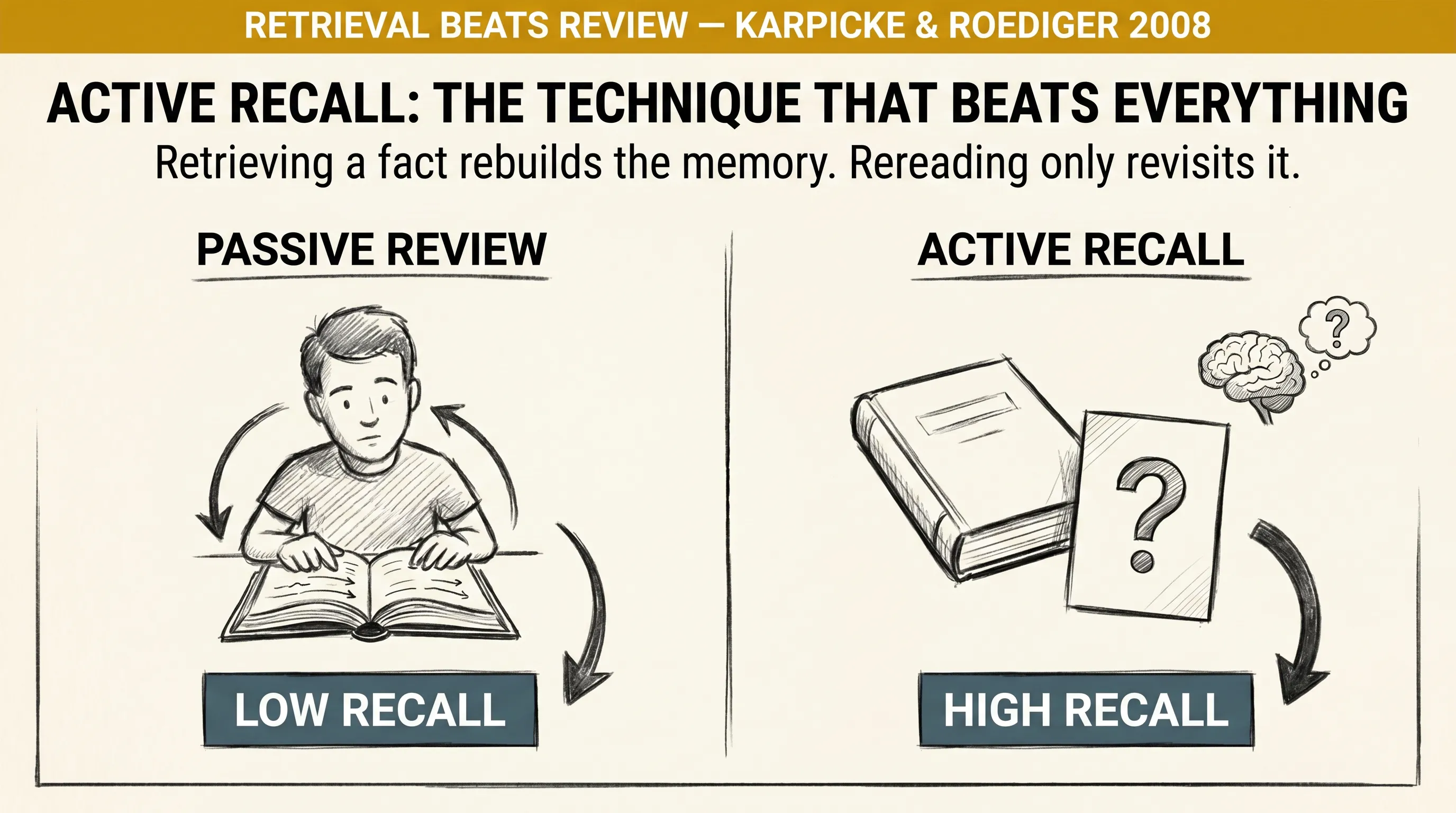
Researchers have replicated this finding across dozens of studies. Roediger and Karpicke’s 2006 study in Psychological Science compared students who studied prose passages through repeated reading against students who studied once and then attempted to recall the passage freely.
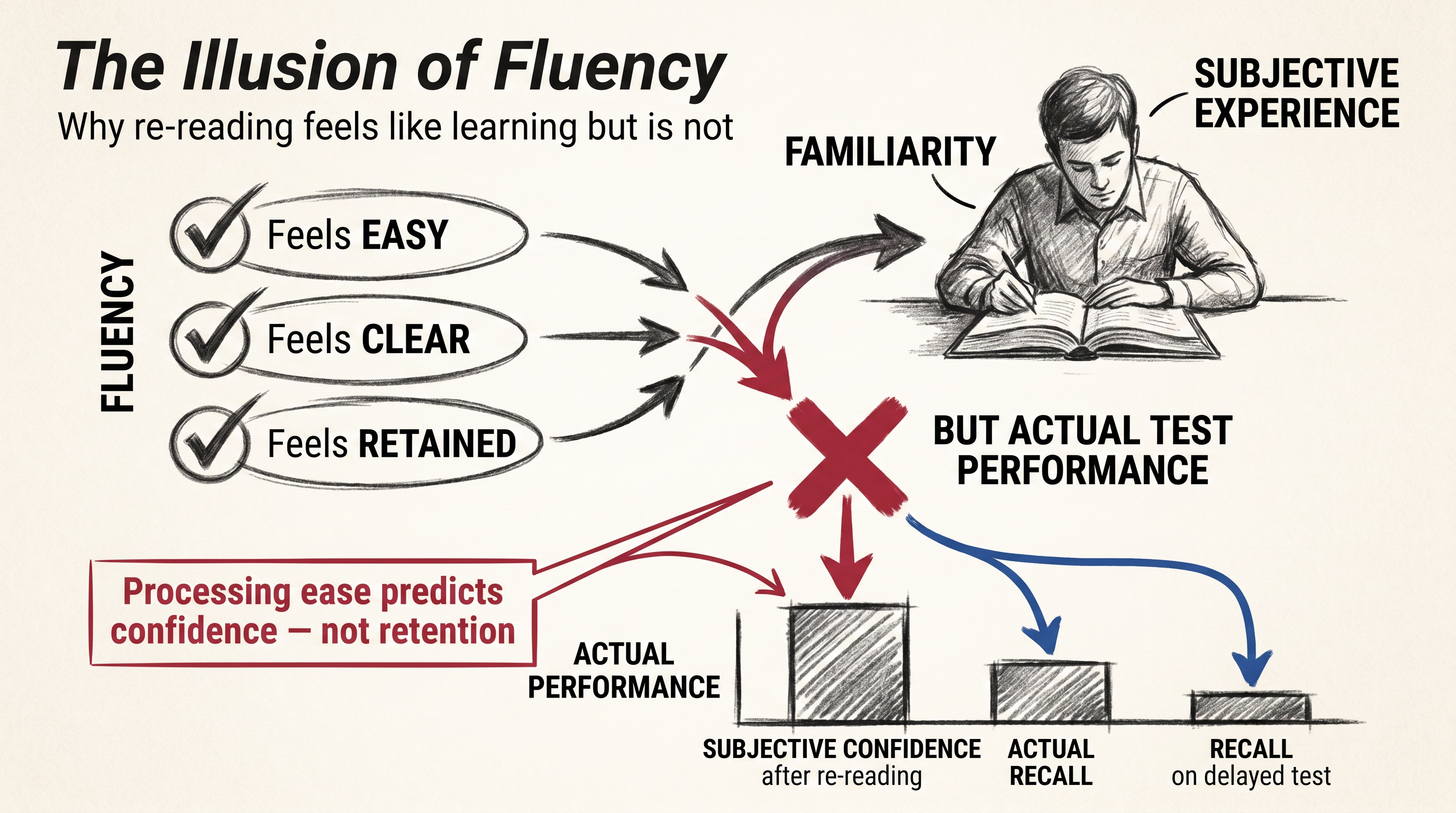
On a test one week later, the retrieval-practice group outperformed the repeated-reading group by a substantial margin. Importantly, the repeated-reading group reported higher confidence immediately after studying, while the retrieval-practice group found the process harder and reported lower confidence. Actual performance reversed this subjective judgment entirely.
THE ILLUSION OF FLUENCY
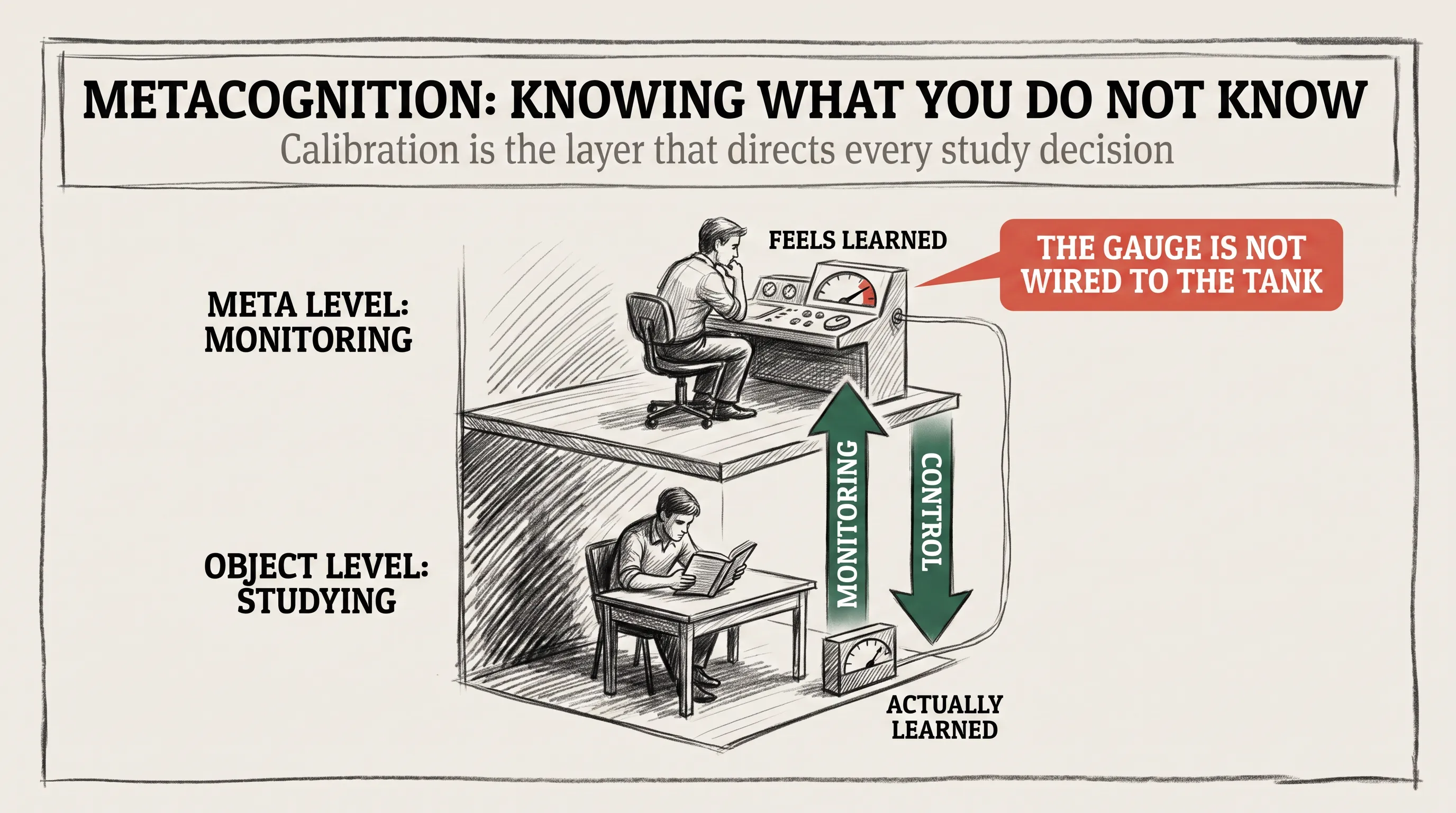
The persistence of ineffective study methods is not simply a matter of ignorance. Students who use re-reading and highlighting genuinely believe these techniques work, and they believe this because the techniques produce a real and detectable feeling of learning. That feeling is the illusion of fluency.
Fluency, in this context, means the ease with which cognitive processing occurs. Watching an expert perform a skill looks effortless, but that smoothness does not mean the observer could replicate the skill. Re-reading works on the same perceptual mechanism: a familiar text reads fast and smooth, the reader recognizes the words immediately, and the arguments feel clear. This ease feels like a smooth downhill coast: fast and effortless, but it does not build the muscle needed to climb the same hill later. It actually measures familiarity with the surface form of the material rather than deep encoding of its meaning.
Research by Bjork and colleagues on desirable difficulties provides a framework for understanding this phenomenon. Conditions that make encoding harder, such as spacing practice over time, varying the context of study, and requiring retrieval rather than recognition, actually improve long-term retention even though they feel less productive in the moment. The reverse is also true: conditions that make encoding feel easy and smooth often produce weaker long-term memory, precisely because the cognitive effort required for durable learning is absent.
Highlighting is a clear example. The act of physically marking text creates a feeling of engagement and active processing. Returning to a highlighted chapter provides an even stronger fluency experience, since the key content already stands out, pre-selected and visually distinct.
Yet multiple studies show that students who highlight perform no better on subsequent tests than students who simply read, and in some conditions perform worse, because highlighting may substitute for deeper processing. The hand does the work, and the mind takes a rest.
WHAT THE EVIDENCE ACTUALLY SUPPORTS
The Dunlosky meta-analysis identified two techniques with strong evidence of effectiveness: practice testing and distributed practice (also known as spaced repetition).
Practice testing, also called the testing effect or retrieval practice, refers to any activity that requires the learner to retrieve information from memory rather than review it from an external source. This includes answering practice questions, writing summaries from memory, creating flashcards and self-testing, or engaging in free recall: closing the book and writing down everything just learned.
The mechanism behind the testing effect is well established. Each act of retrieval strengthens the memory trace for the retrieved information and makes future retrieval more reliable.
The effort involved in failed or partially successful retrieval attempts, that uncomfortable feeling of struggle, appears to be a feature rather than a bug. Research by Kornell and Bjork (2007) showed that difficult, effortful retrieval attempts, even when unsuccessful, produced better long-term retention than easy retrieval of the same information. Difficulty during practice predicts durability after practice.
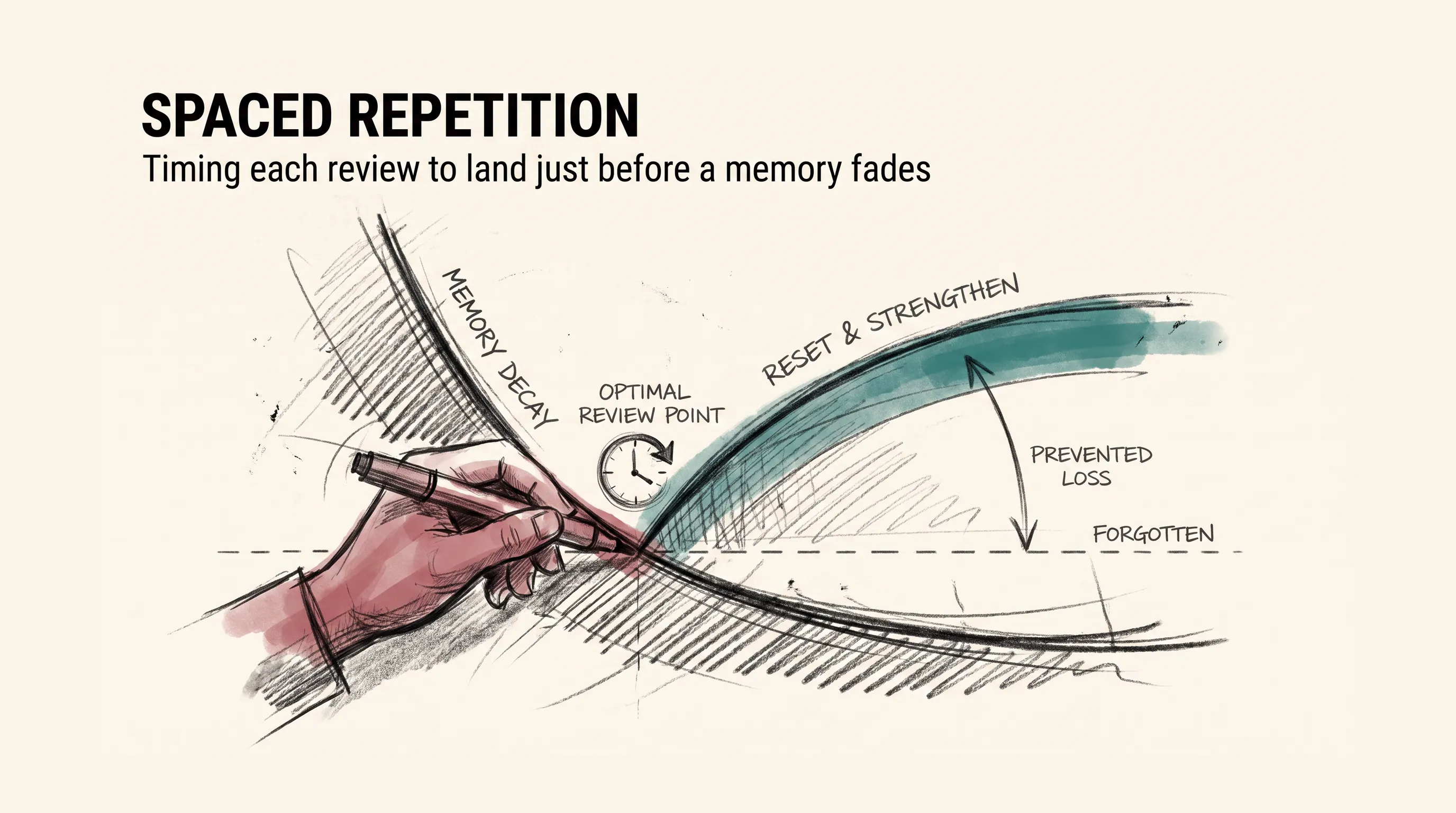
Distributed practice means spreading study sessions across time rather than concentrating them immediately before a test. The spacing effect, the finding that students retain material studied across multiple sessions better than the same content studied in a single massed session, ranks among the most reliable findings in the psychology of memory. Hermann Ebbinghaus first documented it in the 1880s.
Cramming works like watering a plant all at once: the ground absorbs what it can, and the rest runs off. Distributed study gives memory the intervals it needs to consolidate. Despite this, massed practice remains the dominant study strategy at every level of education.
The reason students underuse distributed practice mirrors the reason they underuse retrieval practice: it feels less productive. Studying material several days after initial learning requires more effort than reviewing it while still fresh. The information feels harder to access.
This feeling accurately describes the cognitive experience but predicts outcomes in the wrong direction. The very effort required is what makes the technique effective.
IMPLICATIONS FOR THE SERIES
The evidence in this post does not mean that all conventional study advice is wrong. Summarization, though Dunlosky and colleagues rated it low in utility, performs better when students learn to generate explanatory rather than descriptive summaries. The key constraint: techniques must require genuine cognitive effort and ideally require retrieval or reconstruction rather than passive review.
The series that follows examines these mechanisms in depth: active recall, spaced repetition scheduling, deliberate practice for skill development, metacognition and calibration, and the role of attention in encoding. Each post draws on peer-reviewed research in cognitive psychology and educational science.
The central argument of the series is not that learning is harder than commonly believed. It is that learning is differently hard: the techniques that feel productive often are not, and the techniques that feel difficult often work precisely because of that difficulty.
T.
References
-
Improving Students’ Learning With Effective Learning Techniques - Dunlosky et al. (2013), Psychological Science in the Public Interest. Meta-analysis of ten study techniques; practice testing and distributed practice rated high utility, re-reading and highlighting rated low.
-
Test-Enhanced Learning: Taking Memory Tests Improves Long-Term Retention - Roediger & Karpicke (2006), Psychological Science. Retrieval practice outperforms repeated studying on delayed tests despite lower immediate confidence.
-
Memory and metamemory considerations in the training of human beings - Bjork (1994), in Metcalfe & Shimamura (Eds.), Metacognition: Knowing about knowing. Foundational framework for desirable difficulties and the relationship between encoding ease and long-term retention.
-
The promise and perils of self-regulated study - Kornell & Bjork (2007), Psychonomic Bulletin & Review. Learners’ preferences for massed study conflict with the evidence for spaced practice.
-
Memory: A Contribution to Experimental Psychology - Ebbinghaus (1885/1913). Original documentation of the forgetting curve and spacing effect, foundational to all subsequent spaced-repetition research.