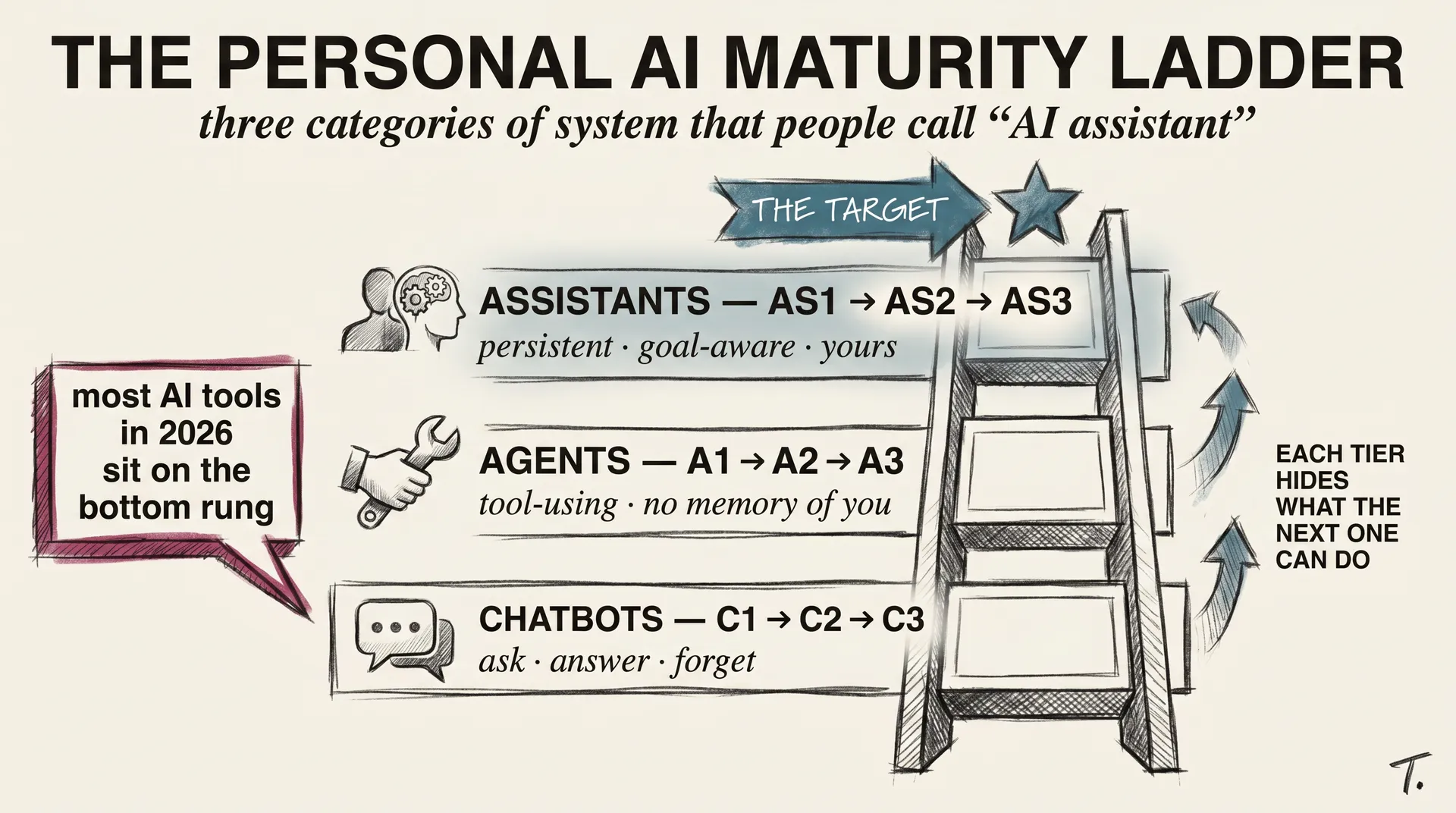
The previous article made the case for the assistant tier. Persistent identity, memory of you, alignment with your goals. The next obvious question is what you actually install to get there.
By the middle of 2026 there are three options for someone who wants more than a hosted chatbot but does not want to invent the whole stack themselves. Each one assumes a different center of gravity. Each one fits a different temperament. I have spent real time with all three, and I run one of them as my daily.
KAI, OR PAI
Kai is the name Daniel Miessler uses for his Personal AI Infrastructure. PAI is the framework, Kai is his instance of it. Anyone who runs it gives their version a different name. I call mine Cicero.
PAI runs on top of Claude Code, which is Anthropic’s terminal-native coding agent. That choice matters more than it looks at first.
It means a PAI install is a directory of plain Markdown and TypeScript files, version-controlled in git, edited like code. There is no app, no GUI, no vendor lock. The same skills that read your morning brief also publish your blog and respond to your messages.
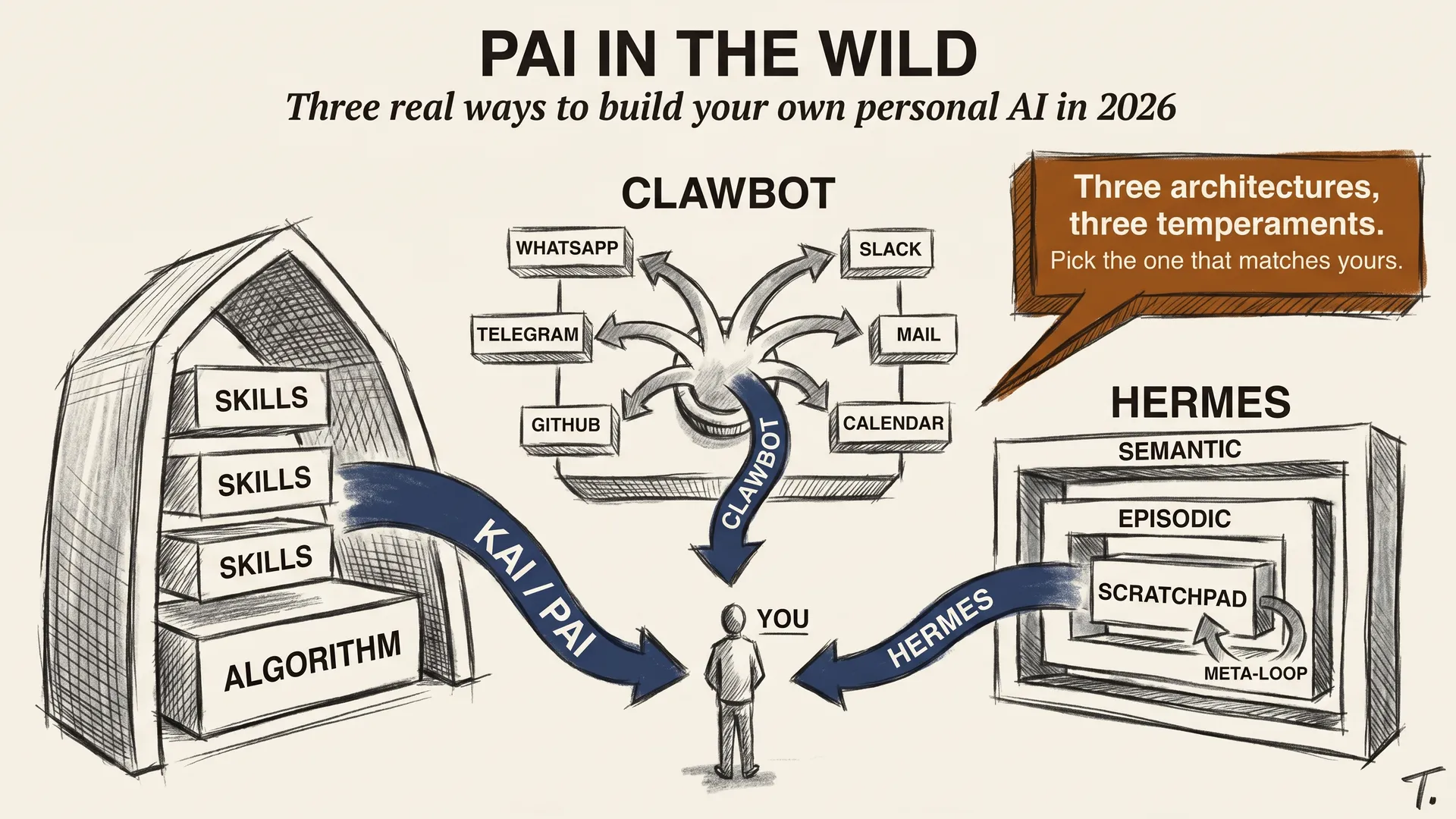
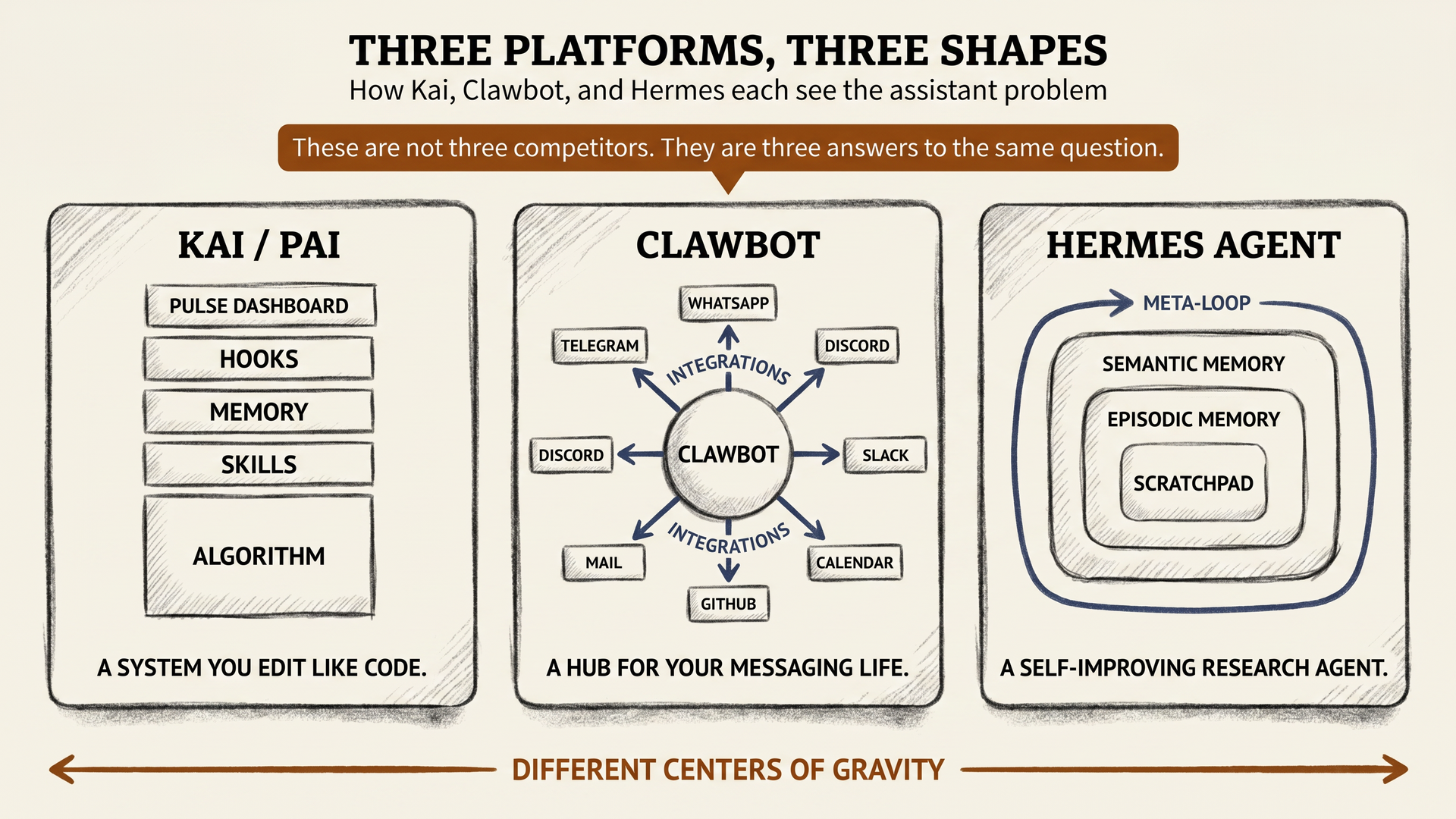
The architecture has seven big pieces. An Algorithm that decides how hard to think about each task. A skill system where each capability lives in its own folder with its own prompt and tools. A memory system that compounds across sessions.
On top of that sit a hook system that fires on events, a notification layer with voice, an observability layer, and a dashboard called Pulse for the human in the loop. Honestly, it reads more like an operating system than a chatbot, and that is the point.
The bet is that prompts and instructions are software, and software should be edited the way you edit any other code. If you are already a developer, this is the shortest path to a system that actually does work for you.
The cost is that you need to be comfortable in a terminal. PAI does not hide complexity. It exposes complexity on purpose, so you can change it.
Think of it less like Notion and more like Linux. People who want an app will hate this. People who want a tool will love it.
CLAWBOT
Clawbot is the integrations-first option. The pitch is local-first hosting plus a long list of services it already talks to. WhatsApp, Telegram, Discord, Slack, calendar, mail, GitHub, Notion, plus a few dozen more.
The first thing you notice when you install it is that the messaging part already works. No glue code, no API plumbing, no half-broken bots. That alone saves a weekend.
If your daily life happens inside chat apps, this is where Clawbot earns its weight. You run it on a small home server and reach it from your phone the same way you reach a friend.
Ever tried to write a custom Telegram bot from scratch? It is the kind of small pain that adds up to never finishing. Clawbot removes it.
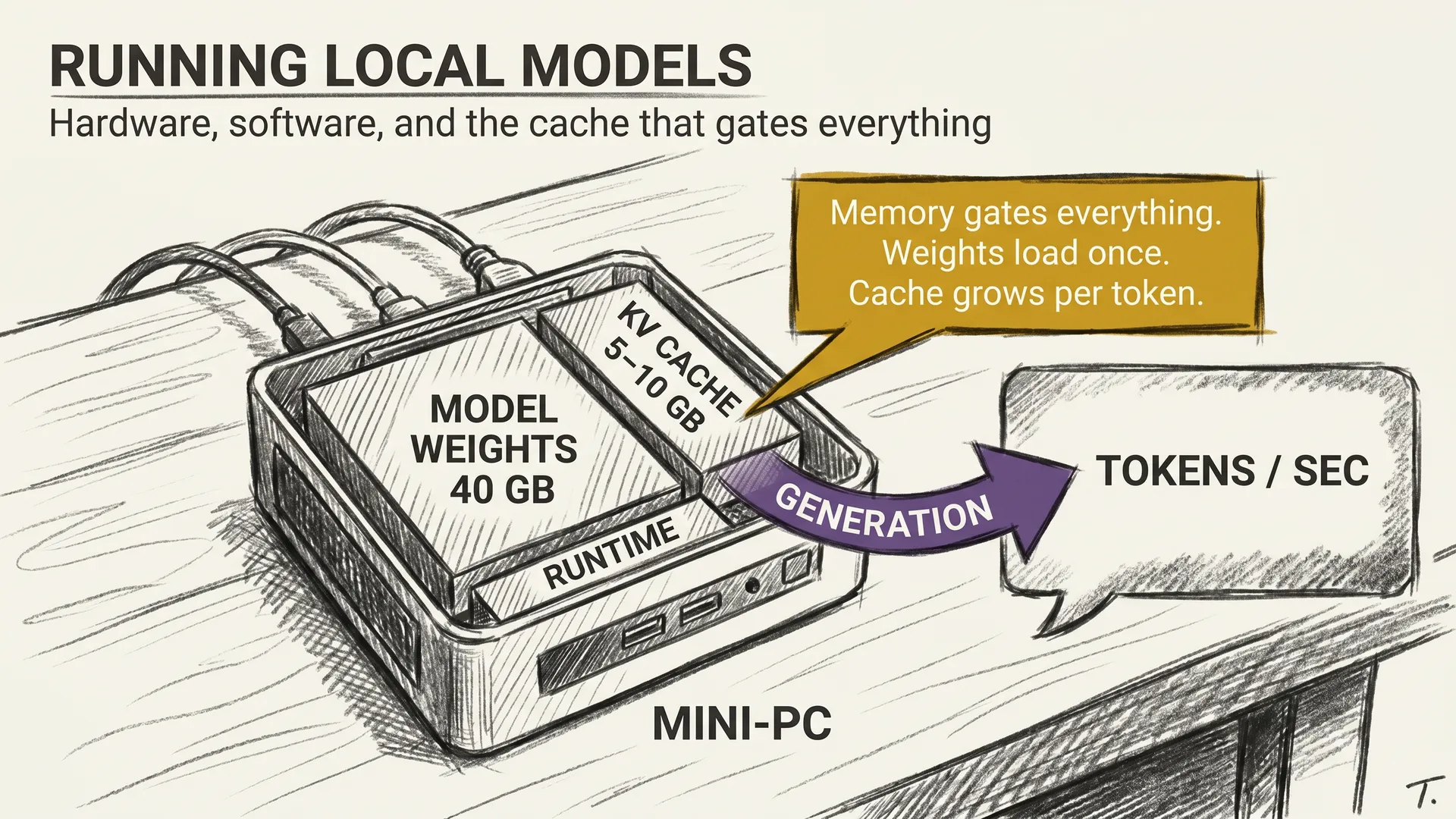
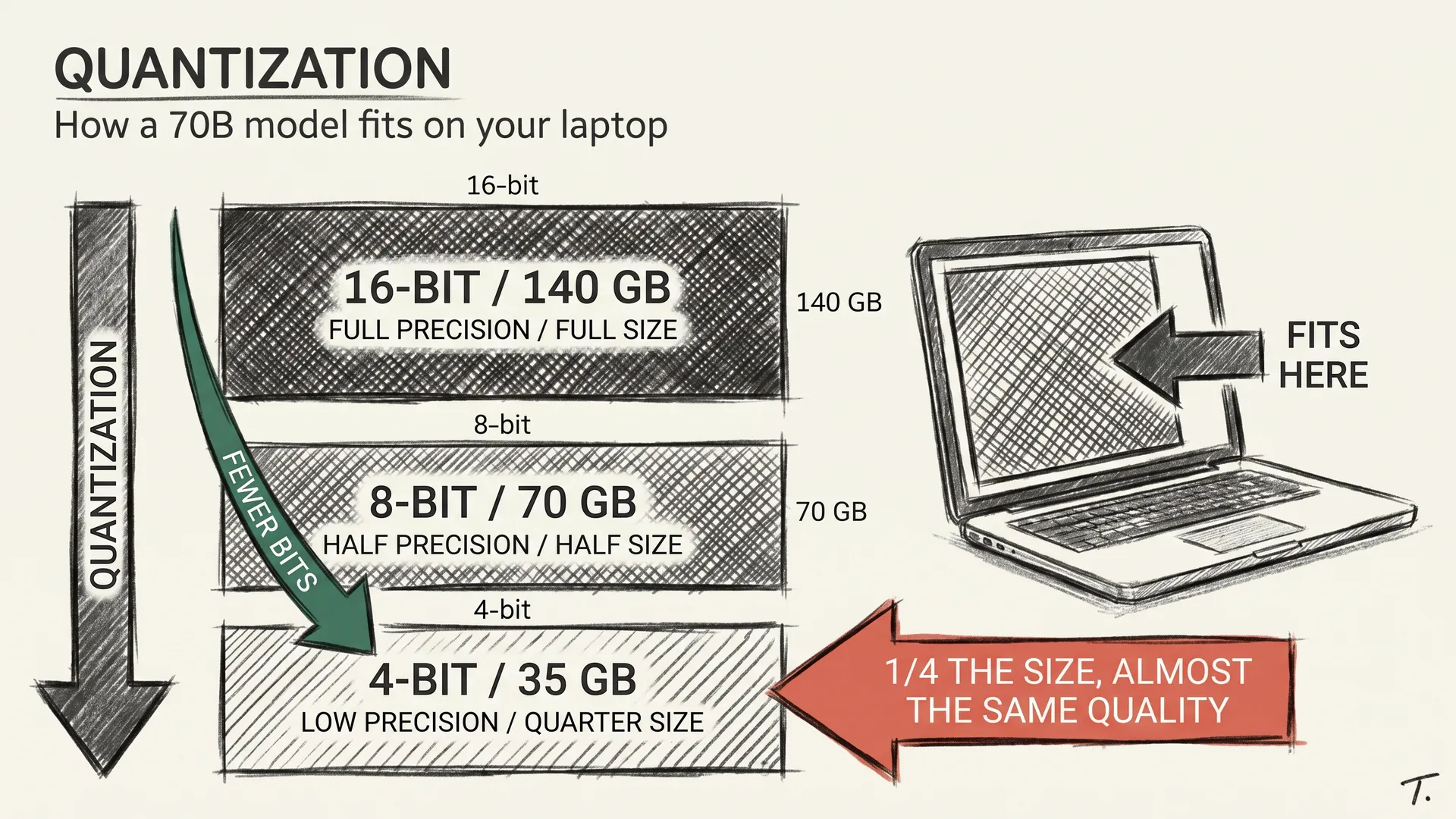
Under the hood Clawbot uses Docker, so the install is a compose file and a few credentials. It runs local models via Docker Model Runner, hosted models via the usual APIs, or a mix. You can fall back from local to hosted when you need more brain.
The trade is shape. Clawbot covers the messaging layer well, the assistant layer less so. If you want hill-climbing toward goals, persistent identity that grows over years, the kind of long-loop assistant the last article described, you will end up bolting that on yourself.
HERMES AGENT
Hermes Agent is the Nous Research project. It is open source, over 180K stars on GitHub, and the most ambitious of the three on the agent-architecture side. Hermes wants to be a self-improving AI rather than a useful tool, and the codebase reads that way.
The headline feature is three-layer memory. A short-term scratchpad for the current task. A medium-term episodic store for recent sessions. And a long-term semantic memory the agent updates from its own activity.
The model writes the memories, the model reads them, and the loop sharpens at you over time. Imagine a notebook that quietly rewrites itself between meetings to highlight only what matters.
The other thing Hermes does that the others do not is the meta-loop. The agent watches its own behavior, scores how well a session went, and rewrites its own prompts and patterns based on what worked. It is the closest a public project has come to a Lamarckian assistant.
The cost is maturity. Hermes is research-grade. It is the platform you pick when you want to learn how this kind of system works, not when you want to ship something tomorrow.
THE COMPARISON
The honest summary is that these three projects are not direct competitors. They sit on different axes.
Kai is for people who want to own and edit their assistant as code. The center of gravity is the Algorithm and the skills system. It rewards the developer, punishes the non-developer, and ages well because it is plain files.
Clawbot is for people who want a working messaging-first AI on a home server in a weekend. The center of gravity is the integrations layer. It rewards the hobbyist who lives in chat, less so the person who wants long-horizon goal pursuit.
Hermes is for people who want to study self-improving agents and are willing to be the alpha tester. The center of gravity is memory and the meta-loop. It rewards the researcher and the patient, less so the person who needs reliable output by Monday.
If I had to map them onto the maturity model from the last article, Kai and Clawbot both sit in the assistant tier, on different parts of the same surface. Hermes is trying to reach further, but is not there yet.
WHAT NONE OF THEM SOLVE YET
There is a human-agent relationship question all three projects are still figuring out.
If your AI represents you, when it sends a message in your name, who is responsible for what it said? When it makes a decision on a calendar invite, when it negotiates a meeting time, when it summarizes a person to you, the AI is doing identity work. Today none of these systems have a clean answer.
The privacy story is not the problem. All three can run locally, all three can talk to local models, all three keep your data on hardware you own. The problem is upstream. Your assistant is an entity acting in the world on your behalf, and the social and legal language for what that means has not arrived.
Honestly, I do not think this is a reason to wait. Running one of these makes the shape of the problem clearer, not muddier. But I would not pretend the problem has an answer yet.
THE PRACTICAL TAKEAWAY
If you want to actually try one, here is the honest map. Are you a developer who edits Markdown for fun? Install PAI from Daniel Miessler’s GitHub and call your instance whatever you want.
Are you a hobbyist whose life happens in messaging apps? Try Clawbot. Are you a curious researcher with time and tolerance for sharp edges? Clone Hermes Agent.
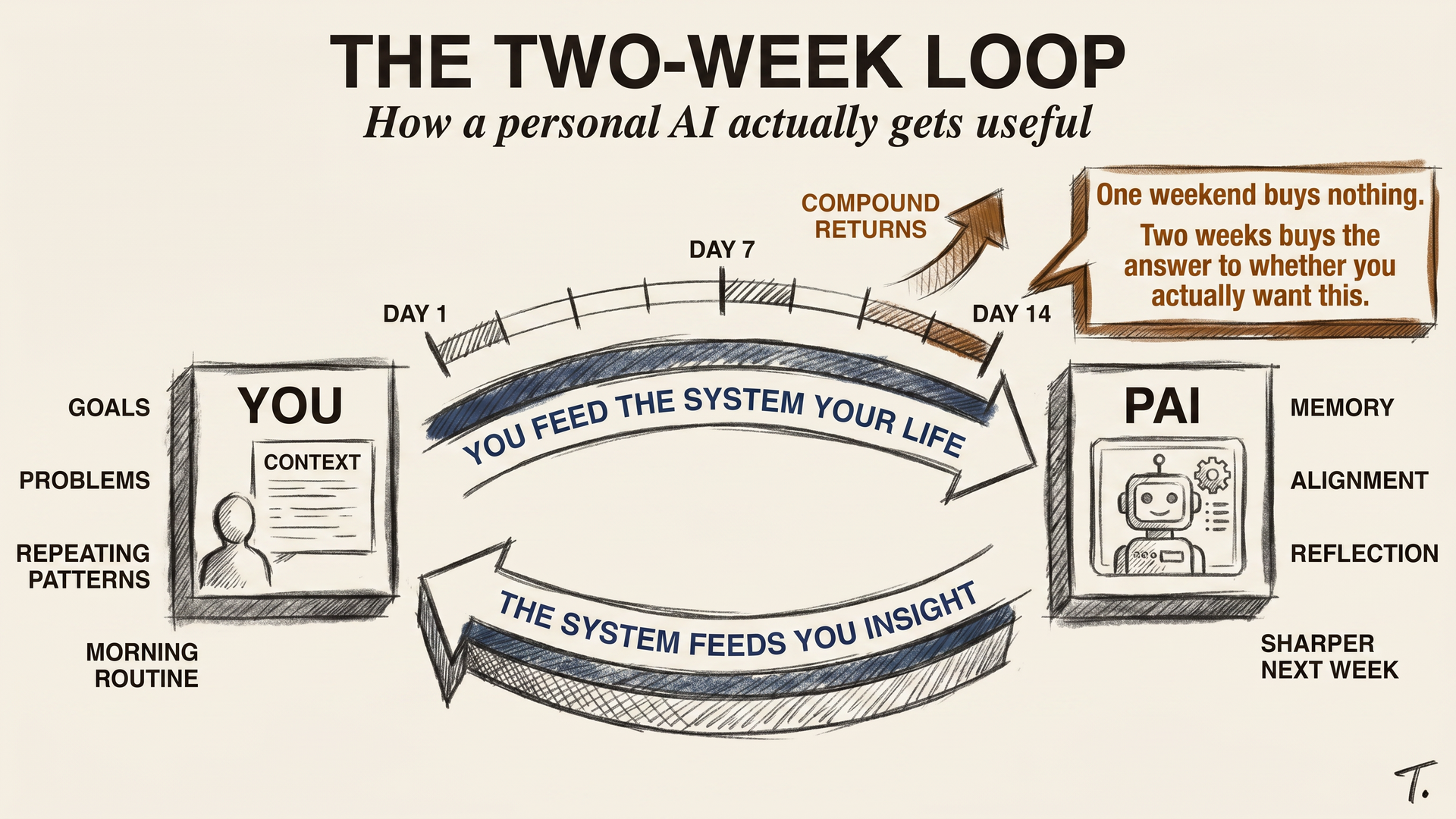
The thing nobody can do for you is the first two weeks. You do not get the benefit from one weekend of tinkering. The compound returns of an assistant come from feeding it your real context, your goals, your problems, your repeating patterns. Like a sourdough starter, it gets useful only after you have fed it for a while.
Do that for two weeks with any of these, and you will know whether the assistant tier is a thing you actually want. You will also know which of the three matches your temperament. That is more useful than any comparison post, including this one.
After about six months running PAI as my daily, the best thing surprised me. It is not the tasks the system finishes for me. It is the way it makes my goals legible to me.
The articulation of what I am trying to do becomes a thing the system reads, edits, and pushes back on. Over time I get sharper about it too. That alone justifies the install.
That closes the series. Twenty-two articles ago we started with tokens, and now we end with assistants you can actually own.
The honest answer is what every honest answer about software ends up being. Pick one. Use it for real. Pay attention.
T.
References
- Personal_AI_Infrastructure (Daniel Miessler, GitHub) - The open-source PAI framework that the author runs as a daily, with documentation for the Algorithm, skill, hook, and memory subsystems.
- Personal AI Infrastructure thesis (Daniel Miessler) - The original essay that frames PAI as a category and explains why the assistant tier is different from a chatbot.
- Personal AI Maturity Model - The maturity model used in the previous article in this series, useful for placing any of these three platforms on a comparable scale.
- Clawbot - The integrations-first PAI option, with Docker-based local-first hosting and a long list of messaging and productivity integrations.
- Hermes Agent (Nous Research) - The research-grade self-improving agent with three-layer memory and a meta-loop that edits the agent’s own prompts based on outcomes.
- nousresearch/hermes-agent (GitHub) - The Hermes Agent source repository, currently over 180K stars, with the reference implementation of the memory and meta-loop systems.