The previous article ended with a 70B model running under my desk on a mini-PC the size of a paperback. It works. The harder question is what you do with it.
A model is not an assistant. A chat window is not an assistant either. Most of what people call AI assistants in 2026 are something simpler, sitting at the bottom of a ladder most people do not know exists.
THE THREE TIERS
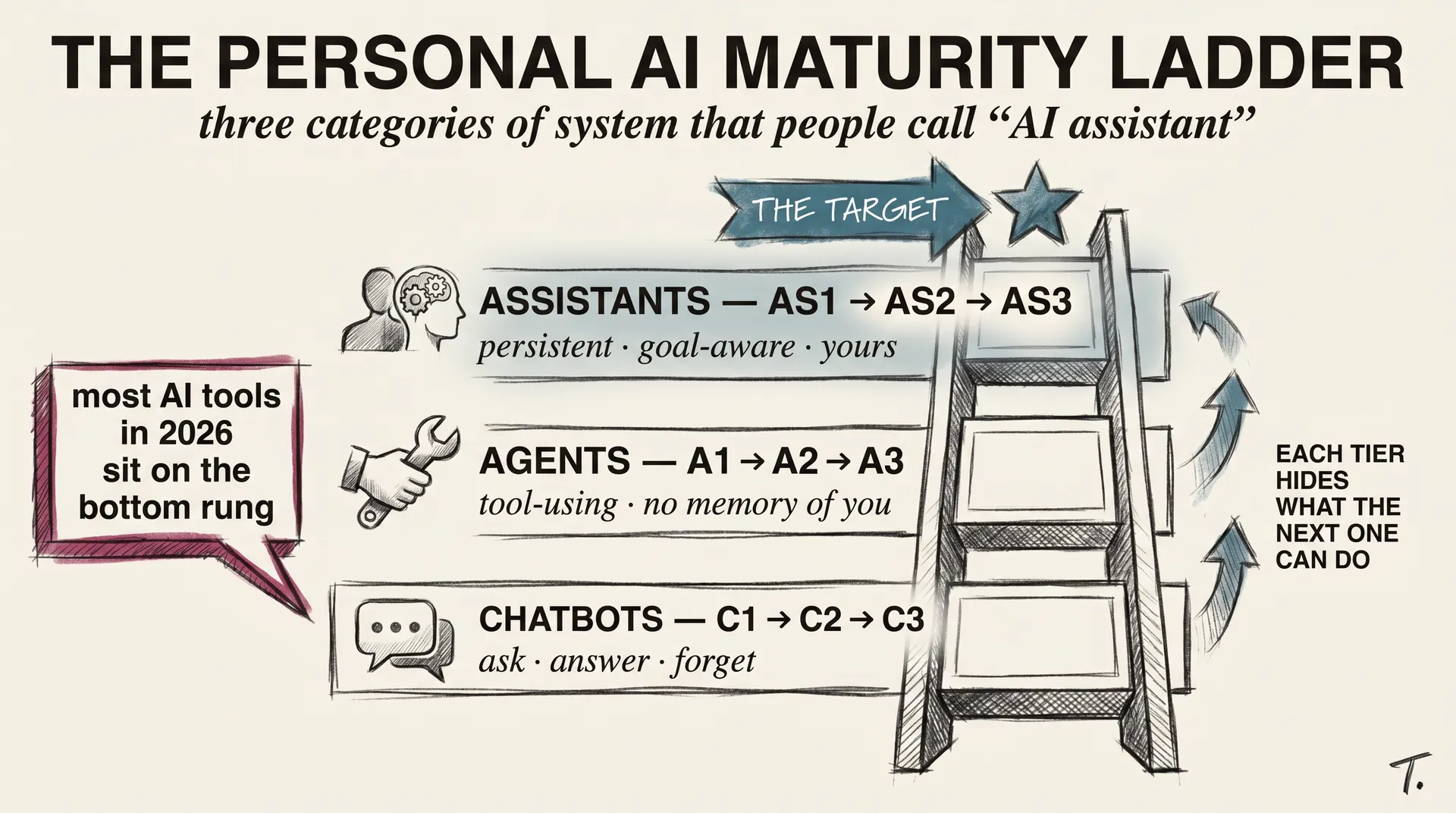
The words AI assistant cover three completely different things. People use them as if they were one. A chatbot you ask a question to, an agent you give a task to, and an assistant that knows you and works on your goals over time. These are not different sizes of the same thing.
They are different categories of system, just as a calculator, a personal accountant, and a financial planner are different categories. Each one swallows the last.
The cleanest map of this terrain is the Personal AI Maturity Model, three tiers with three levels each. Chatbots go C1 to C3. Agents go A1 to A3. Assistants go AS1 to AS3.
Each tier hides what the next one can do. Until you have used a system with persistent memory, you cannot really imagine missing it.
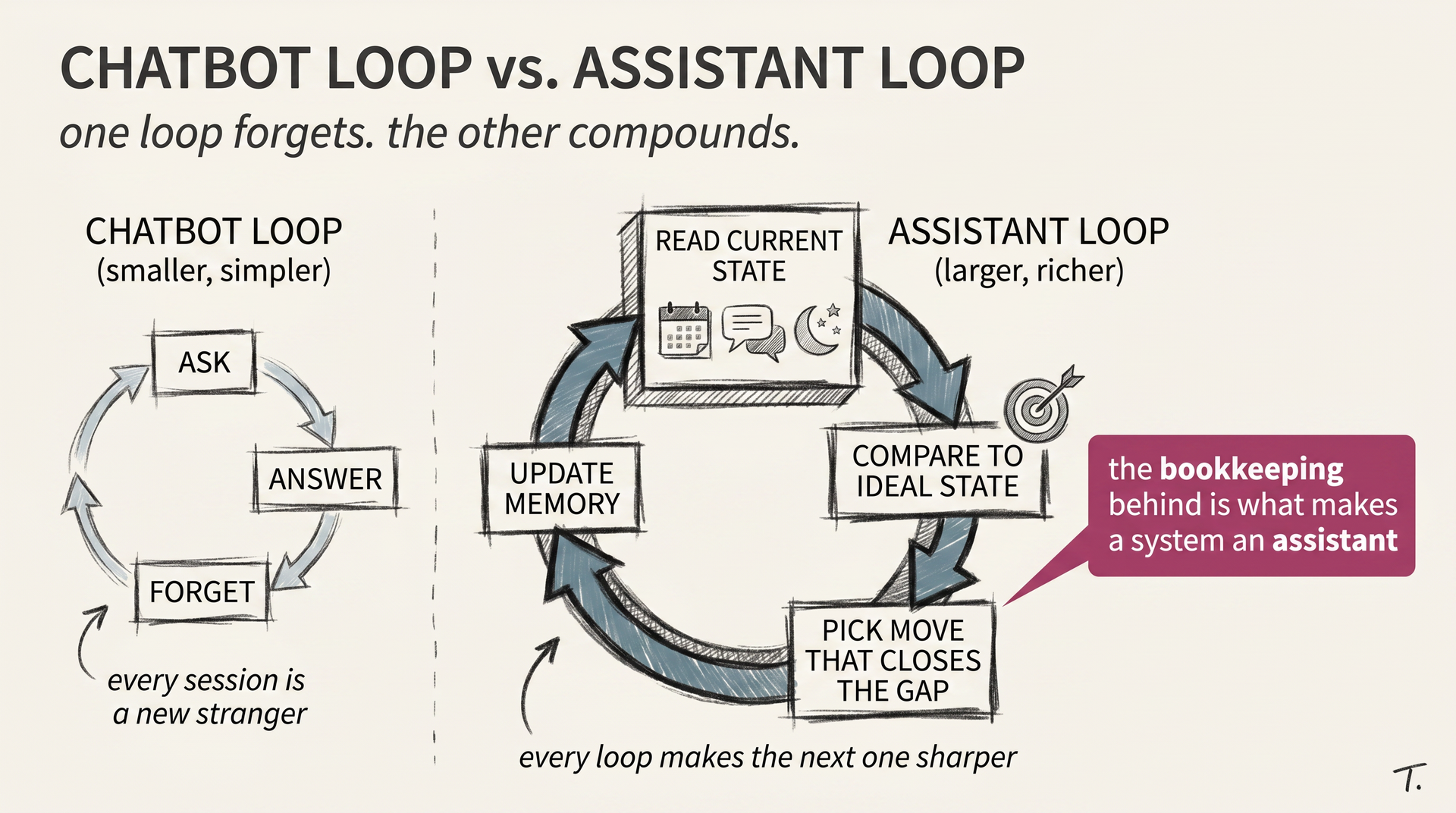
Chatbots are stateless. You ask, you get an answer, the system forgets when you close the window. ChatGPT in late 2022 was C2. Most AI features shipped between 2023 and 2024 were C2 or C3 under a new logo.
Agents are tool-using. They call your calendar, run a search, hit an API, write a file, ship a commit. The A-tier is where the system stops being a text generator and starts being a worker.
But the agent still has no memory of you. It acts like a temp worker who does the job and goes home without remembering your name.
Assistants are persistent. They remember your name, your work, your people, your goals, your last six months. They take action on your behalf because they know what you would want them to do.
AS3, the top of the ladder, is when the system becomes the primary interface you reach for, the same way most people now reach for a phone.
WHERE YOU PROBABLY ARE
Honestly, if you are using ChatGPT or Claude or Gemini today, you are at AS1. Maybe AS1.5 on a good day.
The chat window remembers what you said three messages ago. The system knows a few facts about you if you have stored them. That is it.
A few toolchains push higher. Claude Code with a custom memory and skills stack pushes AS2. Several open-source projects, including the one I build for myself, aim at AS3 explicitly.
None of these tools ship finished. None install easily. But the gap between interesting demo and thing you actually live inside keeps closing fast.
The reason most people stop at AS1 is not that they chose to. It is that no commercial product gives them anywhere else to stand. The chatbot is the product.
Persistence and goal awareness are not features the vendor wants to build, because they make the user harder to switch off.
WHAT CHANGED IN 2026
Four things had to flip for the AS tier to be buildable at home, not just in research labs. All four happened in the last eighteen months.
Open weights got good. Llama 3.3, Qwen 3, DeepSeek R1, several others. The capability gap between what you can download and what the labs serve over an API is now measured in months, not years.
For most personal tasks, the gap is invisible.
Local hardware fits. A 70B model at 4-bit runs on a box that costs less than a flagship phone and draws sixty watts. The hardware constraint that blocked PAI for a decade is gone, as the previous article in this series covered in detail.
MCP, the Model Context Protocol, standardized how models talk to tools. Before MCP, every assistant integration was custom. Imagine a house where every appliance ships with its own wall socket, and you wire each one yourself, and that was the agent integration world before 2024.
After MCP, the agent layer became plumbing instead of a research project. This is the unglamorous unlock, and it might matter more than the other three.
Agents work end to end. Tool use plus memory plus planning, composed into systems that act and recover from errors. A1 was a 2023 demo. A3 in 2026 is a daily driver for software work.
Without working agents, the assistant tier has nothing to stand on.
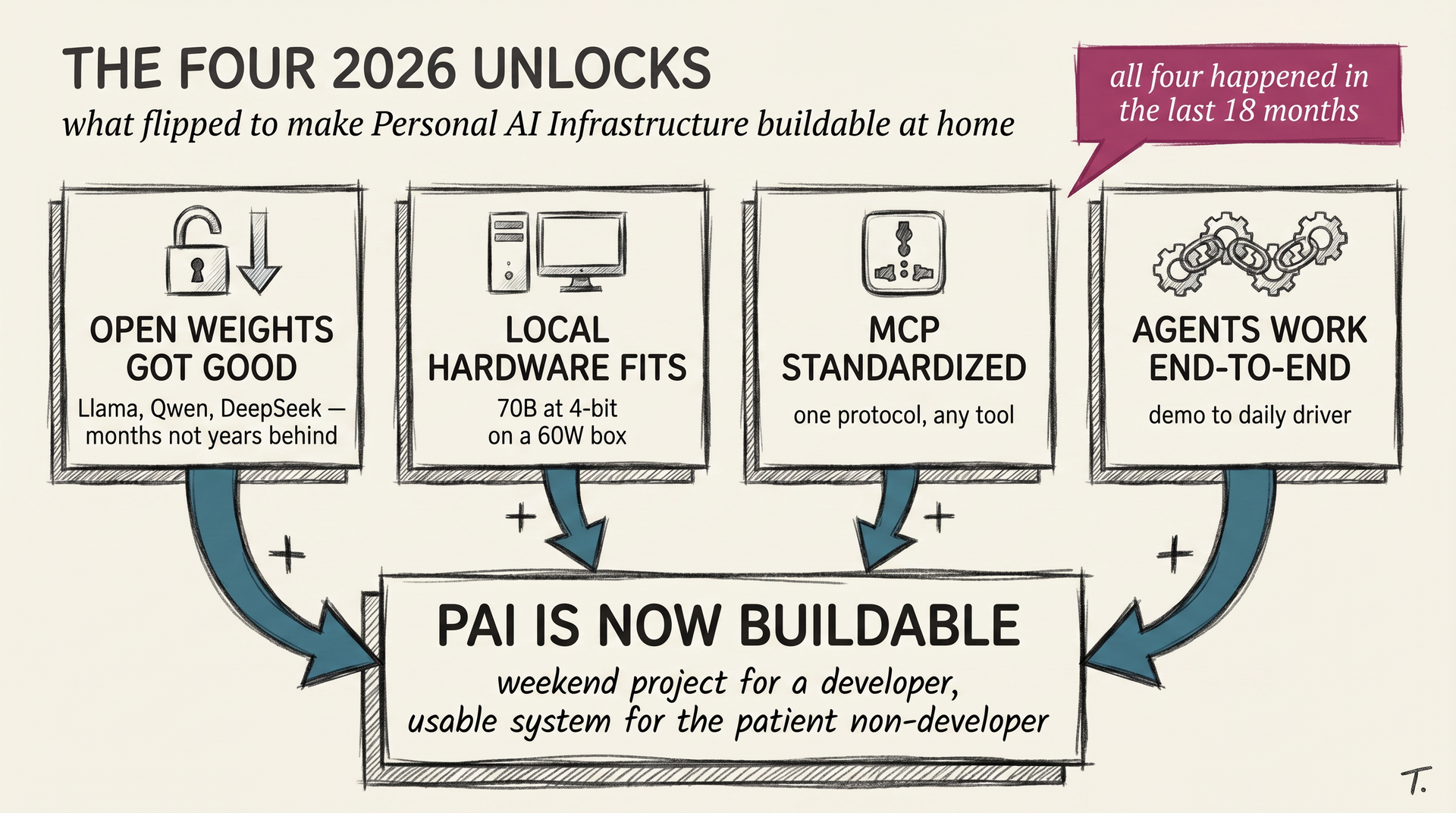
Without any single one of these, PAI is too hard. With all four, it is a weekend project for a curious developer, and a usable system for a patient non-developer.
THE LOOP THAT MATTERS
What makes a system an assistant, and not a fancier chatbot, is one loop. The assistant knows your current state. It knows your ideal state. Every interaction picks a move that closes the gap.
Current state is the boring part. Your calendar, your work in progress, your sleep last night, your last message to your sister, the project you have been avoiding for two weeks.
Ideal state is the hard part. Your goals, your mission, the version of your life you are climbing toward. Most assistants today have neither half, so the loop never starts.
The fancy word for this is hill-climbing. It works like a navigation app that reroutes you around traffic, except the destination is not a place, it is the life you said you wanted.
The plain version is, every time you talk to the system, it picks a move that gets you closer to where you said you wanted to be. The assistant is not the chatbot in front. It is the bookkeeping behind, the thing that lets the chatbot know which move actually matters this morning.
WHY ANYONE WOULD RUN THEIR OWN
The privacy answer is the famous one. It is also the weakest. Three reasons matter more.
Alignment to you, not to the median user. A hosted chatbot speaks to a P50 audience. Your assistant should speak to you, with your vocabulary, your taste, your context.
You cannot get that from a system aligned to the average of a hundred million strangers. Think of the difference between a magazine and a letter written to you by name.
Memory that compounds. A hosted product loses your context every release. Your own system keeps it, and gets sharper about you over time.
The longer you use your own assistant, the less work it takes to use. It is the inverse of a chatbot, which gets you the same blank slate every Monday.
Identity and agency. Your AI is yours, not rented, not deprecated when the vendor pivots, not subject to a TOS change next quarter.
If the assistant becomes the primary way you interact with information, the question of who owns it stops being a small detail.
I am not religious about this. Hosted chatbots are convenient, often excellent, and the right answer for many people for many tasks. But the assistant tier, the AS layer, is not something a hosted product can sell you.
WHERE THIS GOES NEXT
The thinking is not new. Daniel Miessler wrote the Personal AI Infrastructure thesis years before the hardware caught up.
I described the same shape in a 2016 post called The Real Internet of Things, where the AI is the interface to everything and the rest of the world’s services expose APIs to it. Neither of us were predicting. We were looking at what would obviously happen once the hardware was ready.
The hardware is ready. The models are ready. The agent layer works. The standard for tool use exists.
What is missing is the part that turns a working agent into an actual assistant. Persistent identity, memory of you, alignment with your goals.
That layer is what Personal AI Infrastructure is for. The next article looks at what it takes to actually build one, and at the shape of the thing once you do.
T.
References
- Personal AI Infrastructure (Daniel Miessler) - The original thesis that named the category, written years before the hardware made it practical.
- The Real Internet of Things (2016) - My earlier post describing the future where personal AI is the interface and services expose APIs to it.
- Personal AI Maturity Model - The three-tier ladder used as the spine of this article, with the AS3 target spelled out in detail.
- Model Context Protocol - The 2024 standard for how any model talks to any tool, the unglamorous unlock that made the agent layer plumbing instead of research.
- Running Local Models - The previous article in this series, which covered the hardware and software stack that put a 70B model under your desk.